







Question: The three systems being considered are shown below, where the arrow denotes flow with arrival rate R ak , for stream k = 1, 2,
The three systems being considered are shown below, where the arrow denotes flow with arrival rate Rak, for stream k = 1, 2, the triangle represents the waiting line or queue and the rectangles represent processing by a server with specified average unit processing time the two rectangles inside a larger rectangle in System B corresponds to a two-server station; System C is a single-server station with average unit process time cut by 50%. Assume values for Rak and p, for instance, take Ra1 = Ra2 = 0.95 customers per hour, p = 1 hour. Unless otherwise stated, assume all coefficients of variation are 1.0. In the class on waiting lines, we have seen that the independent system A has higher time in queue than the pooled system B. In II.1 & 2 below, we compare systems B and C. 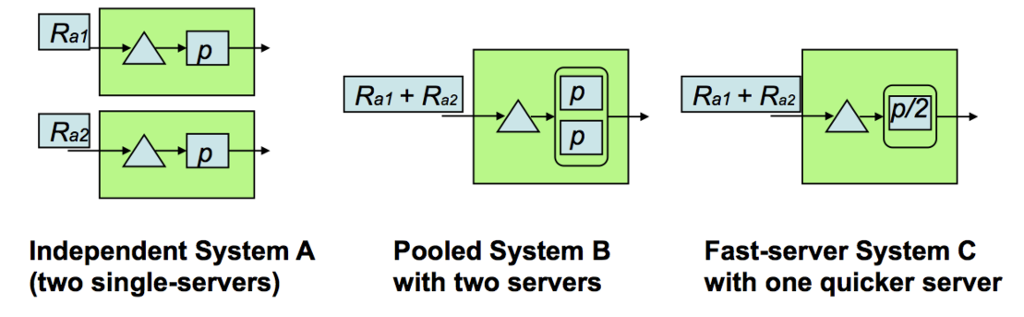 Suppose that the fast server in System C is unavailable. Instead, the process design team is considering System D depicted below which splits the single step in System B into two sequential steps of equal process time, with no inventory allowed between the two steps. Is System D is an improvement over System B or not. [Note: No formulas are needed to answer this question, just try to use a qualitative argument.]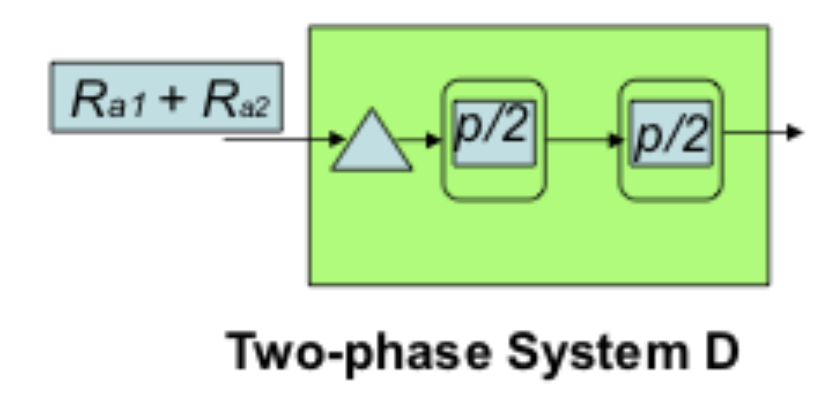
Ra Ra1 Ra2 Independent System A (two single-servers) Pooled System B with two servers Fast-server System C with one quicker server
Step by Step Solution
There are 3 Steps involved in it

Get step-by-step solutions from verified subject matter experts
 Study Help