



Question: THE TIMES 1 0 0 BUSINESS CASE STUDIESTraining and development - ASDAASDA's mission is ' to be Britain's best valueretailer exceeding customer needs, everyday'.ASDA recognises
THE TIMES BUSINESS CASE STUDIESTraining and development ASDAASDA's mission is to be Britain's best valueretailer exceeding customer needs, everyday'.ASDA recognises that this depends on acommitment always to put customers first ineverything ASDA does, which is achieved throughdedicated teams of ASDA colleagues. ASDAemploys over colleagues and rewardslong service. It focuses on developing anaccessible 'family' atmosphere in the stores. Thisprovides a platform for longterm careers as colleagues develop within the business.Around of ASDA managers began their careers in its stores.Training involves acquiring new skills and knowledge in relation to a current role.Development relates to a person's potential to acquire wider capabilities. ASDA uses both to support its mission and to benefit the business and colleagues. The retail sector offers a longterm career path. By developing colleagues with the potential to be General Store Managers GSMs ASDA has put in place a robust longterm succession plan to develop the Regional Operating Managers ROMs of the future. GSMs are like managing directors many have responsibility for colleagues and sales turnover of over million a week. They need to be able to demonstrate a wide range of behaviours and technical skills. They are responsible for:leadership leading their store teamscelebrating achievement and managing underperformancecoaching and developing colleagues and managerssetting goals and agreeing priorities by responding to change and spotting opportunitiesASDA uses both onthejob and offthejob training to develop colleagues at all levels. As a GSM begins their transition to a ROM role, they need to complete several different types of activities. Onthejob, GSMs begin to experience the ROM role in order to put their skills into practice. Onthejob activities account for of their development and it is up to the individual to drive their own development opportunities. Examples include:covering their ROM's duties when they are on holidayreceiving guidance from a mentor on the Retail Board a senior managerattending meetings on behalf of the ROMOffthejob, GSMs develop the skills needed to be a ROM through modules and a series of external coaching. These account for around of the overall development and include: 'Being at my Best' this programme focuses on emotional intelligence and supports GSMs to understand their strengths and areas for development.'Influencing across the business' provides an opportunity to learn how to communicate in a compelling way.'Thought Leadership' develops the capability to lead a team through innovation, creative thinking and leading with courage.Identifying skills and development opportunities for senior roles is essential to maintain leadership succession. Once training needs are identified these are managed through various programmes, such as store visits, Line Manager coaching, offthejob modules, coaching calls and mentoring.THE TIMES BUSINESS CASE STUDIESQuestionsWhat is the difference between training and development?Describe the two types of training used by ASDAExplain how training and development helps ASDA to achieve its missionAnalyse why 'development' of colleagues is so important for organisations like ASDATaskScenario You have decided to open a sandwich shop in your local town. You have carried out some research and think you need to hire two full time and one part time member of staff to work in the shop making sandwiches and serving customers. Devise and training programme for these new staff assuming they have had no previous experience You will need to identify the knowledge, skills and qualifications required, then determine what on and offthejob methods can be used to ensure the workers gain these.What have you learned? second challenge. Work with a partner and decide who is going to go first. This person then has to speak for seconds, without pausing, about what they have learned about training and development. Then, the second person has to talk for seconds about what they have learned, without repeating anything the first person has said.THE TIMES BUSINESS CASE STUDIESTraining and development ASDAASDA's mission is to be Britain's best valueretailer exceeding customer needs, everyday'.ASDA recognises that this depends on acommitment always to put customers first ineverything ASDA does, which is achieved throughdedicated teams of ASDA colleagues. ASDAemploys over colleagues and rewardslong service. It focuses on developing anaccessible 'family' atmosphere in the stores. Thisprovides a platform for longterm careers as colleagues develop within the business.Around of ASDA managers b
THE TIMES
BUSINESS CASE STUDIES
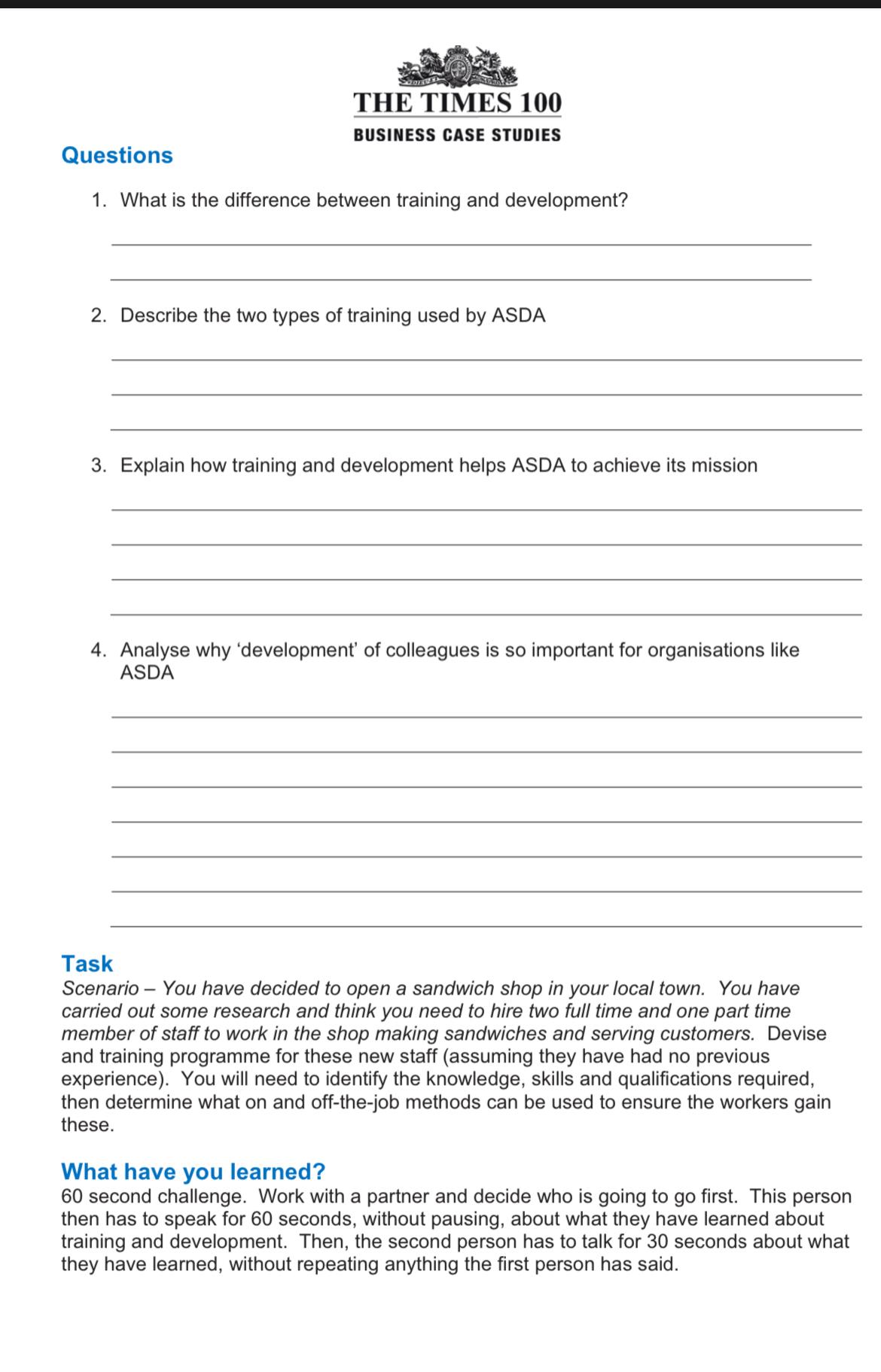
Questions
What is the difference between training and development?
Describe the two types of training used by ASDA
Explain how training and development helps ASDA to achieve its mission
Analyse why 'develop
Step by Step Solution
There are 3 Steps involved in it
1 Expert Approved Answer
Step: 1 Unlock

Question Has Been Solved by an Expert!
Get step-by-step solutions from verified subject matter experts
Step: 2 Unlock
Step: 3 Unlock