







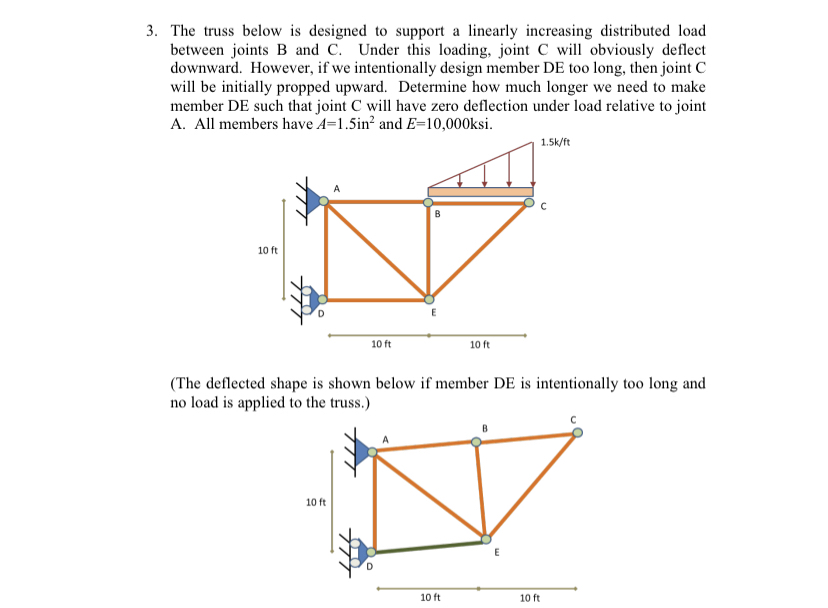
Question: The truss below is designed to support a linearly increasing distributed load between joints B and C . Under this loading, joint C will obviously
The truss below is designed to support a linearly increasing distributed load between joints B and C Under this loading, joint C will obviously deflect downward. However, if we intentionally design member DE too long, then joint C will be initially propped upward. Determine how much longer we need to make member DE such that joint C will have zero deflection under load relative to joint A All members have and ksi.
The deflected shape is shown below if member DE is intentionally too long and no load is applied to the truss.
Step by Step Solution
There are 3 Steps involved in it
1 Expert Approved Answer
Step: 1 Unlock

Question Has Been Solved by an Expert!
Get step-by-step solutions from verified subject matter experts
Step: 2 Unlock
Step: 3 Unlock
 Study Help