







Question: The van der Pol's equation is a second-order nonlinear differential equation which has been used to describe (among other systems) action potentials in neurons, beating
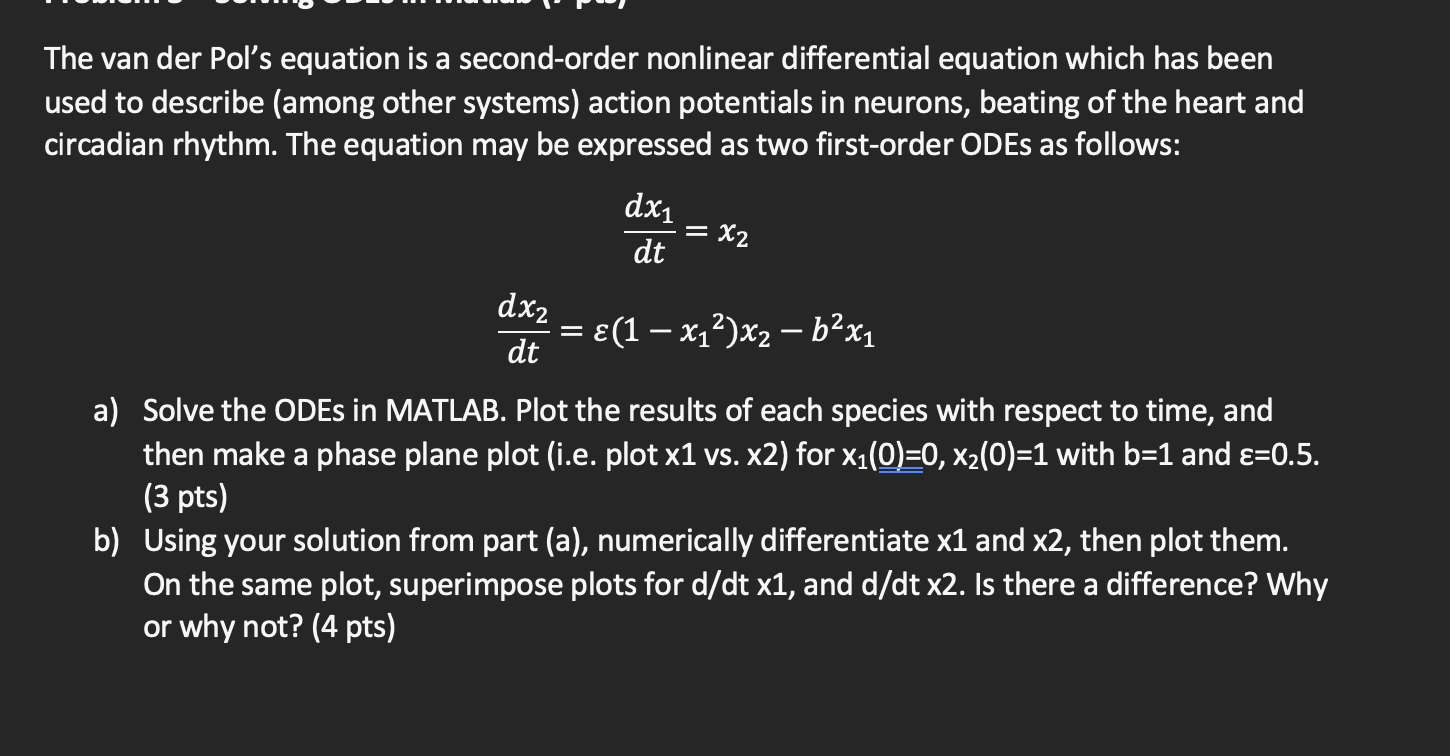
The van der Pol's equation is a second-order nonlinear differential equation which has been used to describe (among other systems) action potentials in neurons, beating of the heart and circadian rhythm. The equation may be expressed as two first-order ODEs as follows: dtdx1=x2dtdx2=(1x12)x2b2x1 a) Solve the ODEs in MATLAB. Plot the results of each species with respect to time, and then make a phase plane plot (i.e. plot x1 vs. x2 ) for x1(0)=0,x2(0)=1 with b=1 and =0.5. (3 pts) b) Using your solution from part (a), numerically differentiate x1 and x2, then plot them. On the same plot, superimpose plots for d/dt1, and d/dt2. Is there a difference? Why or why not? (4 pts)
Step by Step Solution
There are 3 Steps involved in it

Get step-by-step solutions from verified subject matter experts
 Study Help