







Question: The very simple file system (VSFS) uses basic data structures such as a super block, bitmaps, inodes, and data blocks to store all relevant
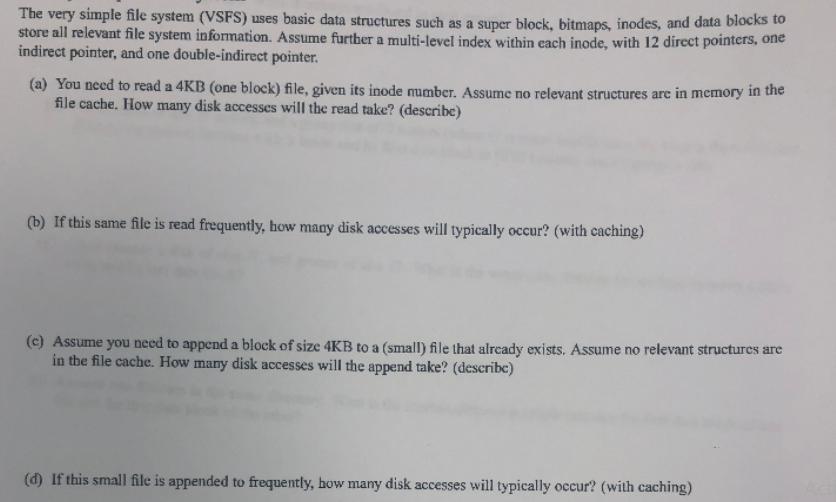
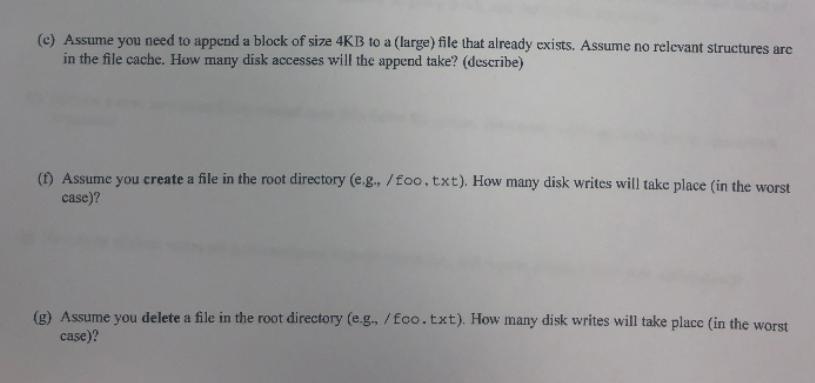
The very simple file system (VSFS) uses basic data structures such as a super block, bitmaps, inodes, and data blocks to store all relevant file system information. Assume further a multi-level index within each inode, with 12 direct pointers, one indirect pointer, and one double-indirect pointer. (a) You need to read a 4KB (one block) file, given its inode number. Assume no relevant structures are in memory in the file cache. How many disk accesses will the read take? (describe) (b) If this same file is read frequently, how many disk accesses will typically occur? (with caching) (c) Assume you need to append a block of size 4KB to a (small) file that already exists. Assume no relevant structures are in the file cache. How many disk accesses will the append take? (describe) (d) If this small file is appended to frequently, how many disk accesses will typically occur? (with caching) (c) Assume you need to append a block of size 4KB to a (large) file that already exists. Assume no relevant structures are in the file cache. How many disk accesses will the append take? (describe) (t) Assume you create a file in the root directory (e.g., /foo.txt). How many disk writes will take place (in the worst case)? (g) Assume you delete a file in the root directory (e.g., /fco.txt). How many disk writes will take place (in the worst case)?
Step by Step Solution
There are 3 Steps involved in it
a To read a 4KB one block file given its inode number in the Very Simple File System VSFS you would typically need the following disk accesses 1 Access the disk to read the inode corresponding to the ... View full answer

Get step-by-step solutions from verified subject matter experts
 Study Help