







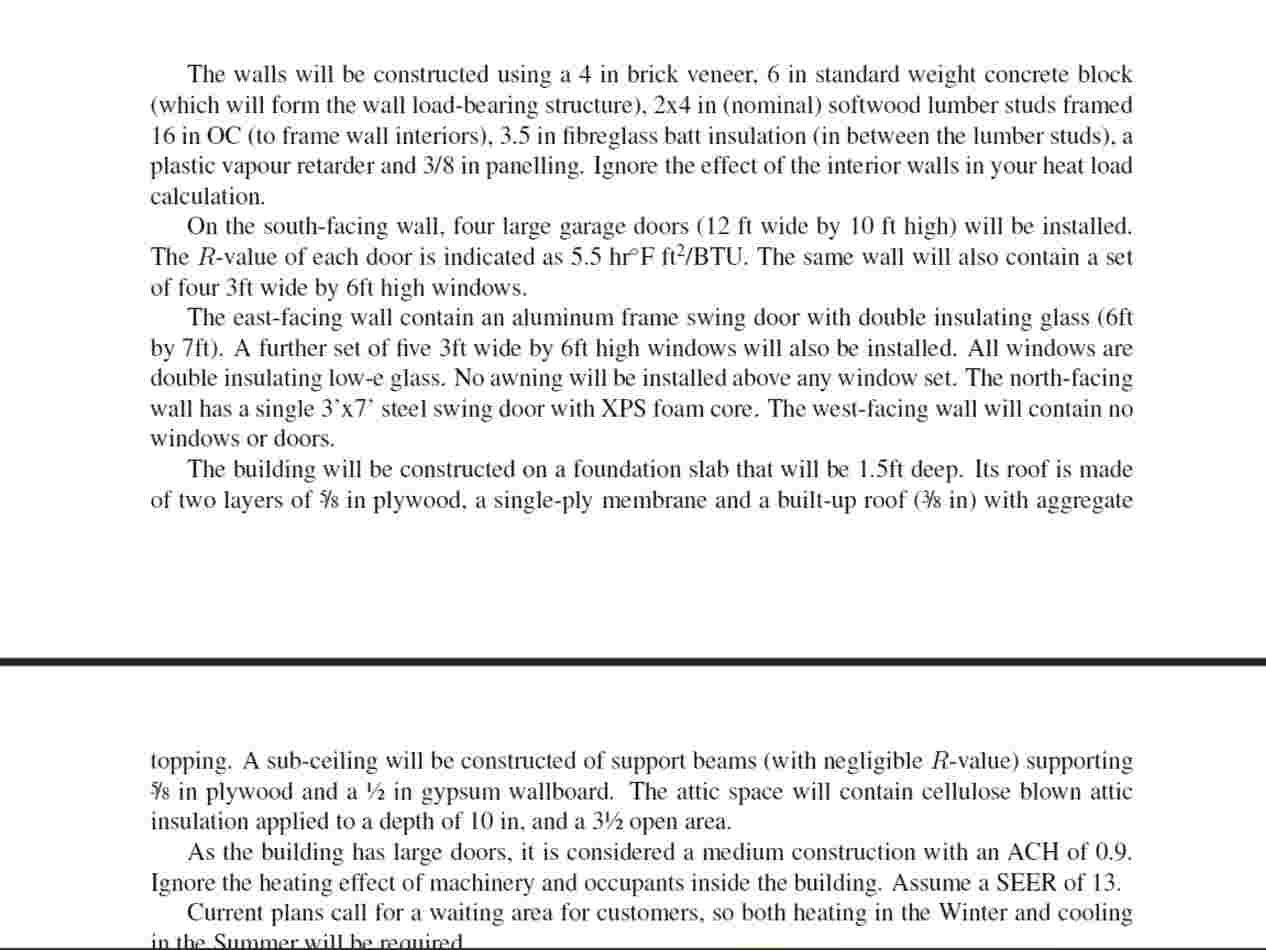
Question: The walls will be constructed using a 4 in brick veneer, 6 in standard weight concrete block ( which will form the wall load -
The walls will be constructed using a in brick veneer, in standard weight concrete block
which will form the wall loadbearing structurexx in nominal softwood lumber studs framed
in OC to frame wall interiors in fibreglass batt insulation in between the lumber studs a
plastic vapour retarder and in panelling. Ignore the effect of the interior walls in your heat load
calculation.
On the southfacing wall, four large garage doors ft wide by ft high will be installed.
The Rvalue of each door is indicated as hr@FftBTU The same wall will also contain a set
of four ft wide by ft high windows.
The eastfacing wall contain an aluminum frame swing door with double insulating glass ft
by ft A further set of five ft wide by ft high windows will also be installed. All windows are
double insulating lowe glass. No awning will be installed above any window set. The northfacing
wall has a single xx steel swing door with XPS foam core. The westfacing wall will contain no
windows or doors.
The building will be constructed on a foundation slab that will be ft deep. Its roof is made
of two layers of $ in plywood, a singleply membrane and a builtup roof in with aggregate
topping. A subceiling will be constructed of support beams with negligible Rvalue supporting
in plywood and a in gypsum wallboard. The attic space will contain cellulose blown attic
insulation applied to a depth of in and a open area.
As the building has large doors, it is considered a medium construction with an ACH of
Ignore the heating effect of machinery and occupants inside the building. Assume a SEER of
Current plans call for a waiting area for customers, so both heating in the Winter and cooling in the Summer will be required. a For winter conditions, calculate
i Calculate the R value of the northfacing wall.
ii Calculate the R value of the eastfacing wall.
iii. Calculate the R value of the southfacing wall.
iv Calculate the R value of the westfacing wall.
v Calculate the R value of the floor.
vi Calculate the R value of the roof.
b For summer conditions, calculate if different from Winter conditions
i Calculate the R value of the northfacing wall.
ii Calculate the R value of the eastfacing wall.
iii. Calculate the R value of the southfacing wall.
iv Calculate the R value of the westfacing wall.
v Calculate the R value of the floor:
vi Calculate the R value of the roof.
c Calculate the heating load for the building in the city of Saint John.
d Estimate the cost of heating using a $ mathrmkWh
e Calculate the cooling load for the building in the city of Saint John.
f Estimate the cost of cooling using a $ mathrmkWh Assume cooling load hours.
Step by Step Solution
There are 3 Steps involved in it
1 Expert Approved Answer
Step: 1 Unlock

Question Has Been Solved by an Expert!
Get step-by-step solutions from verified subject matter experts
Step: 2 Unlock
Step: 3 Unlock
 Study Help