- The x-axis numbers: 0, 10, 20, 30, 40, 50, 60, 70, 80, 90.
- The y-axis numbers: 0, 20, 40, 60, 80, 100, 120.
(In case the numbers are not clear in the chart.)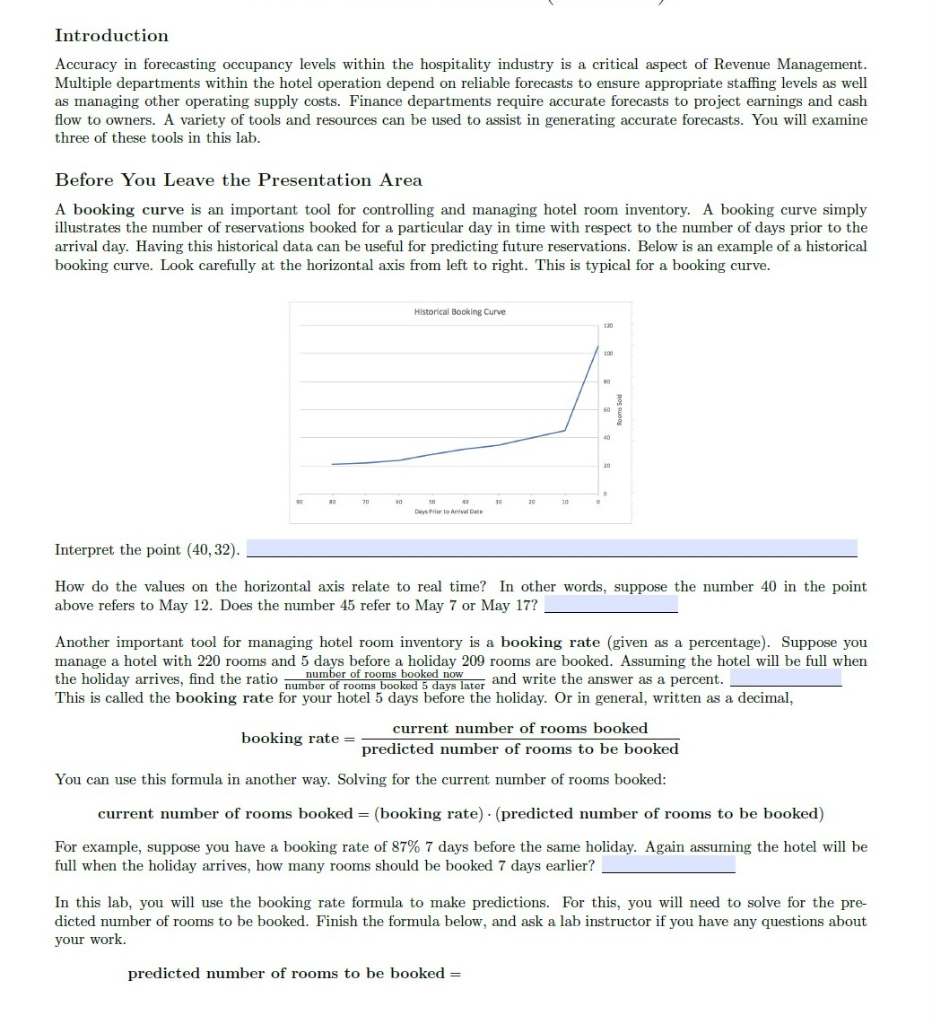
Introduction Accuracy in forecasting occupancy levels within the hospitality industry is a critical aspect of Revenue Management. Multiple departments within the hotel operation depend on reliable forecasts to ensure appropriate staffing levels as well as managing other operating supply costs. Finance departments require accurate forecasts to project earnings and cash flow to owners. A variety of tools and resources can be used to assist in generating accurate forecasts. You will examine three of these tools in this lab. Before You Leave the Presentation Area A booking curve is an important tool for controlling and managing hotel room inventory. A booking curve simply illustrates the number of reservations booked for a particular day in time with respect to the number of days prior to the arrival day. Having this historical data can be useful for predicting future reservations. Below is an example of a historical booking curve. Look carefully at the horizontal axis from left to right. This is typical for a booking curve. Historical Booking Curve Days to Avala Interpret the point (40,32). How do the values on the horizontal axis relate to real time? In other words, suppose the number 40 in the point above refers to May 12. Does the number 45 refer to May 7 or May 17? Another important tool for managing hotel room inventory is a booking rate (given as a percentage). Suppose you manage a hotel with 220 rooms and 5 days before a holiday 209 rooms are booked. Assuming the hotel will be full when the holiday arrives, find the ratio num tie number of rooms booked now number of rooms booked 5 days later and write the answer as a percent. This is called the booking rate for your hotel 5 days before the holiday. Or in general, written as a decimal, current number of rooms booked booking rate =- predicted number of rooms to be booked You can use this formula in another way. Solving for the current number of rooms booked: current number of rooms booked = (booking rate) - (predicted number of rooms to be booked) For example, suppose you have a booking rate of 87% 7 days before the same holiday. Again assuming the hotel will be full when the holiday arrives, how many rooms should be booked 7 days earlier? In this lab, you will use the booking rate formula to make predictions. For this, you will need to solve for the pre- dicted number of rooms to be booked. Finish the formula below, and ask a lab instructor if you have any questions about your work. predicted number of rooms to be booked =




