







Question: The Young's modulus is measured for a polyisobutylene (PIB) sample and time-temperature superposition is used to produce a master curve, as shown in the figure
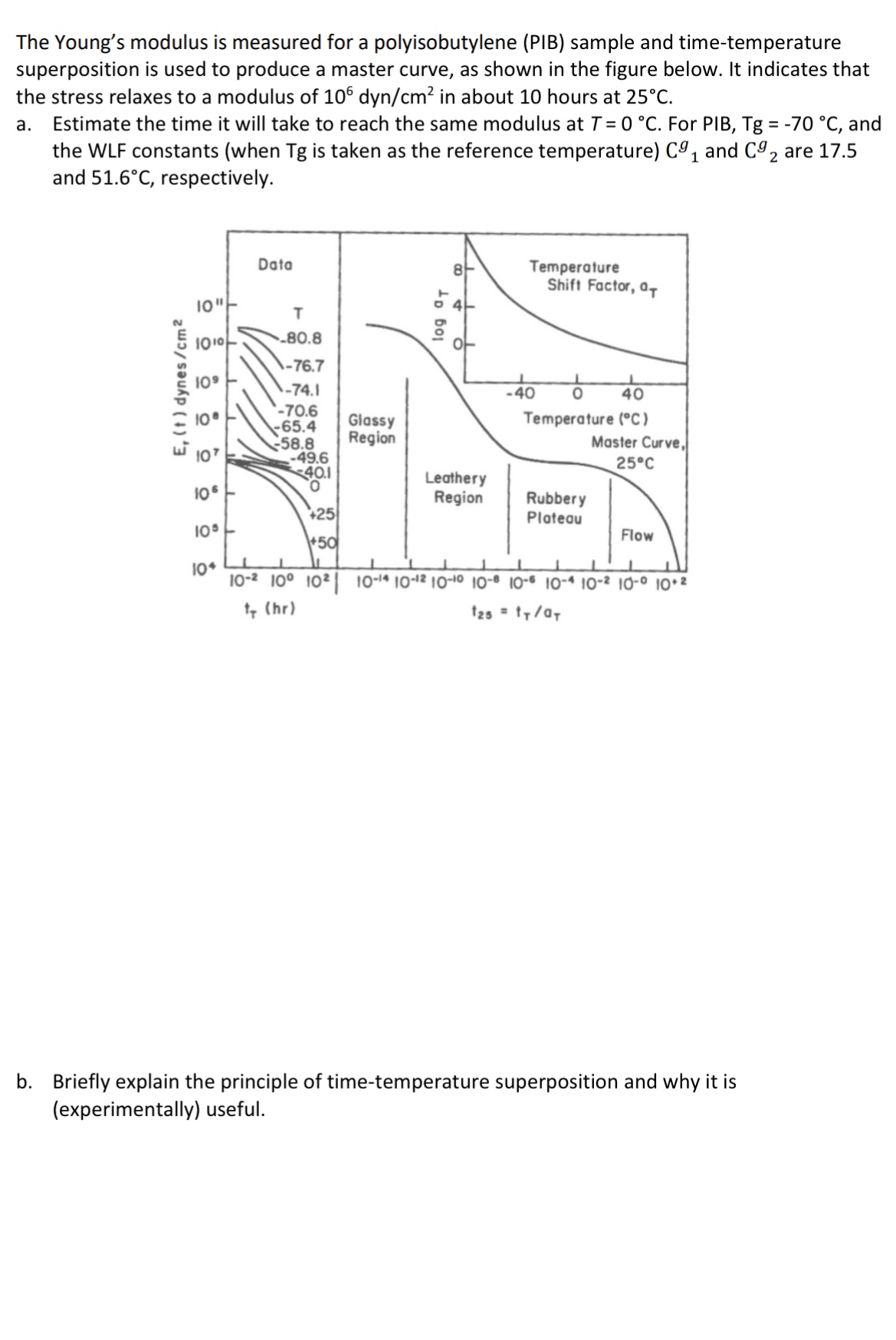
The Young's modulus is measured for a polyisobutylene (PIB) sample and time-temperature superposition is used to produce a master curve, as shown in the figure below. It indicates that the stress relaxes to a modulus of 106dyn/cm2 in about 10 hours at 25C. a. Estimate the time it will take to reach the same modulus at T=0C. For PIB, Tg=70C, and the WLF constants (when Tg is taken as the reference temperature) Cg1 and Cg2 are 17.5 and 51.6C, respectively. b. Briefly explain the principle of time-temperature superposition and why it is (experimentally) useful
Step by Step Solution
There are 3 Steps involved in it
1 Expert Approved Answer
Step: 1 Unlock

Question Has Been Solved by an Expert!
Get step-by-step solutions from verified subject matter experts
Step: 2 Unlock
Step: 3 Unlock
 Study Help