







Question: THEME : CUSTOMER FOCUS CASE STUDY : SERVICE QUALITY, CUSTOMER SATISFACTION AND BEHAVIOUR INTENTIONS. EVIDENCE FROM THE CHINA'S TELECOMMUNICATION INDUSTRY BY YONGGUI WANG AND HING
THEME : CUSTOMER FOCUS
CASE STUDY : SERVICE QUALITY, CUSTOMER SATISFACTION AND BEHAVIOUR INTENTIONS. EVIDENCE FROM THE CHINA'S TELECOMMUNICATION INDUSTRY BY YONGGUI WANG AND HING PO-LO
QUESTION : Excellent Conclusion to reflect on the importance of the customer focus in relation to the quality management principles in industry for successful of business.
kindly help me with this. thank you.
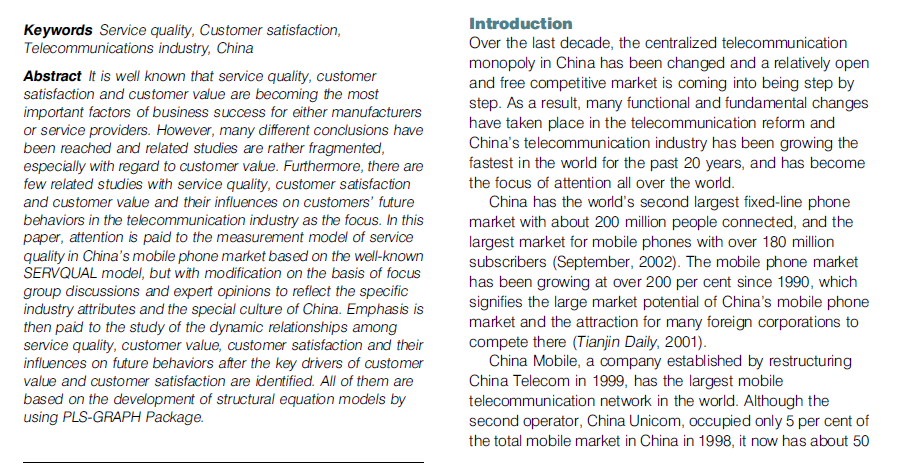
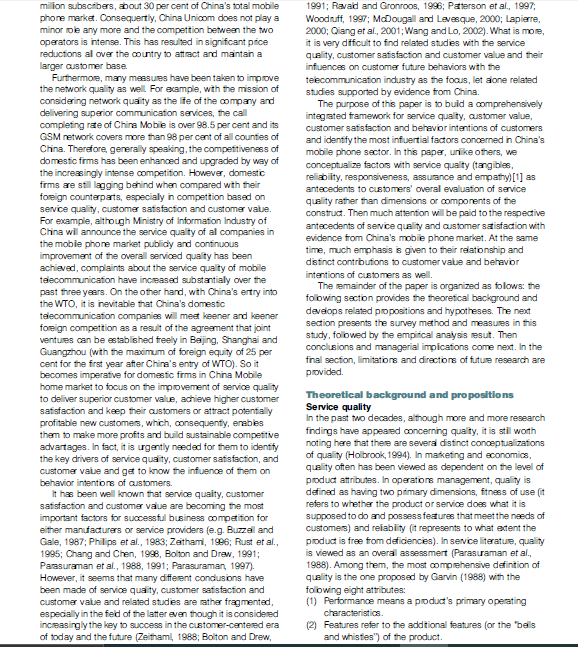
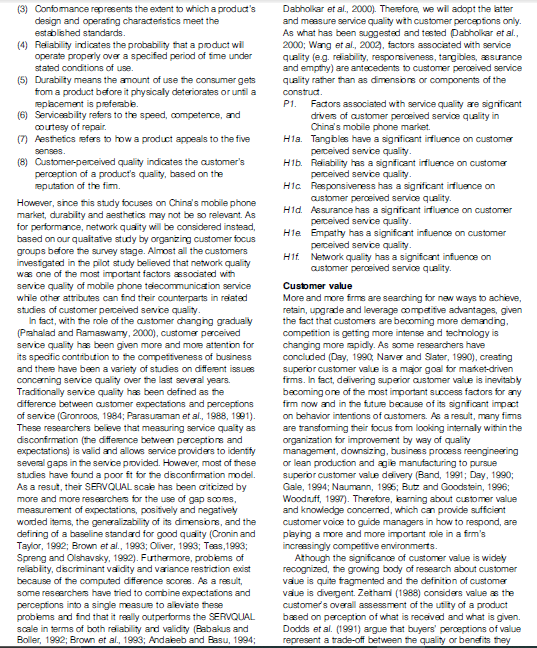
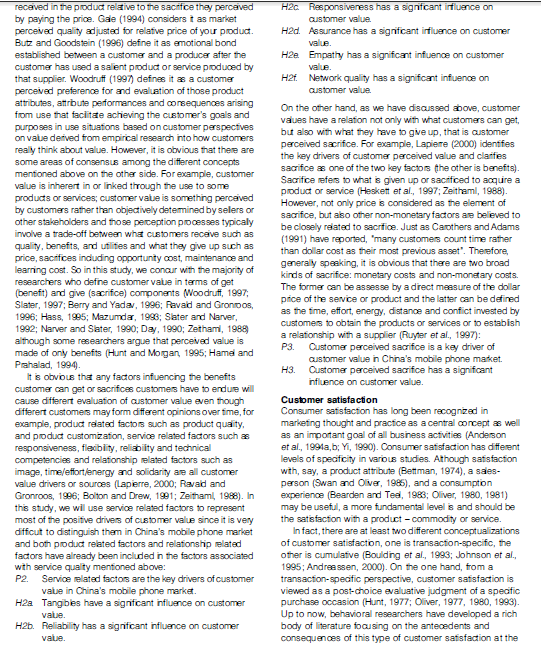
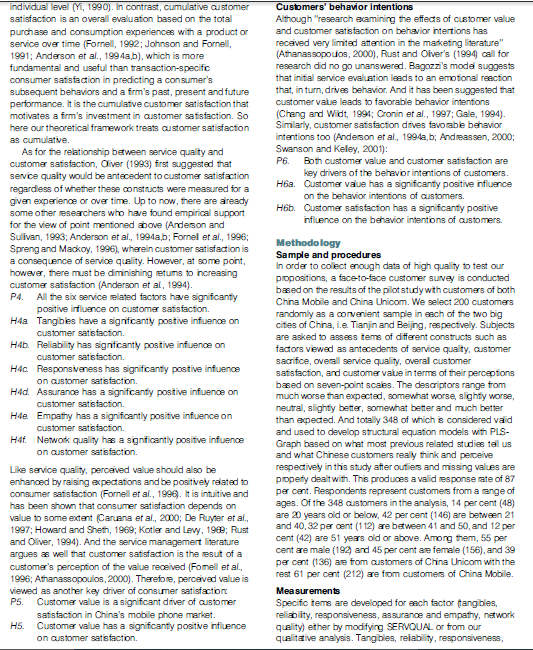
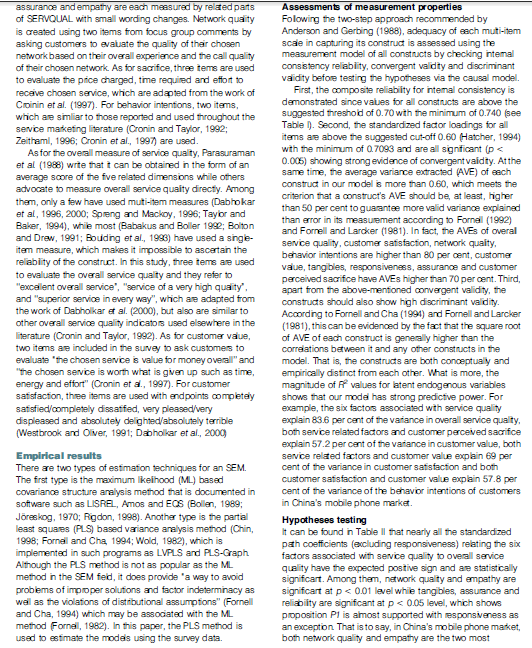
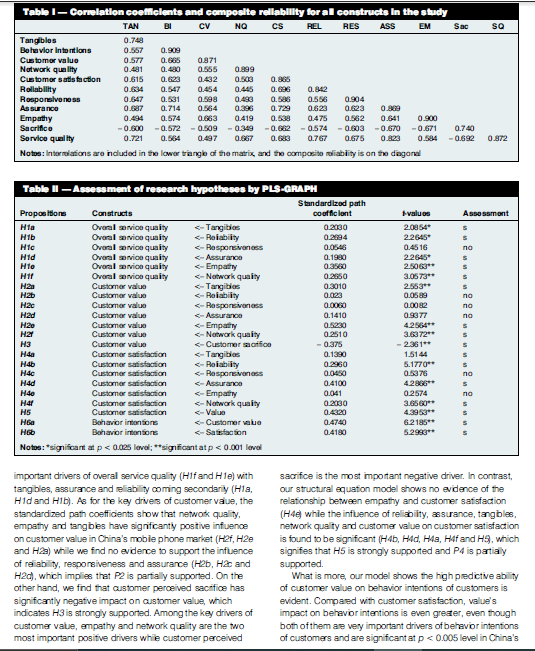
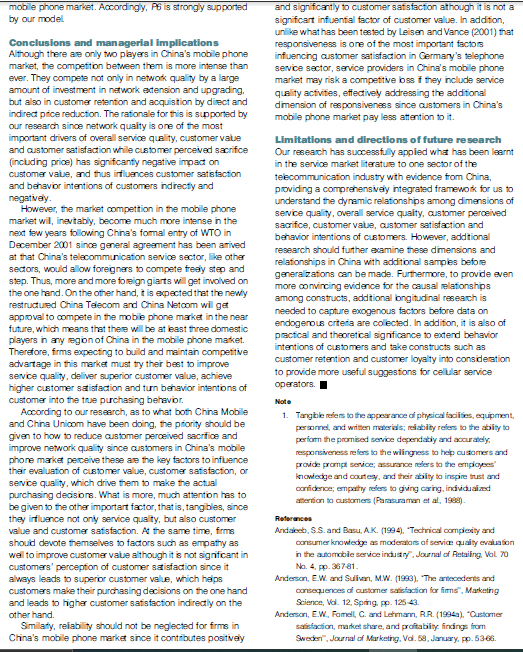
Keywords Service quality, Customer satisfaction, Telecommunications industry, China Abstract It is well known that service quality, customer satisfaction and customer value are becoming the most important factors of business success for either manufacturers or service providers. However, many different conclusions have been reached and related studies are rather fragmented, especially with regard to customer value. Furthermore, there are few related studies with service quality, customer satisfaction and customer value and their influences on customers' future behaviors in the telecommunication industry as the focus. In this paper, attention is paid to the measurement model of service quality in China's mobile phone market based on the well-known SERVQUAL model, but with modification on the basis of focus group discussions and expert opinions to reflect the specific industry attributes and the special culture of China. Emphasis is then paid to the study of the dynamic relationships among service quality, customer value, customer satisfaction and their influences on future behaviors after the key drivers of customer value and customer satisfaction are identified. All of them are based on the development of structural equation models by using PLS-GRAPH Package. Introduction Over the last decade, the centralized telecommunication monopoly in China has been changed and a relatively open and free competitive market is coming into being step by step. As a result, many functional and fundamental changes have taken place in the telecommunication reform and China's telecommunication industry has been growing the fastest in the world for the past 20 years, and has become the focus of attention all over the world. China has the world's second largest fixed-line phone market with about 200 million people connected, and the largest market for mobile phones with over 180 million subscribers (September, 2002). The mobile phone market has been growing at over 200 per cent since 1990, which signifies the large market potential of China's mobile phone market and the attraction for many foreign corporations to compete there (Tianjin Daily, 2001). China Mobile, a company established by restructuring China Telecom in 1999, has the largest mobile telecommunication network in the world. Although the second operator, China Unicom, occupied only 5 per cent of the total mobile market in China in 1998, it now has about 50 milion subscribers, about 30 per cent of China's total mobile phone market. Consequently, China Unicom does not play a minor role any more and the compettion between the two operators is intense. This has resulted in significant price reductions al over the country to attract and maintain a larger customer base Furthermore, many measures have been taken to improve the network quality as well Forecample, wth the mission of considering network quality as the life of the company and delivering superior communication services, the call completing rate of China Mobile is over 98.5 per cent and its GSM network covers more than 98 per cent of all counties of China. Therefore, generally speaking, the competitiveness of domestic firms has been enhanced and upgraded by way of the increasingly intense competition. However, domestic firms are still lagging behind when compared with their foreign counterparts, especialy in compettion based on service quality, customer satisfaction and customer value. For example, although Ministry of Information Industry of China wil announce the service quality of al companies in the mobie phone market publicy and continuous improvement of the overal serviced quality has been achieved, complaints about the service quality of mobile telecommunication have increased substantialy over the past three years. On the other hand, with China's entry into the WTO, it is inevitable that China's domestic telecommunication companies will meet keener and keener foreign compettion as a result of the agreement that joint ventures can be established freely in Bajing, Shanghai and Guangzhou (wth the maximum of foreign equity of 25 per cent for the first year after China's entry of WTO). So it becomes imperative for domestic frms in China Mobile home market to focus on the improvement of service quality to deliver superior customer value, achieve higher customer satisfaction and keep their customers or attract potentially profitable new customers, which, consequently, enables them to make more profits and build sustainable competitive advantages. In fact, it is urgently needed for them to identity the key drivers of service quality, customer satisfaction, and customer value and get to know the influence of them on behavior intentions of customers. It has been well known that service quality, customer satisfaction and customer value are becoming the most important factors for successful business competition for either manufacturers or service providers (e.g. Buzzel and Gale, 1987; Philips et al., 1983Zatham, 1996; Rust et al., 1995; Chang and Chen, 1998, Bolton and Drew, 1991; Parasuraman et al., 1988, 1991; Parasuraman, 1997). However, it seems that many different conclusions have been made of service quality, customer satisfaction and customer value and related studies are rather fragmented, especially in the field of the latter even though it is considered increasingly the key to success in the customer-centered era of today and the future (Zeithaml, 1988; Bolton and Drew, 1991; Ravad and Gronroos, 1996; Patterson et al., 1997, Woodruff, 1997; McDougall and Levesque, 2000; Lapierre, 2000; Qiang et al., 2001; Wang and Lo, 2002). What is more, it is very dificult to find related studies with the service quality, customer satisfaction and customer value and their infuences on customer future behaviors with the telecommunication industry as the focus, let alone related studies supported by evidence from China The purpose of this paper is to buid a comprehensively integrated framework for service quality, customer value, customer satisfaction and behavior intentions of customers and identify the most infuertial factors concerned in China's mobile phone sector. In this paper, unlike others, we conceptualize factors with service quality (tangibles, reliability, responsiveness, assurance and empathy) [t] as antecedents to customers' overal evaluation of service quality rather than dimensions or components of the construct. Then much attention will be paid to the respective antecedents of service quality and customer satisfaction with evidence from China's mobile phone market. At the same time, much emphasis is given to their relationship and distinct contributions to customer value and behavior intentions of customers as well. The remainder of the paper is organized as folows: the folowing section provides the theoretical background and develops related propositions and hypotheses. The next section presents the survey method and measures in this study, folowed by the empirical analysis resut. Then conclusions and managerial impications come next. In the final section, limitations and directions of future research are provided. Theoretical background and propositions Service quality In the past two decades, although more and more research findings have appeared concerning quality, it is still worth noting here that there are several distinct conceptualizations of quality (Holbrook, 1994). In marketing and economics, quality often has been viewed as dependent on the level of product attributes. In operations management, quality is defined as having two primary dimensions, fitness of use it refers to whether the product or service does what it is supposed to do and possess features that meet the needs of customers) and reiability (it represents to what extent the product is free from deficiencies). In service literature, quality is viewed as an overal assessment (Parasuraman et al., 1988). Among them, the most comprehensive defintion of quality is the one proposed by Garvin (1988) with the folowing eight attributes: (1) Performance means a product's primary operating characteristics (2) Features refer to the additional features (or the 'bels and whistles") of the product (3) Confomance represents the extent to which a product's design and operating characteristics meet the established standards. (4) Rai abity indicates the probability that a product will operate properly over a specified period of time under stated conditions of use. (5) Durabi ty means the amount of use the consumer gets from a product before it physicaly deteriorates or until a replacement is preferable. (6) Serviceability refers to the speed, competence, and courtesy of repair (7) Aesthetics refers to how a product appeals to the five senses . (8) Customer-perceived quality indicates the customer's perception of a product's quality, based on the reputation of the film. However, since this study focuses on China's mobile phone market, durability and aesthetics may not be so relevant. As for performance, network quality will be considered instead, based on our qualitative study by organizing customer focus groups before the survey stage. Almost all the customers investigated in the pilot study believed that network quality was one of the most important factors associated with service quality of mobile phone telecommunication service while other attributes can find their counterparts in related studies of customer perceived service quality In fact, with the role of the customer changing gradualy (Pahalad and Ramaswamy, 2000), customer perceived service quality has been given more and more attention for its specific contribution to the competitiveness of business and there have been a variety of studies on different issues concerning service quality over the last several years. Traditionally service quality has been defined as the difference between customer expectations and perceptions of service (Gronroos, 1984; Parasuraman et al., 1988, 1991). These researchers believe that measuring service quality as disconfirmation (the difference between perceptions and expectations) is valid and allows service providers to identity several gaps in the service provided. However, most of these studies have found a poor fit for the disconfirmation model As a result, their SERVQUAL scale has been criticized by more and more researchers for the use of gap scores, measurement of expectations, positively and negatively worded items, the generalizability of its dimensions, and the defining of a baseline standard for good quality (Cronin and Taylor, 1992; Brown et al., 1993; Oliver, 1993; Tees 1993; Spreng and Olshavsky, 1992). Furthermore, problems of relabiity, discriminant vaidity and variance restriction exist because of the computed difference scores. As a result, some researchers have tried to combine expectations and perceptions into a single measure to aleviate these problems and find that it really outperforms the SERVQUAL scale in terms of both reiab ity and validity (Babakus and Boller, 1992; Brown et al., 1993; Andaleeb and Basu, 1994; Dabholkar et al., 2000). Therefore, we wil adopt the latter and measure service quality with customer perceptions only. As what has been suggested and tested Dabholkar et al., 2000; Wang et al., 2002, factors associated with service quality leg. reliability, responsiveness, tangibles, assurance and empthy) are antecedents to customer perceived service quality rather than as dimensions or components of the construct P1 Factors associated with service quality are significant drivers of customer perceived service quality in China's mobile phone market. Hla. Tangibles have a significant influence on customer perceived service quality H1b. Reliability has a significant influence on customer perceived service quality Hic Responsiveness has a significant influence on customer perceived service quality Hid. Assurance has a significant influence on customer perceived service quality Hle Empathy has a significant influence on customer perceived service quality H1f Network quality has a significant infuence on customer perceived service quality Customer value More and more firms are searching for new ways to achieve, retain, upgrade and leverage competitive advantages, given the fact that customers are becoming more demanding, competition is getting more intense and technology is changing more rapidly. As some researchers have concluded (Day, 1990, Narver and Slater, 1990), creating superior customer value is a major goal for market-driven firms. In fact, deivering superior customer value is inevitably becoming one of the most important success factors for any frm now and in the future because of its significant impact on behavior intentions of customers. As a result, many films are transforming their focus from looking internaly within the organization for improvement by way of quality management, downsizing, business process reengineering or lean production and agile manufacturing to pursue superior customer value delivery (Band, 1991; Day, 1990; Gale, 1994; Naumann, 1996; Butz and Goodstein, 1996, Woodruff, 1997). Therefore, learning about customer value and knowledge concerned, which can provide sufficient customer voice to guide managers in how to respond, are playing a more and more important role in a firm's increasingly competitive environments. Athough the significance of customer value is widely recognized, the growing body of research about customer value is quite fragmented and the definition of customer value is divergent. Zeitham (1988) considers value as the customer's overall assessment of the utility of a product based on perception of what is received and what is given. Dodds et al. (1991) argue that buyers' perceptions of value represent a trade-off between the quality or benefits they received in the product relative to the sacrice they percaved by paying the price. Gale (1994) considers t as market perceived quality adjusted for relative price of your product Butz and Goodstein (1996) define it as emotional bond established between a customer and a producer after the customer has used a salent product or service produced by that supplier. Woodruff (1997) defines it as a customer perceived preference for and evaluation of those product attributes, attbute performances and consequences arising from use that facilitate achieving the customer's goals and purposes in use situations based on customer perspectives on value derived from empirical research into how customers realy think about value. However, it is obvious that there are some areas of consensus among the different concepts mentioned above on the other side. For example, customer value is inherent in or linked through the use to some products or services, customer value is something percaved by customers rather than objectively determined by selers or other stakeholders and those perception processes typicaly involve a trade-off between what customers receive such as quality, benefits, and utilities and what they give up such as price, sacrifices including opportunity cost, maintenance and learning cost. So in this study, we concur with the majority of researchers who define customer value in terms of get (beneft) and give (sacrifice) components Woodruff, 1997, Slater, 1997; Berry and Yadav, 1996; Pavad and Gronidos, 1996; Hass, 1995; Mazumda, 1993; Slater and Narver, 1992; Narver and Slater, 1990; Day, 1990; Zetham, 1988 although some researchers argue that perceived value is made of only benefits (Hunt and Morgan, 1995; Hame and Pahalad, 1994) It is obvious that any factors infuencing the benefts customer can get or sacrifices customers have to endure wil cause differert evaluation of customer value even though different customers may form different opinions over time, for example, product related factors such as product quality, and product customization, service related factors such as responsiveness, flebiity, reliability and technical competencies and relationship related factors such as image, time/effort/energy and solidarity as all customer value drivers or sources (Lapierre, 2000; Ravad and Gronroos, 1986; Bolton and Drew, 1991; Zeithaml, 1988). In this study, we wil use service related factors to represent most of the positive drivers of customer value since it is very difficut to distinguish them in China's mobile phone market and both product related factors and relationship related factors have already been included in the factors associated with service quality mentioned above: P2. Service related factors are the key drivers of customer value in China's mobile phone market. H2a Tangibles have a significant influence on customer vale H25. Reliability has a significant influence on customer value H2c Responsiveness has a significant influence on customer value H2d. Assurance has a significant influence on customer value H2e Empathy has a significant infuence on customer value H2f. Network quality has a significant influence on customer value On the other hand, as we have discussed above, customer values have a relation not only with what customers can get but also with what they have to give up, that is customer perceived sacrifice. For example, Lapierre (2000) identifies the key drivers of customer perceived value and clarifies sacrifice as one of the two key factors the other is benefits). Sacrifice refers to what is given up or sacrificed to acquire a product or service (Heskett et al., 1997; Zeithaml, 1988). However, not only price is considered as the element of sacrifice, but also other non-monetary factors are believed to be closely related to sacrifice. Just as Carothers and Adams (1991) have reported, 'many customers count time rather than dollar cost as their most previous asset'. Therefore, generaly speaking, it is obvious that there are two broad kinds of sacrifice: monetary costs and non-monetary costs The former can be assesse by a direct measure of the dollar price of the service or product and the latter can be defined as the time, effort, energy, distance and confict invested by customers to obtain the products or services or to estabish a relationship with a supplier (Ruyter et al., 1997): P3. Customer perceived sacrifice is a key driver of customer value in China's mobile phone market. H3 Customer perceived sacrifice has a significant influence on customer value. Customer satisfaction Consumer satisfaction has long been recognized in marketing thought and practice as a central concept as well as an important goal of al business activities (Anderson et al., 1991a, b; Y, 1990). Consumer satisfaction has different levels of specificity in various studies. Although satisfaction with, say, a product attribute (Bettman, 1974), a sales- person (Swan and Oliver, 1985), and a consumption experience (Bearden and Teal, 1983; Oliver, 1980, 1981) may be useful, a more fundamental levels and should be the satisfaction with a product commodity or service. In fact, there are at least two different conceptualizations of customer satisfaction, one is transaction-specific, the other is cumulative (Boulding et al., 1993; Johnson et al., 1995; Andreassen, 2000). On the one hand, from a transaction-specific perspective, customer satisfaction is viewed as a post-choice evaluative judgment of a specific purchase occasion (Hunt, 1977; Oliver, 1977, 1980, 1993). Up to now, behavioral researchers have developed a rich body of literature focusing on the antecedents and consequences of this type of customer satisfaction at the individual level (Y, 1990). In contrast, cumulative customer satisfaction is an overal evaluation based on the total purchase and consumption experiences with a productor service over time (Fornell, 1992; Johnson and Fornell, 1991; Anderson et al., 1994a,b), which is more fundamental and useful than transaction-specific consumer satisfaction in predicting a consumer's subsequent behaviors and a firm's past, present and future performance. It is the cumulative customer satisfaction that motivates a firm's investment in customer satisfaction. So here our theoretical framework treats customer satisfaction as cumulative As for the relationship between service quality and customer satisfaction, Oliver (1993) first suggested that service quality would be antecedent to customer satisfaction regardless of whether these constructs were measured for a given experience or over time. Up to now, there are already some other researchers who have found empirical support for the view of point mentioned above (Anderson and Sulivan, 1993; Anderson et al., 1994a,b; Fornel et al., 1996; Spreng and Mackoy, 1996), wherein customer satisfaction is a consequence of service quality. However, at some point, however, there must be diminishing retums to increasing customer satisfaction (Anderson et al, 1994). P4. All the six service related factors have significantly positive influence on customer satisfaction. H4a Tangibles have a significantly positive infuence on customer satisfaction Hub. Reliability has significantly postive infuence on customer satisfaction H4c Responsiveness has significantly positive influence on customer satisfaction. H4d. Assurance has a significantly positive infuence on customer satisfaction. Hde Empathy has a significantly positive infuence on customer satisfaction. H4f Network quality has a significantly positive influence on customer satisfaction Like service quality perceived value should also be enhanced by raising expectations and be positively related to consumer satisfaction (Fornell et al., 1996). It is intuitive and has been shown that consumer satisfaction depends on value to some extent Caruana et al., 2000; De Ruyter et al., 1997; Howard and Sheth, 1969; Kotler and Levy, 1989; Rust and Oliver, 1994). And the service management literature argues as well that customer satisfaction is the result of a customer's perception of the value received (Fomell et al., 1996, Athanassopoulos, 2000). Therefore, perceived value is viewed as another key driver of consumer satisfaction P5. Customer value is a significant driver of customer satisfaction in China's mobile phone market. H5 Customer value has a significantly positive influence on customer satisfaction Customers' behavior intentions Although "research examining the effects of customer value and customer satisfaction on behavior intertions has received very limited attention in the marketing literature" (Athanassopoulos, 2000), Rust and Oiver's (1994) call for research did no go unanswered. Bagozzi's mode suggests that initial service evaluation leads to an emotional reaction that, in turn, drives behavior. And it has been suggested that customer value leads to favorable behavior intentions (Chang and Widt, 1994; Cronin et al., 1997; Gale, 1994). Similarly, customer satisfaction drives favorable behavior intentions too (Anderson et al., 1994a, b; Andreassen, 2000; Swanson and Keley, 2001): P6. Both customer value and customer satisfaction are key drivers of the behavior intentions of customers. H62. Customer value has a significantly positive influence on the behavior intentions of customers. H6b. Customer satisfaction has a significantly positive influence on the behavior intentions of customers. Methodology Sample and procedures In order to colect enough data of high quality to test our propositions, a face-to-face customer survey is conducted bed on the results of the pilot study with customers of both China Mobile and China Unicom. We select 200 customers randomly as a convenient sample in each of the two big cities of China, i.e. Tianjin and Beijing, respectively. Subjects are asked to assess tems of different constructs such as factors viewed as antecedents of service quality, customer sacrifice, overall service quality, overal customer satisfaction, and customer value in terms of their perceptions based on seven-point scales. The descriptors range from much worse than expected, somewhat worse, slightly worse, neutral, slightly better, somewhat better and much better than expected. And totally 348 of which is considered vaid and used to develop structural equation models with PLS- Graph based on what most previous related studies tellus and what Chinese customers realy think and perceive respectively in this study after outies and missing values are property dealt with. This produces a valid response rate of 87 per cent. Respondents represent customers from a range of ages. Of the 348 customers in the analysis, 14 per cent (48) are 20 years old or below, 42 per cent (146) are between 21 and 40,32 per cent (112) are between 41 and 50, and 12 per cent (42) are 51 years old or above. Among them, 55 per cent are male (192 and 45 per cent are female (156), and 39 per cent (136) are from customers of China Unicom with the rest 61 per cent (212) are from customers of China Mobile Measurements Specific tems are developed for each factor tangibles, reliability, responsiveness, assurance and empathy, network quality) ether by modifying SERVQUAL or from our qualitative analysis. Tangibles, reiability, responsiveness, assurance and empathy are each measured by related parts of SERVQUAL with small wording changes. Network quality is created using two items from focus group comments by asking customers to evaluate the quality of their chosen network based on their overall experience and the call quality of their chosen network. As for sacrifice, three tems are used to evaluate the price charged, time required and effort to receive chosen service, which are adapted from the work of Cronin et al. (1997). For behavior intentions, two items, which are similar to those reported and used throughout the service marketing literature (Cronin and Taylor, 1992; Zeithaml, 1996; Cronin et al., 1997) are used. As for the overall measure of service quality, Parasuraman et al (1988) write that it can be obtained in the form of an average score of the fve related dimensions while others advocate to measure overall service quaity directly. Among them, only a few have used multi-item measures (Dabhokar et al, 1996, 2000; Spreng and Mackoy, 1996; Taylor and Baker, 1994), while most (Babakus and Boller 1992; Bolton and Drew, 1991; Bouding et al., 1998) have used a single- item measure, which makes it impossible to ascertain the relability of the construct. In this study, three tems are used to evaluate the overall service quality and they refer to "excelent overall service","service of a very high quality and "superior service in every way", which are adapted from the work of Dabholkar et al. (2000), but also are similar to other overall service quality indicatos used elsewhere in the literature (Cronin and Tayior, 1992). As for customer value, two items are included in the survey to ask customers to evaluate the chosen service is value for money overall and "the chosen service is worth what is given up such as time, energy and effort" (Cronin et al., 1997). For customer satisfaction, the items are used with endpoints completely satisfied completely dissatified, very pleased/very displeased and absolutely delighted/absolutely terrible (Westbrook and Oliver, 1991; Dabholkar et al., 2000 Empirical results There are two types of estimation techniques for an SEM. The first type is the maximum likelihood (ML) based covariance structure analysis method that is documented in software such as LISREL, Amos and EOS (Bollen, 1989; Jreskog, 1970; Rgdon, 1998). Another type is the partial least squares (PLS) based variance analysis method (Chin, 1998; Fornell and Cha, 1994; Wold, 1982), which is implemented in such programs as LVPLS and PLS-Graph Although the PLS method is not as popular as the ML method in the SEM field, it does provide a way to avoid problems of improper solutions and factor indeterminacy as well as the violations of distributional assumptions" (Fornell and Cha, 1994) which may be associated with the ML method Fornal, 1982). In this paper, the PLS method is used to estimate the models using the survey data Assessments of measurement properties Folowing the two-step approach recommended by Anderson and Gerbing (1988), adequacy of each muti-item scale in capturing its construct is assessed using the measurement model of al constructs by checking intemal consistency reliability, convergent validity and discriminant vaidity before testing the hypotheses via the causal model First, the composite reliability for internal consistency is demonstrated since values for all constructs are above the suggested threshold of 0.70 with the minimum of 0.740 (see Table 1). Second, the standardized factor loadings for all items are above the suggested cut-off 0.60 Hatcher, 1994) with the minimum of 07093 and are all significant (pStep by Step Solution
There are 3 Steps involved in it
1 Expert Approved Answer
Step: 1 Unlock

Question Has Been Solved by an Expert!
Get step-by-step solutions from verified subject matter experts
Step: 2 Unlock
Step: 3 Unlock
 Study Help