







Question: then Show that if u(x,t) = F(x + ct) + G(x - ct) satisfies u(x, 0) = f(x), u(x, 0) = g(x), for all
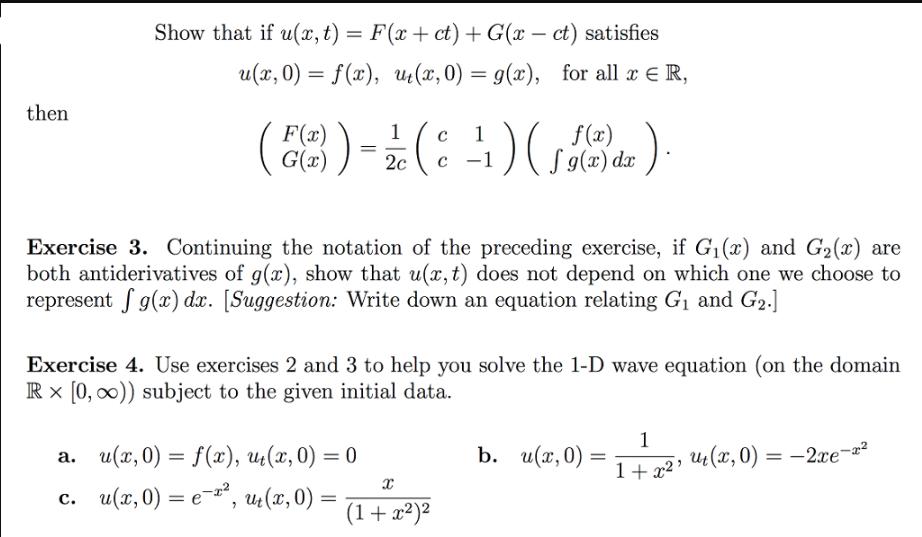
then Show that if u(x,t) = F(x + ct) + G(x - ct) satisfies u(x, 0) = f(x), u(x, 0) = g(x), for all x = R, 1 C 2c f(x) 9(x)dx ((x)) = (-1) (())- Exercise 3. Continuing the notation of the preceding exercise, if G(x) and G2(x) are both antiderivatives of g(x), show that u(x, t) does not depend on which one we choose to represent g(x) dx. [Suggestion: Write down an equation relating G and G2.] Exercise 4. Use exercises 2 and 3 to help you solve the 1-D wave equation (on the domain Rx [0, )) subject to the given initial data. a. u(x, 0) = f(x), u(x, 0) = 0 1 b. u(x, 0) = 1+x' ut(x, 0) = -2xe-x == c. u(x, 0) = ex, ut(x, 0) = = (1 + x2)2 X
Step by Step Solution
There are 3 Steps involved in it
To solve these exercises lets start with Exercise 3 and then move on to Exercise 2 After that well use the results to solve Exercise 4 Exercise 3 We h... View full answer

Get step-by-step solutions from verified subject matter experts
 Study Help