







Question: Theorem. If M is an NFA accepting a language L, then there is an NFA M' accepting the language L*. This shows that the set
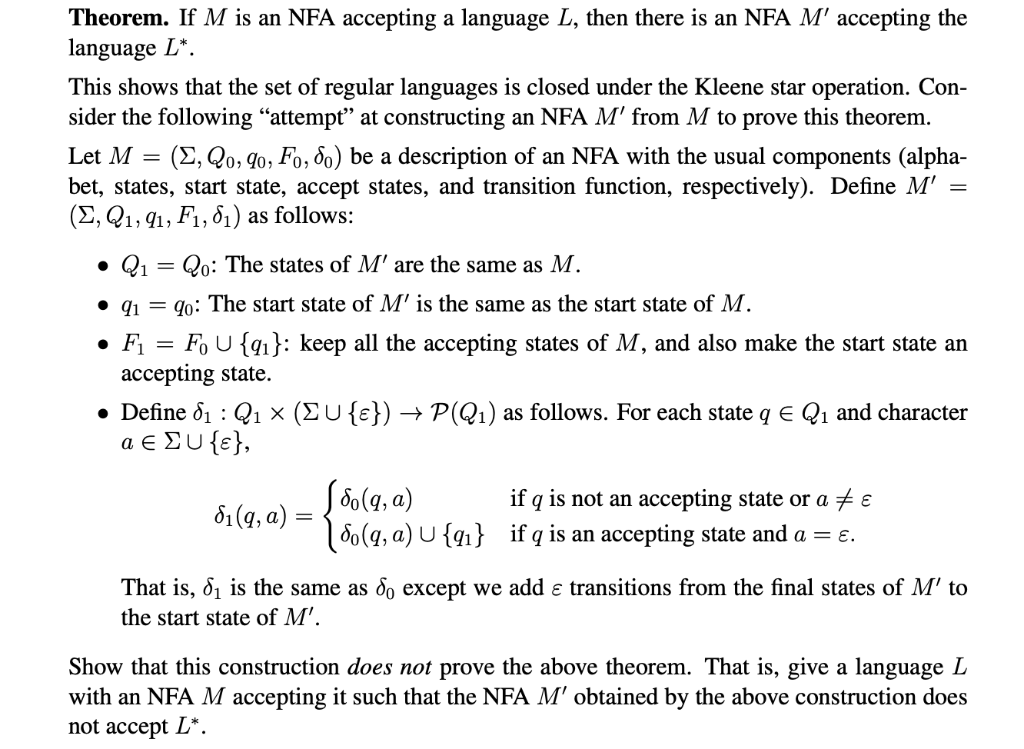
Theorem. If M is an NFA accepting a language L, then there is an NFA M' accepting the language L*. This shows that the set of regular languages is closed under the Kleene star operation. Con- sider the following "attempt" at constructing an NFA M' from M to prove this theorem Let M (, Qo, o, Fo,&J be a description of an NFA with the usual components (alpha- bet, states, start state, accept states, and transition function, respectively). Define M' 2, Qi A, F1, 1) as follows: Q1 Qo: The states of M' are the same as M qi -q0: The start state of M' is the same as the start state of M . F1-Fo U {i^: keep all the accepting states of M, and also make the start state an accepting state. . Define : QX ( U {}) P(Q) as follows. For each state q Qi and character if q is not an accepting state or a if q is an accepting state and a -E. , (q, a) U {q } That is, is the same as 50 except we add transitions from the final states of M, to the start state of M" Show that this construction does not prove the above theorem. That is, give a language L with an NFA M accepting it such that the NFA M' obtained by the above construction does not accept L. Theorem. If M is an NFA accepting a language L, then there is an NFA M' accepting the language L*. This shows that the set of regular languages is closed under the Kleene star operation. Con- sider the following "attempt" at constructing an NFA M' from M to prove this theorem Let M (, Qo, o, Fo,&J be a description of an NFA with the usual components (alpha- bet, states, start state, accept states, and transition function, respectively). Define M' 2, Qi A, F1, 1) as follows: Q1 Qo: The states of M' are the same as M qi -q0: The start state of M' is the same as the start state of M . F1-Fo U {i^: keep all the accepting states of M, and also make the start state an accepting state. . Define : QX ( U {}) P(Q) as follows. For each state q Qi and character if q is not an accepting state or a if q is an accepting state and a -E. , (q, a) U {q } That is, is the same as 50 except we add transitions from the final states of M, to the start state of M" Show that this construction does not prove the above theorem. That is, give a language L with an NFA M accepting it such that the NFA M' obtained by the above construction does not accept L
Step by Step Solution
There are 3 Steps involved in it

Get step-by-step solutions from verified subject matter experts
 Study Help