



Question: Theorem: Suppose that g(r) 0 for all r >0. If 30 q(x) dx = 00, (31) then u(r) has infinitely many zeros on the positive

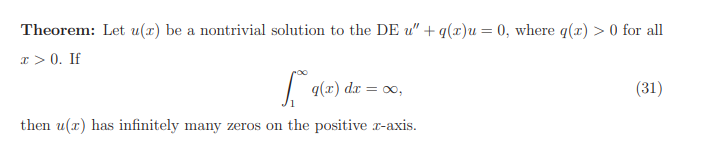

Theorem: Suppose that g(r) 0 for all r >0. If 30 q(x) dx = 00, (31) then u(r) has infinitely many zeros on the positive r-axis.cy'' oy Fay=0, x>0 (i) What is the normal form of the DE? (ii) For what values of v, the solutions of the DE will be oscillatory? (have infinitely many zeros) (iii) For what values of , the solutions of the DE will not be oscillatory? (have at most one zero)
Step by Step Solution
There are 3 Steps involved in it
1 Expert Approved Answer
Step: 1 Unlock

Question Has Been Solved by an Expert!
Get step-by-step solutions from verified subject matter experts
Step: 2 Unlock
Step: 3 Unlock