







Question: There are five steps to complete a meal in a restaurant. The processing time of each step is shown in the table below. The manager
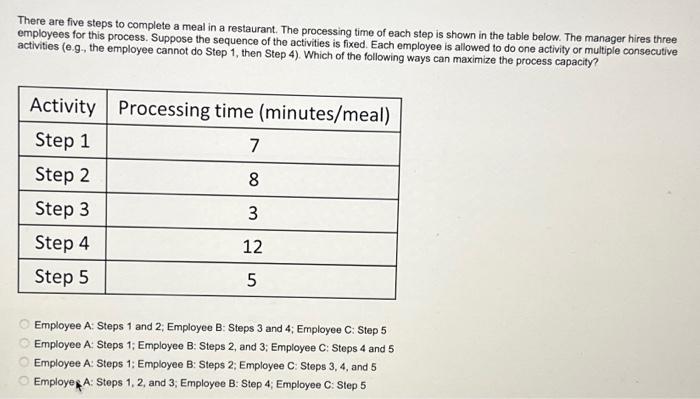
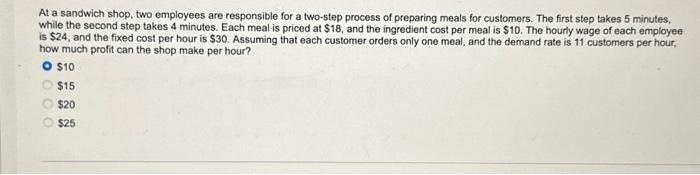
There are five steps to complete a meal in a restaurant. The processing time of each step is shown in the table below. The manager hires three employees for this process. Suppose the sequence of the activities is fixed. Each employee is allowed to do one activity or multiple consecutive activities (e.g., the employee cannot do Step 1, then Step 4). Which of the following ways can maximize the process capacity? Employee A: Steps 1 and 2; Employee B: Steps 3 and 4; Employee C: Step 5 Employee A: Steps 1; Employee B: Steps 2, and 3; Employee C: Steps 4 and 5 Employee A: Steps 1; Employee B: Steps 2; Employee C: Steps 3, 4, and 5 Employe A: Steps 1, 2, and 3; Employee B: Step 4; Employee C: Step 5 At a sandwich shop, two employees are responsible for a two-step process of preparing meals for customers. The first step takes 5 minutes, while the second step takes 4 minutes. Each meal is priced at $18, and the ingredient cost per meal is $10. The hourly wage of each employee is $24, and the fixed cost per hour is $30. Assuming that each customer orders only one meal, and the demand rate is 11 customers per hour, how much profit can the shop make per hour? $10 $15 $20 $25
Step by Step Solution
There are 3 Steps involved in it

Get step-by-step solutions from verified subject matter experts
 Study Help