







Question: There are two stock markets, each driven by the same common force, F, with an expected value of zero and standard deviation of 10 percent.
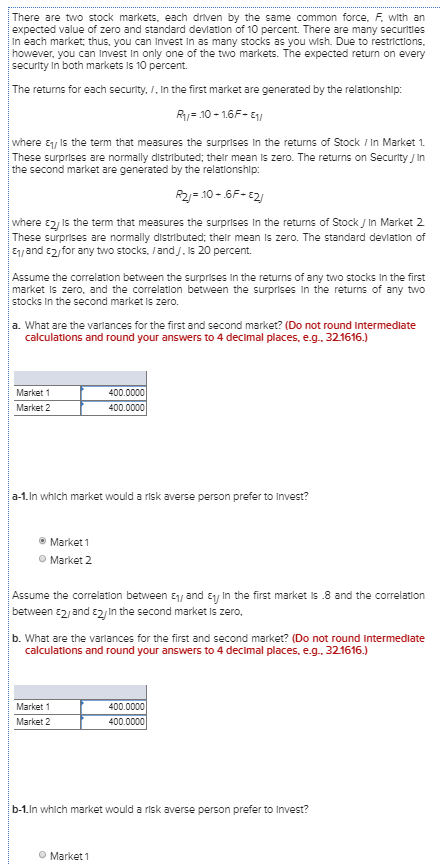
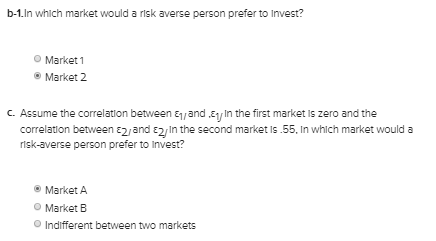
There are two stock markets, each driven by the same common force, F, with an expected value of zero and standard deviation of 10 percent. There are many securities In each market: thus, you can Invest in as many stocks as you wish. Due to restrictions however, you can Invest in only one of the two markets. The expected return on every security in both markets is 10 percent. The returns for each security. 1. In the first market are generated by the relationship: R = 10-16F-1 where ay is the term that measures the surprises in the returns of Stock / in Market 1 These surprises are normally distributed: their mean is zero. The returns on Security in the second market are generated by the relationship 2 = 10-6F-21 where [2, is the term that measures the surprises in the returns of Stock In Market 2 These surprises are normally distributed their mean is zero. The standard deviation of 1 and 2 for any two stocks, land/. ls 20 percent. Assume the correlation between the surprises in the returns of any two stocks in the first market is zero, and the correlation between the surprises in the returns of any two stocks in the second market is zero. a. What are the variances for the first and second market? (Do not round Intermediate calculations and round your answers to 4 decimal places, e.g. 32.1616.) Market 1 Market 2 400 00001 400.0000 a-1. In which market would a risk averse person prefer to Invest? Market 1 Market 2 Assume the correlation between Ey and Ey in the first market is 8 and the correlation between 2 and 2 In the second market is zero. b. What are the variances for the first and second market? (Do not round Intermediate calculations and round your answers to 4 decimal places, e.g. 321616.) Market 1 Market 2 400.0000 400.0000 b-1. In which market would a risk averse person prefer to Invest? Market 1 b-1.In which market would a risk averse person prefer to Invest? Market 1 Market 2 C. Assume the correlation between Ey/ and Ey In the first market is zero and the correlation between 2, and E2, In the second market is.55, in which market would a risk-averse person prefer to Invest? Market A Market B Indifferent between two markets
Step by Step Solution
There are 3 Steps involved in it

Get step-by-step solutions from verified subject matter experts
 Study Help