







Question: There is a chegg user, he keeps copy-pasting the same faulty code to this question. I beg you, do not touch this question! Let someone
There is a chegg user, he keeps copy-pasting the same faulty code to this question. I beg you, do not touch this question! Let someone who understands matlab and can read the question answer the question, don't keep copy-pasting the same answer!
There is a chegg user, he keeps copy-pasting the same faulty code to this question. I beg you, do not touch this question! Let someone who understands matlab and can read the question answer the question, don't keep copy-pasting the same answer!
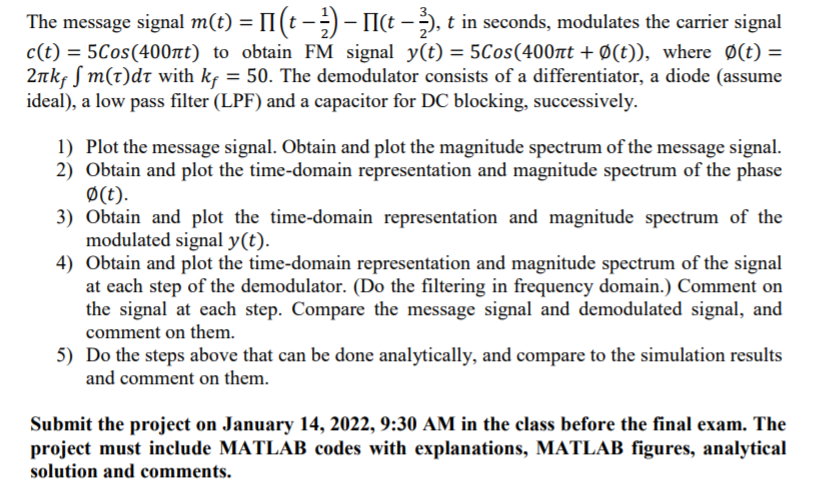
The message signal m(t) = I1(t -) - (t 3), t in seconds, modulates the carrier signal c(t) = 5Cos(400nt) to obtain FM signal y(t) = 5Cos(400nt + (t)), where (t) = 21tkf S m(t)dt with kg = 50. The demodulator consists of a differentiator, a diode (assume ideal), a low pass filter (LPF) and a capacitor for DC blocking, successively. 1) Plot the message signal. Obtain and plot the magnitude spectrum of the message signal. 2) Obtain and plot the time-domain representation and magnitude spectrum of the phase t. 3) Obtain and plot the time-domain representation and magnitude spectrum of the modulated signal y(t). 4) Obtain and plot the time-domain representation and magnitude spectrum of the signal at each step of the demodulator. (Do the filtering in frequency domain.) Comment on the signal at each step. Compare the message signal and demodulated signal, and comment on them. 5) Do the steps above that can be done analytically, and compare to the simulation results and comment on them. Submit the project on January 14, 2022, 9:30 AM in the class before the final exam. The project must include MATLAB codes with explanations, MATLAB figures, analytical solution and comments
Step by Step Solution
There are 3 Steps involved in it

Get step-by-step solutions from verified subject matter experts
 Study Help