







Question: There is a typo statement 3 should be: 3. Either there is a no shipwreck on the beach, or the treasure is hidden in a
There is a typo statement 3 should be:
3. Either there is a no shipwreck on the beach, or the treasure is hidden in a cave.
(without the "a")
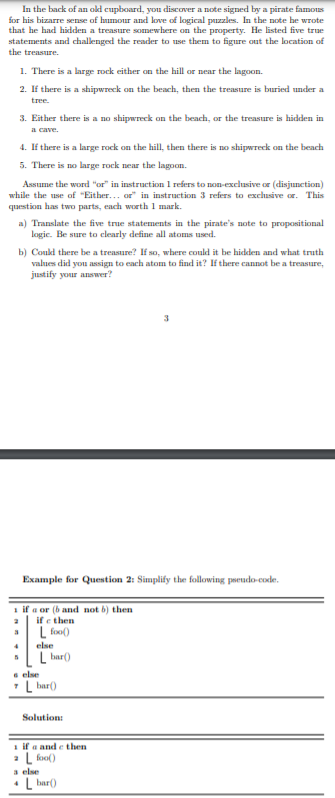
In the back of an old cupboard, you discover a note signed by a pirate famous for his bizarre sense of humour and love of logical puzzles. In the note he wrote that he had hidden a treasure somewhere on the property. He listed five true statements and challenged the reader to use them to figure out the location of the treasure. 1. There is a large rock either on the hill or near the lagoon. 2. If there is a shipwreck on the beach, then the treasure is buried under a tree. 3. Either there is a no shipwreck on the beach, or the treasure is hidden in a cave. 4. If there is a large rock on the hill, then there is no shipwreck on the beach 5. There is no large rock near the lagoon. Assume the word "or" in instruction 1 refers to non-exclusive or (disjunction) while the use of "Either...or" in instruction 3 refers to exclusive or. This question has two parts, each worth 1 mark. a) Translate the five true statements in the pirate's note to propositional logic. Be sure to clearly define all atoms used. b) Could there be a treasure? If so, where could it be hidden and what truth values did you assign to each atom to find it? If there cannot be a treasure, justify your answer? 3 Example for Question 2: Simplify the following pseudo-code. 1 if a or (b and not b) then if c then a Loo) 4 else L bar) else * L ) Solutions 1 If and then L fool) a else L bur) 4
Step by Step Solution
There are 3 Steps involved in it

Get step-by-step solutions from verified subject matter experts
 Study Help