Question: There is only one question. Please solve it by applying the legal principles discussed in the class. In February, 1979, Jamaluddin filed a suit for
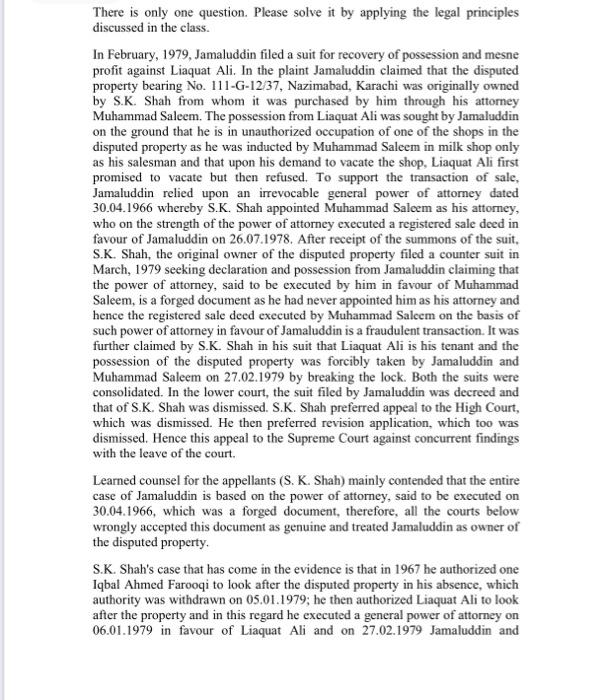
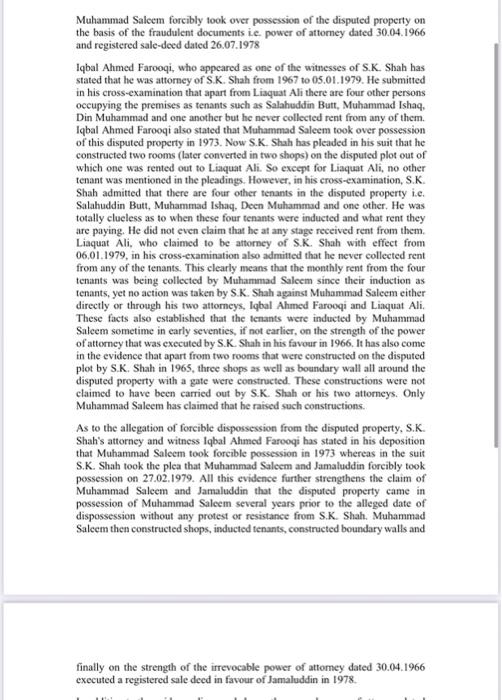
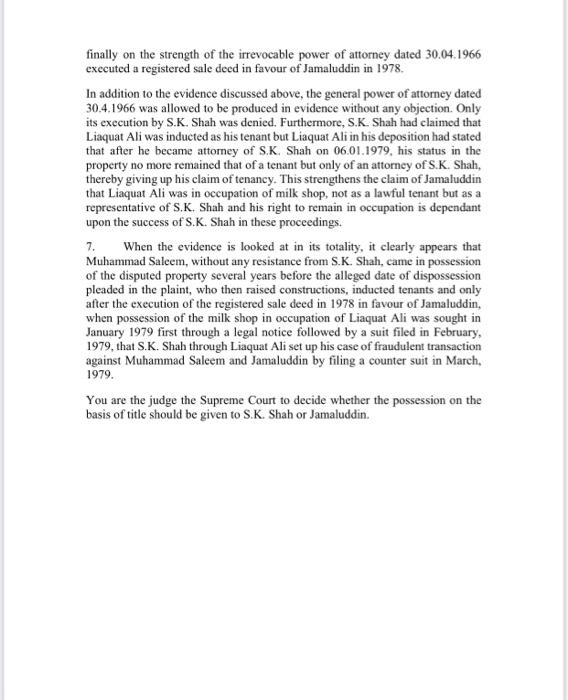
There is only one question. Please solve it by applying the legal principles discussed in the class. In February, 1979, Jamaluddin filed a suit for recovery of possession and mesne profit against Liaquat Ali. In the plaint Jamaluddin claimed that the disputed property bearing No. 111-G-1237, Nazimabad, Karachi was originally owned by S.K. Shah from whom it was purchased by him through his attorney Muhammad Saleem. The possession from Liaquat Ali was sought by Jamaluddin on the ground that he is in unauthorized occupation of one of the shops in the disputed property as he was inducted by Muhammad Saleem in milk shop only as his salesman and that upon his demand to vacate the shop, Liaquat Ali first promised to vacate but then refused. To support the transaction of sale, Jamaluddin relied upon an irrevocable general power of attorney dated 30.04.1966 whereby S.K. Shah appointed Muhammad Saleem as his attorney, who on the strength of the power of attorney executed a registered sale deed in favour of Jamaluddin on 26.07.1978. After receipt of the summons of the suit. S.K. Shah, the original owner of the disputed property filed a counter suit in March, 1979 seeking declaration and possession from Jamaluddin claiming that the power of attorney, said to be executed by him in favour of Muhammad Saleem, is a forged document as he had never appointed him as his attorney and hence the registered sale deed executed by Muhammad Saleem on the basis of such power of attorney in favour of Jamaluddin is a fraudulent transaction. It was further claimed by S.K. Shah in his suit that Liaquat Ali is his tenant and the possession of the disputed property was forcibly taken by Jamaluddin and Muhammad Saleem on 27.02.1979 by breaking the lock. Both the suits were consolidated. In the lower court, the suit filed by Jamaluddin was decreed and that of S.K. Shah was dismissed. S.K. Shah preferred appeal to the High Court, which was dismissed. He then preferred revision application, which too was dismissed. Hence this appeal to the Supreme Court against concurrent findings with the leave of the court. Learned counsel for the appellants (S. K. Shah) mainly contended that the entire case of Jamaluddin is based on the power of attorney, said to be executed on 30.04.1966, which was a forged document, therefore, all the courts below wrongly accepted this document as genuine and treated Jamaluddin as owner of the disputed property. S.K. Shah's case that has come in the evidence is that in 1967 he authorized one Iqbal Ahmed Farooqi to look after the disputed property in his absence, which authority was withdrawn on 05.01.1979, he then authorized Liaquat Ali to look after the property and in this regard he executed a general power of attorney on 06.01.1979 in favour of Liaquat Ali and on 27.02.1979 Jamaluddin and Muhammad Saleem forcibly took over possession of the disputed property on the basis of the fraudulent documents ic power of attomey dated 30.04.1966 and registered sale-deed dated 26.07.1978 Iqbal Ahmed Farooqi, who appeared as one of the witnesses of S.K. Shah has stated that he was attorney of S.K. Shah from 1967 to 05.01.1979. He submitted in his cross-examination that apart from Liaquat Ali there are four other persons occupying the premises as tenants such as Salahuddin Butt, Muhammad Ishaq, Din Muhammad and one another but he never collected rent from any of them. Iqbal Ahmed Farooqi also stated that Muhammad Saleem took over possession of this disputed property in 1973. Now S.K. Shah has pleaded in his suit that he constructed two rooms (later converted in two shops) on the disputed plot out of which one was rented out to Liaquat Ali. So except for Liaquat Ali , no other tenant was mentioned in the pleadings. However, in his cross-examination, S.K. Shah admitted that there are four other tenants in the disputed property i.e. Salahuddin Butt, Muhammad Ishaq, Deen Muhammad and one other. He was totally clueless as to when these four tenants were inducted and what rent they are paying. He did not even claim that he at any stage received rent from them. Liaquat Ali, who claimed to be attorney of S.K. Shah with effect from 06.01.1979, in his cross-examination also admitted that he never collected rent from any of the tenants. This clearly means that the monthly rent from the four tenants was being collected by Muhammad Saleem since their induction as Tenants, yet no action was taken by S.K. Shah against Muhammad Saleem either directly or through his two attorneys, Iqbal Ahmed Farooqi and Liaquat Ali. These facts also established that the tenants were inducted by Muhammad Saleem sometime in carly seventies, if not earlier, on the strength of the power of attorney that was executed by S.K. Shah in his favour in 1966. It has also come in the evidence that apart from two rooms that were constructed on the disputed plot by S.K. Shah in 1965, three shops as well as boundary wall all around the disputed property with a gate were constructed. These constructions were not claimed to have been carried out by S.K. Shah or his two attorneys. Only Muhammad Saleem has claimed that he raised such constructions. As to the allegation of forcible dispossession from the disputed property, S.K. Shah's attorney and witness Iqbal Ahmed Farooqi has stated in his deposition that Muhammad Saleem took forcible possession in 1973 whereas in the suit S.K. Shah took the plea that Muhammad Salcem and Jamaluddin forcibly took possession on 27.02.1979. All this evidence further strengthens the claim of Muhammad Saleem and Jamaluddin that the disputed property came in possession of Muhammad Saleem several years prior to the alleged date of dispossession without any protest or resistance from S.K. Shah. Muhammad Saleem then constructed shops, inducted tenants, constructed boundary walls and finally on the strength of the irrevocable power of attomey dated 30.04.1966 executed a registered sale deed in favour of Jamaluddin in 1978 finally on the strength of the irrevocable power of attorney dated 30.04.1966 executed a registered sale deed in favour of Jamaluddin in 1978. In addition to the evidence discussed above, the general power of attomey dated 30.4.1966 was allowed to be produced in evidence without any objection. Only its execution by S.K. Shah was denied. Furthermore, S.K. Shah had claimed that Liaquat Ali was inducted as his tenant but Liaquat Ali in his deposition had stated that after he became attorney of S.K. Shah on 06.01.1979, his status in the property no more remained that of a tenant but only of an attorney of S.K. Shah, thereby giving up his claim of tenancy. This strengthens the claim of Jamaluddin that Liaquat Ali was in occupation of milk shop, not as a lawful tenant but as a representative of S.K. Shah and his right to remain in occupation is dependant upon the success of S.K. Shah in these proceedings. 7. When the evidence is looked at in its totality, it clearly appears that Muhammad Saleem, without any resistance from S.K. Shah, came in possession of the disputed property several years before the alleged date of dispossession pleaded in the plaint, who then raised constructions, inducted tenants and only after the execution of the registered sale deed in 1978 in favour of Jamaluddin, when possession of the milk shop in occupation of Liaquat Ali was sought in January 1979 first through a legal notice followed by a suit filed in February, 1979, that S.K. Shah through Liaquat Ali set up his case of fraudulent transaction against Muhammad Saleem and Jamaluddin by filing a counter suit in March. 1979. You are the judge the Supreme Court to decide whether the possession on the basis of title should be given to S.K. Shah or Jamaluddin









 Study Help