



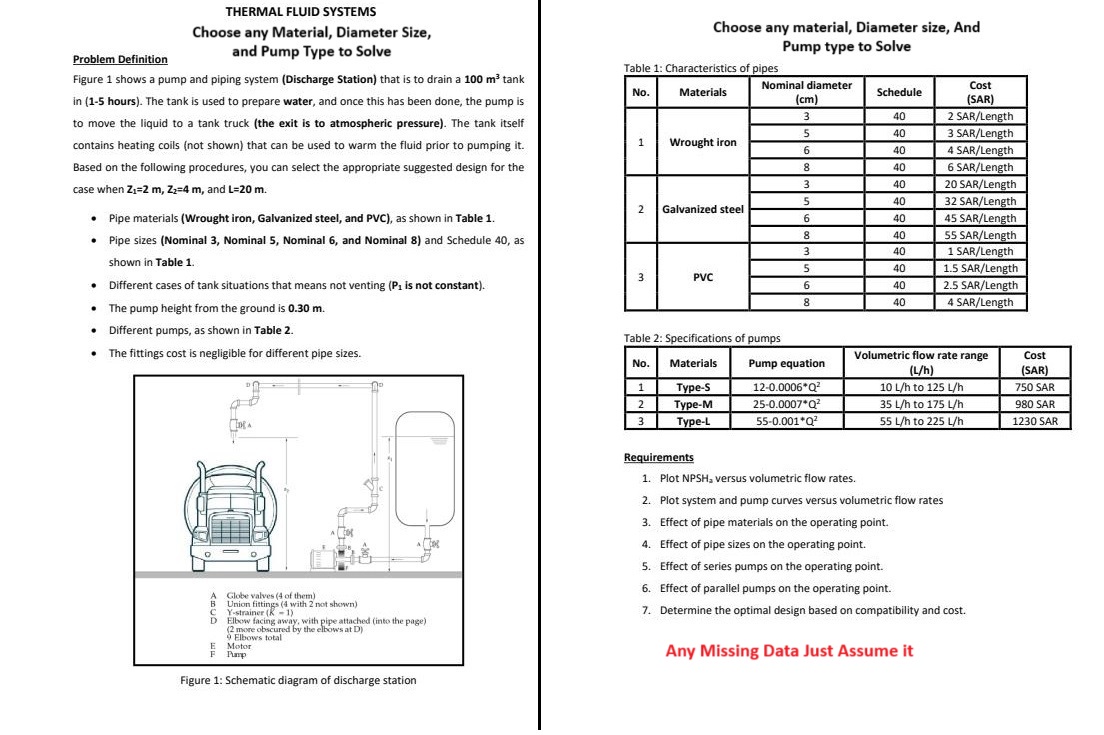
Question: THERMAL FLUID SYSTEMS Choose any Material, Diameter Size, and Pump Type to Solve Problem Definition Figure 1 shows a pump and piping system ( Discharge
THERMAL FLUID SYSTEMS
Choose any Material, Diameter Size, and Pump Type to Solve
Problem Definition
Figure shows a pump and piping system Discharge Station that is to drain a mathbfmathbfmmathbf tank in hours The tank is used to prepare water, and once this has been done, the pump is to move the liquid to a tank truck the exit is to atmospheric pressure The tank itself contains heating coils not shown that can be used to warm the fluid prior to pumping it Based on the following procedures, you can select the appropriate suggested design for the case when mathrmZmathbf ~ mmathrmZmathbfmathbfm and mathrmLmathbfmathrmm
Pipe materials Wrought iron, Galvanized steel, and PVC as shown in Table
Pipe sizes Nominal Nominal Nominal and Nominal and Schedule as shown in Table
Different cases of tank situations that means not venting mathbfPmathbf is not constant
The pump height from the ground is mathbf ~ m
Different pumps, as shown in Table
The fittings cost is negligible for different pipe sizes.
Choose any material, Diameter size, And Pump type to Solve
Table : Characteristics of pipes
Table : Specifications of pumps
Requirements
Plot mathrmNPSH versus volumetric flow rates.
Plot system and pump curves versus volumetric flow rates
Effect of pipe materials on the operating point.
Effect of pipe sizes on the operating point.
Effect of series pumps on the operating point.
Effect of parallel pumps on the operating point.
Determine the optimal design based on compatibility and cost.
Any Missing Data Just Assume it
Step by Step Solution
There are 3 Steps involved in it
1 Expert Approved Answer
Step: 1 Unlock

Question Has Been Solved by an Expert!
Get step-by-step solutions from verified subject matter experts
Step: 2 Unlock
Step: 3 Unlock