Question: **** thes is a q1)(((We discussed 8 orientations regarding ethics and the environment. Discuss which of these orientations would fit with your own orientation, and
**** thes is a q1)(((We discussed 8 orientations regarding ethics and the environment. Discuss which of these orientations would fit with your own orientation, and why. Discuss how your environmental orientation relates to your values, morals, beliefs, attitudes, and behaviours. Note: it is not about which is the best orientation, it is about being able to identify and explain your own.
)))))
note***
above you can find the question and attached you can find the orientations that you can use to answer it I please please choose two of them and discuss it as you talk about me you have to write a 200 words
thanks in advance
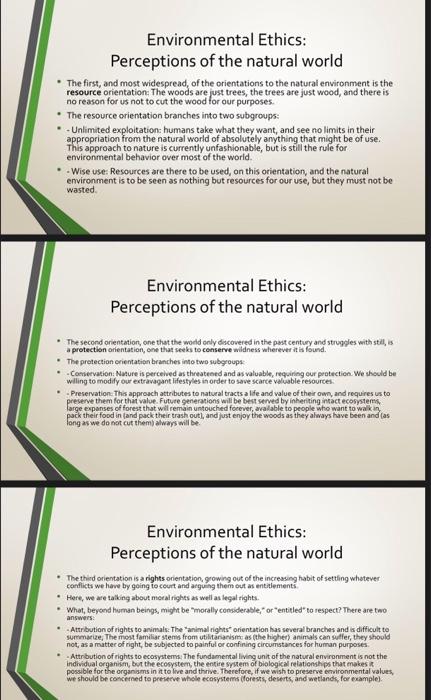
Environmental Ethics: Perceptions of the natural world The first, and most widespread of the orientations to the natural environment is the resource orientation: The woods are just trees, the trees are just wood, and there is no reason for us not to cut the wood for our purposes. . The resource orientation branches into two subgroups: . Unlimited exploitation: humans take what they want, and see no limits in their appropriation from the natural world of absolutely anything that might be of use. This approach to nature is currently unfashionable, but is still the rule for environmental behavior over most of the world. ..Wise use: Resources are there to be used on this orientation, and the natural environment is to be seen as nothing but resources for our use, but they must not be wasted Environmental Ethics: Perceptions of the natural world The second orientation, one that the world only discovered in the past century and struggles with stills a protection orientation, one that seeks to conserve wildness wherever it is found. . The protection orientation branches into two subgroups ..Conservation Nature is perceived as threatened and as valuable, requiring our protection. We should be willing to modify ou extravagant lifestyles in order to save scarce valuable resources Preservation. This approach attributes to natural tracts a life and value of their own, and requires us to preserve them for that value. Future generations will be best served by inheriting intact ecosystems, large expanses of forest that will remain untouched forever, available to people who want to walk in pack their food in (and pack their trash out), and just enjoy the woods as they always have been and las long as we do not cut them always will be Environmental Ethics: Perceptions of the natural world The third orientation is a rights orientation growing out of the increasing habit of setting whatever conflicts we have by going to court and arguing them out as entitlements Here, we are talking about moral rights as well as legal rights. What, beyond human beings, might be morally considerable," or "entitled to respect? There are two answers Attribution of rights to animals. The animal rights orientation has several branches and is difficult to summarize The most familiar stems from utilitarism as the higher) animals can suffer, they should not, as a matter of right, be subjected to painful or confining circumstances for human purposes. - Attribution of rights to ecosystems: The fundamental living unit of the natural environment is not the individual organism, but the ecosystem, the entire system of biological relationships that makes it possible for the organisms in it to live and thrive. Therefore, if we wish to preserve environmental values, we should be concerned to preserve whole ecosystems forests, deserts, and wetlands, for example)




