these just for the first Q
this is the case for all 4 Q
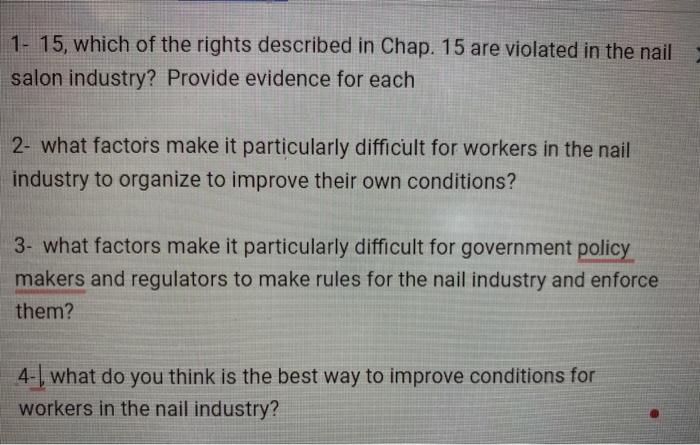
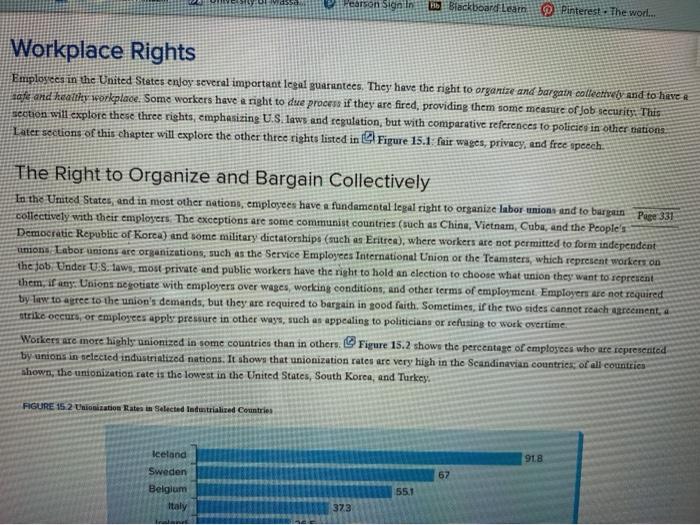
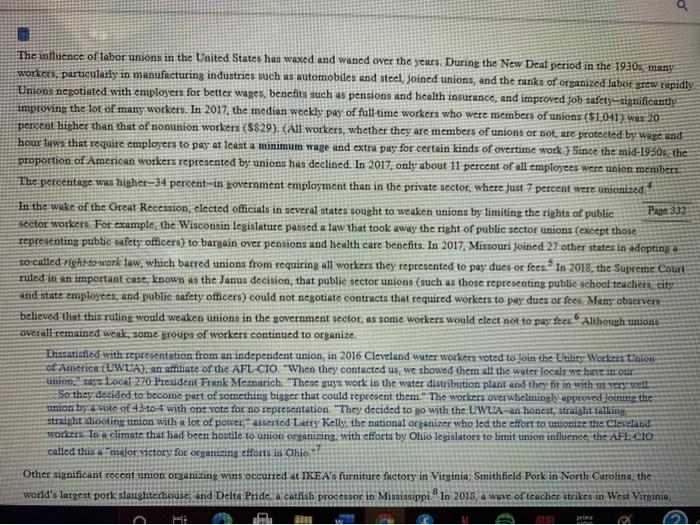
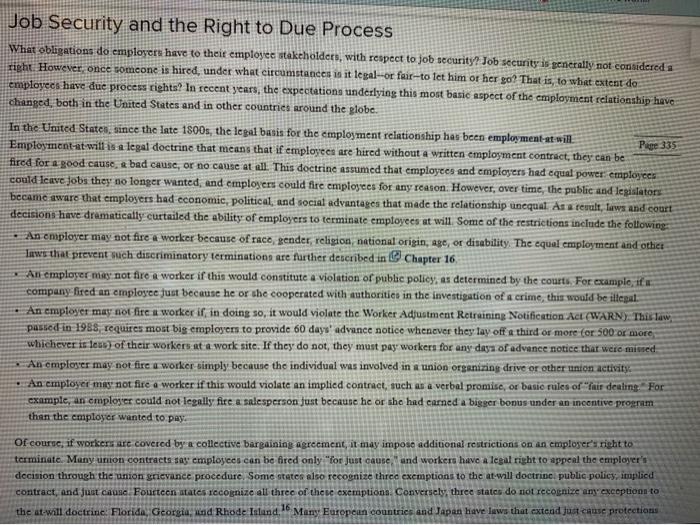
1- 15, which of the rights described in Chap. 15 are violated in the nail salon industry? Provide evidence for each 2- what factors make it particularly difficult for workers in the nail industry to organize to improve their own conditions? 3- what factors make it particularly difficult for government policy makers and regulators to make rules for the nail industry and enforce them? 4., what do you think is the best way to improve conditions for workers in the nail industry? carson Sign in 10 Blackboard Learn Pinterest - The worl... Workplace Rights Employees in the United States enjoy several important legal guarantees. They have the right to organize and bargain collectively and to have a safe and healthy workplace. Some workers have a right to due proces if they are fired, providing them some measure of Job security. This section will explore these three rights, emphasizing US laws and regulation, but with comparative references to policies in other nations Later sections of this chapter will explore the other three rights listed in Figure 15.1 fair wages, privacy, and free speech. The Right to Organize and Bargain Collectively In the United States, and in most other nations, employees have a fundamental legal right to organize labor unions and to bargain Page 331 collectively with their employers. The exceptions are some communist countries (such as China, Vietnam, Cuba, and the People's Democratic Republic of Korea) and some military dictatorships (such as Eritrea), where workers are not permitted to form independent umons Labor unions are organizations, such as the Service Employees International Union or the Teamsters, which represent workers on the job Unda U:Sawy, most private and public workers have the right to hold an election to choose what union they want to represent them, if any: Unions negotiate with employers over wages, working conditions, and other terms of employment Employers are not required by law to agree to the union's demands, but they are required to bargain in good faith. Sometimes, if the two sides cannot reach agreement stelke occurs, or employees appl premure in other ways, such as appealing to politicians or refusing to work overtime. Workers are more highly unionized in some countries than in others. Figure 15.2 shows the percentage of employees who are represented by unions in selected industrialized nations. It shows that unionization rates are very high in the Scandinavian countries of all countties shown, the unionization rate in the lowest in the United States, South Korea, and Turkey. FIGURE 15.2 Unionization Rates in selected industrialized Countries 918 Iceland Sweden 67 55.1 Belgium Italy 323 The influence of labor unions in the United States has waxed and waned over the years. During the New Deal period in the 1930s, many workers, particularly in manufacturing industries such as automobiles and steel, joined unions, and the ranks of organized labor grew rapidly Unions negotiated with employers for better wages, benefits such as pensions and health insurance, and improved job safety significantly improving the lot of many workers. In 2017, the median weekly pay of full-time workers who were mernbers of unions ($1.041) was 20 percent higher than that of nonunion workers ($829). (All workers, whether they are members of unions or not, are protected by wage and hour laws that require employers to pay at least a minimum wage and extra pay for certain kinds of overtime work.) Since the mid-1950s, the proportion of American workers represented by unions has declined. In 2017, only about 11 percent of all employees were union members The percentage was higher-34 percent-in government employment than in the private sector, where just 7 percent were unionized! In the wake of the Great Recession, elected officials in several states tought to weaken unions by limiting the rights of public Page 332 Sector workers. For example, the Wisconsin legislature passed a law that took away the right of public sector unions (except those representing public safety officers) to bargain over pensions and health care benefits. In 2017, Missouri joined 27 other states in adopting a to called right-to-wark law, which barred unions from requiring all workers they represented to pay dues or fees. In 2018, the Supreme Court ruted in an important case, known as the Janus decision, that public sector union (such as those representing public school teachers city and state employees, and public safety officers) could not negotiato contracts that required workers to per dues or fees Many observers believed that this ruling would weaken unions in the government sector, as some workers would elect not to pay fees. Although unions Overall remained weak, same groups of workers continued to organize Thistatisfied with representation from an independent union in 2016 Cleveland water work to voted to join the Utility Workers Union of Ametice (UWLA), an affiliate of the AFL-CIO "When they contacted us, we showed them all the water locals we have in our union, masa Local 270 President Frank Meznarich. "These guys work in the water distribution plant and they fit in with a very well So they decided to become part of something bigger that could represent them." The workers overwhelmingly approved Joining the union by a vote of 43 to 4 with one vote for no representation. "They decided to go with the UWLA-an honest, straight talking straight shooting union with a lot of power, assented Larry Kelly, the national organizer who led the effort to unionize the Cleveland workers to a climate that had been hostile to union organizing, with efforts by Ohio legislators to limit union influence the AFL CIO called this a major victory for organizing efforts in Ohio Other significant recent union organizing wins occurred at IKEA's furniture factory in Virginia Smithfield Pork in North Carolina, the world's largest pork slaughterhouse and Delta Pride, eatfish processor in Mississippi In 2018, a wave of teacher strikes in West Virginia Job Security and the Right to Due Process What obligations do employers have to their employee stakeholders, with respect to job security? Job security is generally not considered a right. However, once someone is hired, under what circumstances in it legal--or fair-to let him or her go? That is, to what extent do employees have due process rights? In recent years, the expectations underlying this most basic aspect of the employment relationship have changed, both in the United States and in other countries around the globe. In the United States, since the late 1800s, the legal basis for the employment relationship has been employment-at-will Page 335 Employment-at will is a legal doctrine that means that if employees are hired without a written employment contract, they can be fired for a good cause, s bad cause, or no cause at all. This doctrine assumed that employees and employers had equal power employees could leave jobs they no longer wanted, and employers could fire employees for any reason. However, over time, the public and legislators became aware that employers had economic, political and social advantages that made the relationship unequal. As a revult, laws and court decisions have dramatically curtaited the ability of employers to terminate employees at will. Some of the restrictions include the following: An employer may not fire & worker because of race, gender, religion, national origin, age, or disability. The equal employment and othiet laws that prevent such discriminatory terminations are further described in Chapter 16 An employer may not fire a worker if this would constitute a violation of public policy, as determined by the courts. For example, it's company fired an employee just because he or she cooperated with authorities in the investigation of a crime, this would be iltepat. An employer may not fire a worker if in doing so, it would violate the Worker Adjustment Retraining Notification A (WARN) This law, passed in 1988 requires most big employees to provide 60 days' advance notice whenever they lay off a third or more for 500 or more whichever is deus) of their workers at work site. If they do not, they mast pay workers for any days of advance notice that were mined An employer may not fire u worker simply because the individual was involved in a union organizing drive or other unton activity An employer may not fire a worker if this would violate an implica contract, such as a verbal promise, or basic rules of "fair dealing For example, an employer could not legally fite a salesperson just because he or she had carned a bigger bonus under an incentive program than the employer wanted to pay. Of course, if workers are covered by a collective bargaining agreement, it may impose additional restrictions on an employer's right to terminate. Many union contracts as employees can be fired only "for just cause and workers have a legal right to appeal the employer's decision through the union grievance procedure. Some states also recognize three exemptions to the at will doctrine public policy, implied contract, and just cause. Fourteen states recognize all three of these exemptions Conversely, three states do not recognize any exception to the at-wall doctrine. Florida Georgia, wd Rhode Island. 16 Many European countries and Japan have laws that extend just cause protection the world Discussion Case: The Ugly Side of Beautiful Nails For many people going to a nail salon for a manicure or pedicure is a small, affordable luxury and a pleasant way to relax. For workers in these salons, however, the story is often less glamorous low pay, abusive working conditions, and constant exposure to dangerous chemicals that threaten to ruin their health Nail care is very popular. In 2017, women (and some men) spent more than $8 billion a year on nail care at around 200,000 naut salons across the nation. The publisher of the magazine Nalts explained the phenomenon this way: "Nail care isn't just about grootting anymore it's self-expression. Just as tattoos have become mainstream, nail art has too." Technical innovations such as gel polishes, which last longer katid arc casier to remove also drove the trend. For most customers, the price of the service-averaging less than $20 for a manicure-war case to fit into their budgets. Who were the manicurists and pedicurists laboring over all these hands and feet? According to Natla, 350,000 people worked in nail salons in the United States Ninety-four percent were women Over half were Vietnamese, although ethnicity varied by location in New York City for example, Koreans dominated the industry. Many workers had limited English proficienes, and a significant proportion were undocumented immigrants Wages were very low According to government data, the median annual ware for a manicurist was $19,620 Only quarter of the 100 workers interviewed by a reporter for The New York Timer said they had been paid the equivalent of the state minimum wage. The Promes" expos alvo reported that sometimes workers were not paid at all many new workers were required to preso called training fee and to work without wages during an apprenticeship period. Overtime pay was almost unheard of the newspaper found, even though long work dayr und wecka were commonplace. Natta magazine reported that more than a fifth of nail salon workers' income came from tips, which relied entirely on the goodwill of customers Most salons were small Barriers to entry were low: an operator could set up business by renting a storefront and investing a few thousand dollara in furnishings, equipment, and supplies. Eighty-one percent of manicurists and pedicurists worked in a shop with three or fewer technicians. The industry was highly competitive, and salons went in and out of business frequently Nail technicians worked with polishes, solvents, hardeners, and glues that caused respiratory and skin ailments, reproductive harm, and even cancer. Although occupational health in nail salons had not been fully studied, the three most dangerous chemicals used there were believed to be toluene (which made polish glide on smoothly), dibutyl phthalate (which made it pliable), and formaldehyde (which hardened it). Workers also inhaled acrylic dust, acquired fungal infections from customer hands and feet: and injured their backs, necks, and shoulders from constant repetitive motion. Nafis reported that more than half of nail technicians said they suffered from a work related ailment wage The Times expor also reported that sometimes workers were not paid at all, many new workers were required to pay a so-called training fee and to work without wages during an apprenticeship period. Overtime pay was almost unheard of the newspaper found, even though tong work days and weeks were commonplace. Nails magazine reported that more than fifth of nail salon workers income came from tips, which relied cntircise on the goodwill of customers Most salons were amall Barriers to entry were low: an operator could set up business by renting a storefront and investing it few thousand dollars in furnishings, equipment, and supplics. Eighty-onc percent of manicurists and pedicurists worked in a shop with three or fewer technicians. The industry was highly competitive, and salons went in and out of business frequently Nail technicians worked with polishes, solvents, hardeners, and glues that caused respiratory and skin ailments, reproductive harm, and even cincer. Although occupational health in nail salons had not been fully studied, the three most dangerous chemicals used there were believed to be toluene (which made potich glide on smoothly), dibutyt phthalate (which made it pliable), and formaldchyde (which hardened it) Workers also inhaled acrylic dust required fungal infections from customers' hands and feet and injured their backs, necks, and shoulders from constant repetitive motion. Naita reported that more than half of nail technicians said they suffered from work related ailment The Occupational Safety and Health Administration set standards for workplace exposure to many of the chemicals used in rail ratong and urged workers to wear protective gear like gloves and masks and to properly ventilate their salona. States also set safety and health rute Box aura practical matter these rules were routinely ignored, and inspections were conducted only in response to specific comptaints. In New York, in the wake of the expos published by The New York Times, officials rushed to assemble ask force to address conditions in the industry and said they would post a manicurist's "bill of rights" in 10 languages in every salon, describing minimum wage laws and required safety measures. "We will not stand idly by as workers are deprived of their hard-earned wages and robbed of their most banc rights said the governor of New York. But it was unclear how much impact these measures would have. One official observed that manicurists were particularly reluctant to cooperate with investigators, saying, "They are totally running scared in this industry SourcesThe Price of Nice Nail The New York Times, Atas: 7. 2015, "Perfect Nails, Poisoned Workers, The New York Times May 1, 2018 uomo Onder med Measures to Protect Workers at Naa Salone. The res, May 11, 2015: "New York Salons Now Required to Pout Workert Bal of Rights, The MG 29 2015, California Health Nail Salon Collaborative, Onerexposed and thereformed Diomantting Barriers is Halk and Sin Carte Na Ston April 2009 and 04-2011 Nalle Ba Hook at ttp://findia.com/M MILS Magadhe-Book 2014 pdr Wage data are from the area of Labor Statistical Page 319 FP