







Question: this article which provides some loyalty statistics. I don't expect you to read all 40 stats, but randomly pick 2 customer loyalty stats that you
 this article which provides some loyalty statistics.
I don't expect you to read all 40 stats, but randomly pick 2 customer loyalty stats that you can relate to and relate them to your experiences (as someone who sells or provides customer service or as a consumer).
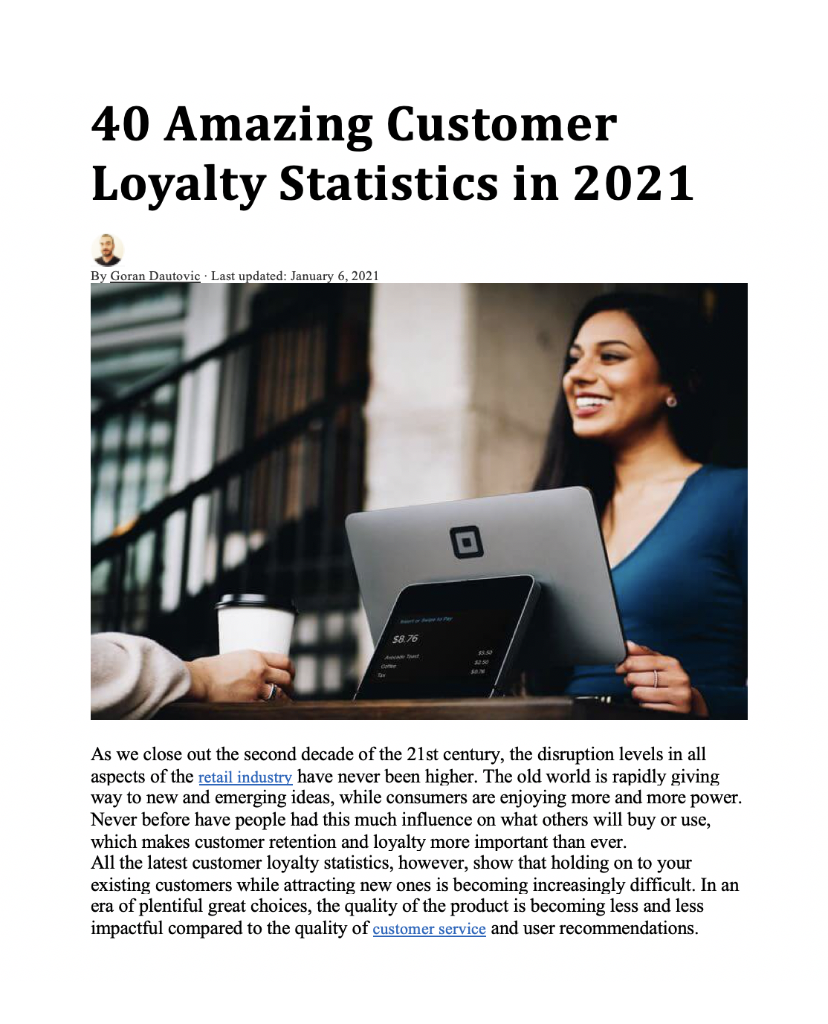
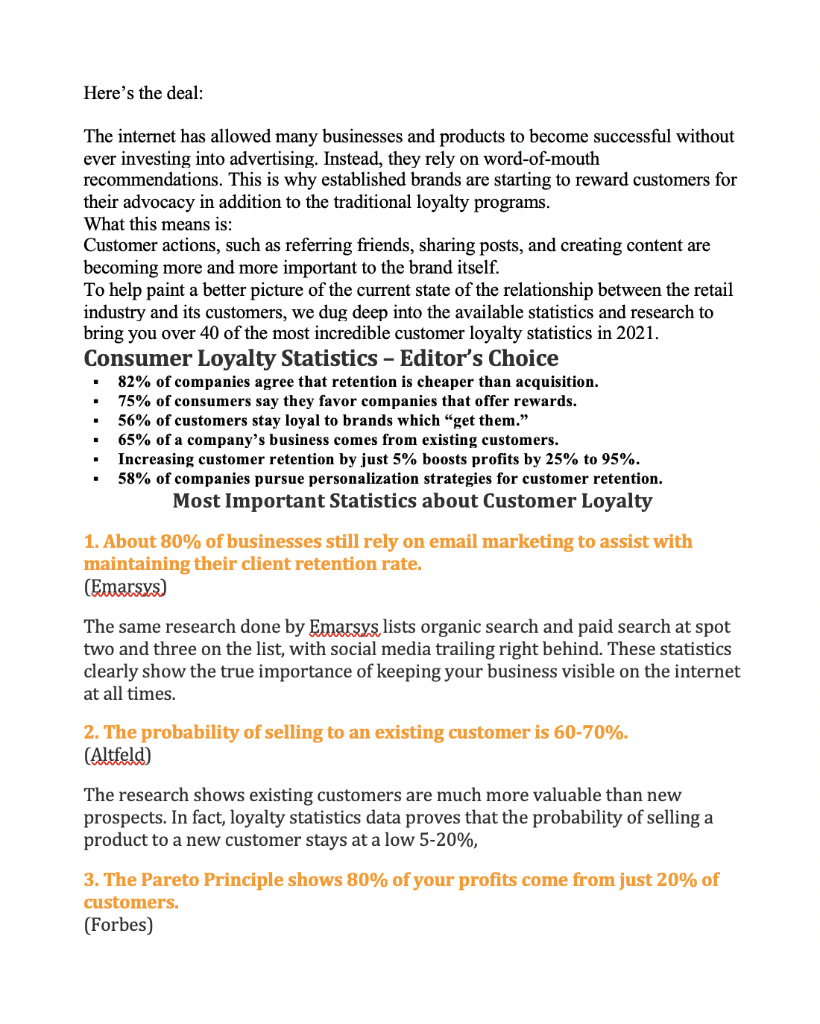
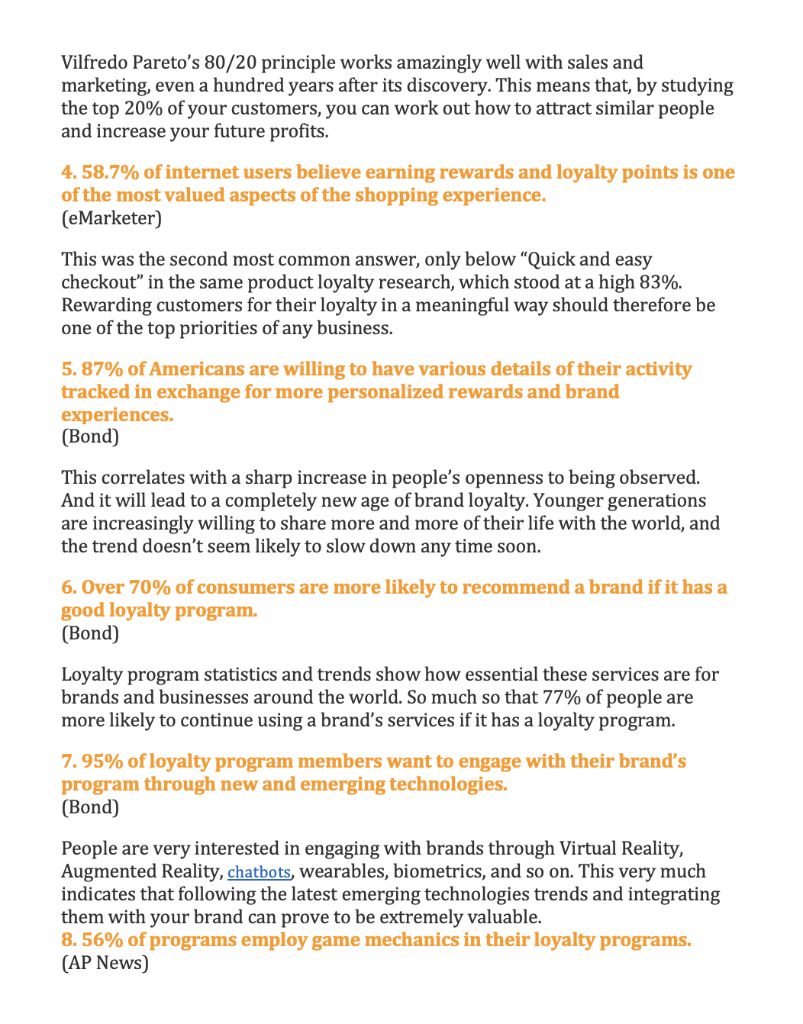
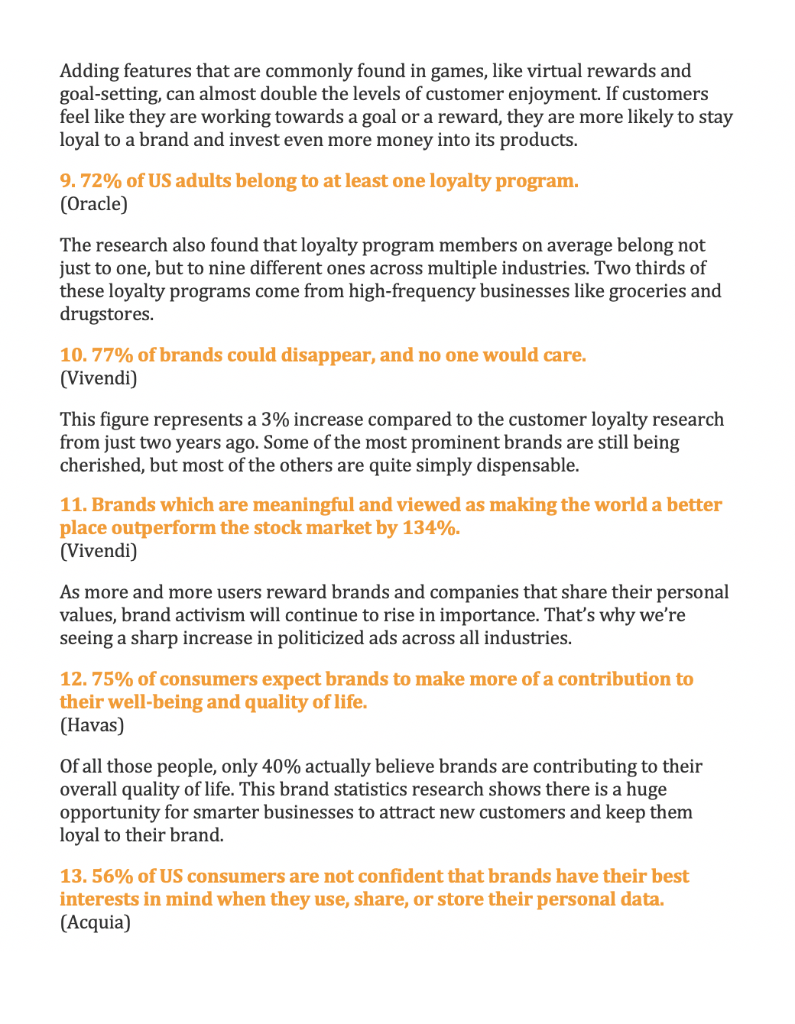
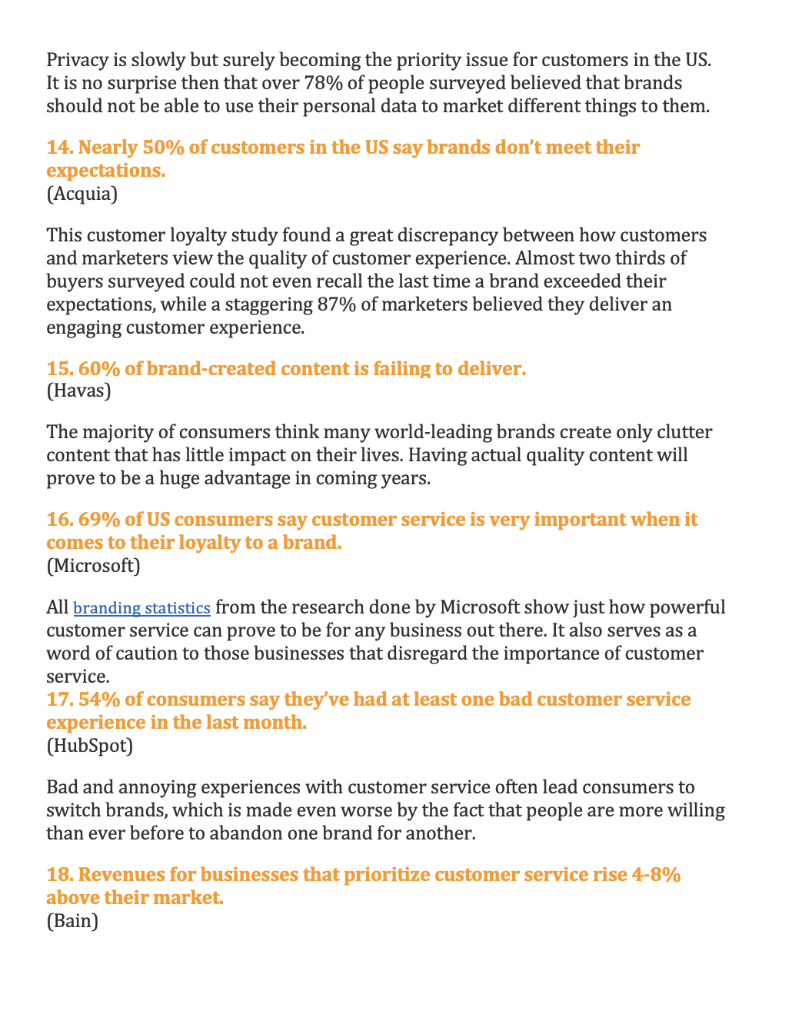
40 Amazing Customer Loyalty Statistics in 2021 By Goran Dautovic Last updated: January 6, 2021 S8.76 39 As we close out the second decade of the 21st century, the disruption levels in all aspects of the retail industry have never been higher. The old world is rapidly giving way to new and emerging ideas, while consumers are enjoying more and more power. Never before have people had this much influence on what others will buy or use, which makes customer retention and loyalty more important than ever. All the latest customer loyalty statistics, however, show that holding on to your existing customers while attracting new ones is becoming increasingly difficult. In an era of plentiful great choices, the quality of the product is becoming less and less impactful compared to the quality of customer service and user recommendations. Here's the deal: The internet has allowed many businesses and products to become successful without ever investing into advertising. Instead, they rely on word-of-mouth recommendations. This is why established brands are starting to reward customers for their advocacy in addition to the traditional loyalty programs. What this means is: Customer actions, such as referring friends, sharing posts, and creating content are becoming more and more important to the brand itself. To help paint a better picture of the current state of the relationship between the retail industry and its customers, we dug deep into the available statistics and research to bring you over 40 of the most incredible customer loyalty statistics in 2021. Consumer Loyalty Statistics - Editor's Choice 82% of companies agree that retention is cheaper than acquisition. 75% of consumers say they favor companies that offer rewards. 56% of customers stay loyal to brands which "get them." 65% of a company's business comes from existing customers. Increasing customer retention by just 5% boosts profits by 25% to 95%. 58% of companies pursue personalization strategies for customer retention. Most Important Statistics about Customer Loyalty . . 1. About 80% of businesses still rely on email marketing to assist with maintaining their client retention rate. (Emarsys) The same research done by Emarsys lists organic search and paid search at spot two and three on the list, with social media trailing right behind. These statistics clearly show the true importance of keeping your business visible on the internet at all times. 2. The probability of selling to an existing customer is 60-70%. (Altfeld) The research shows existing customers are much more valuable than new prospects. In fact, loyalty statistics data proves that the probability of selling a product to a new customer stays at a low 5-20%, 3. The Pareto Principle shows 80% of your profits come from just 20% of customers. (Forbes) Vilfredo Pareto's 80/20 principle works amazingly well with sales and marketing, even a hundred years after its discovery. This means that, by studying the top 20% of your customers, you can work out how to attract similar people and increase your future profits. 4.58.7% of internet users believe earning rewards and loyalty points is one of the most valued aspects of the shopping experience. (eMarketer) This was the second most common answer, only below "Quick and easy checkout in the same product loyalty research, which stood at a high 83%. Rewarding customers for their loyalty in a meaningful way should therefore be one of the top priorities of any business. 5. 87% of Americans are willing to have various details of their activity tracked in exchange for more personalized rewards and brand experiences. (Bond) This correlates with a sharp increase in people's openness to being observed. And it will lead to a completely new age of brand loyalty. Younger generations are increasingly willing to share more and more of their life with the world, and the trend doesn't seem likely to slow down any time soon. 6. Over 70% of consumers are more likely to recommend a brand if it has a good loyalty program. (Bond) Loyalty program statistics and trends show how essential these services are for brands and businesses around the world. So much so that 77% of people are more likely to continue using a brand's services if it has a loyalty program. 7.95% of loyalty program members want to engage with their brand's program through new and emerging technologies. (Bond) People are very interested in engaging with brands through Virtual Reality, Augmented Reality, chatbots, wearables, biometrics, and so on. This very much indicates that following the latest emerging technologies trends and integrating them with your brand can prove to be extremely valuable. 8.56% of programs employ game mechanics in their loyalty programs. (AP News) Adding features that are commonly found in games, like virtual rewards and goal-setting, can almost double the levels of customer enjoyment. If customers feel like they are working towards a goal or a reward, they are more likely to stay loyal to a brand and invest even more money into its products. 9.72% of US adults belong to at least one loyalty program. (Oracle) The research also found that loyalty program members on average belong not just to one, but to nine different ones across multiple industries. Two thirds of these loyalty programs come from high-frequency businesses like groceries and drugstores. 10.77% of brands could disappear, and no one would care. (Vivendi) This figure represents a 3% increase compared to the customer loyalty research from just two years ago. Some of the most prominent brands are still being cherished, but most of the others are quite simply dispensable. 11. Brands which are meaningful and viewed as making the world a better place outperform the stock market by 134%. (Vivendi) As more and more users reward brands and companies that share their personal values, brand activism will continue to rise in importance. That's why we're seeing a sharp increase in politicized ads across all industries. 12. 75% of consumers expect brands to make more of a contribution to their well-being and quality of life. (Havas) Of all those people, only 40% actually believe brands are contributing to their overall quality of life. This brand statistics research shows there is a huge opportunity for smarter businesses to attract new customers and keep them loyal to their brand. 13. 56% of US consumers are not confident that brands have their best interests in mind when they use, share, or store their personal data. (Acquia) Privacy is slowly but surely becoming the priority issue for customers in the US. It is no surprise then that over 78% of people surveyed believed that brands should not be able to use their personal data to market different things to them. 14. Nearly 50% of customers in the US say brands don't meet their expectations. (Acquia) This customer loyalty study found a great discrepancy between how customers and marketers view the quality of customer experience. Almost two thirds of buyers surveyed could not even recall the last time a brand exceeded their expectations, while a staggering 87% of marketers believed they deliver an engaging customer experience. 15.60% of brand-created content is failing to deliver. (Havas) The majority of consumers think many world-leading brands create only clutter content that has little impact on their lives. Having actual quality content will prove to be a huge advantage in coming years. 16.69% of US consumers say customer service is very important when it comes to their loyalty to a brand. (Microsoft) All branding statistics from the research done by Microsoft show just how powerful customer service can prove to be for any business out there. It also serves as a word of caution to those businesses that disregard the importance of customer service. 17.54% of consumers say they've had at least one bad customer service experience in the last month. (HubSpot) Bad and annoying experiences with customer service often lead consumers to switch brands, which is made even worse by the fact that people are more willing than ever before to abandon one brand for another. 18. Revenues for businesses that prioritize customer service rise 4-8% above their market. (Bain) 40 Amazing Customer Loyalty Statistics in 2021 By Goran Dautovic Last updated: January 6, 2021 S8.76 39 As we close out the second decade of the 21st century, the disruption levels in all aspects of the retail industry have never been higher. The old world is rapidly giving way to new and emerging ideas, while consumers are enjoying more and more power. Never before have people had this much influence on what others will buy or use, which makes customer retention and loyalty more important than ever. All the latest customer loyalty statistics, however, show that holding on to your existing customers while attracting new ones is becoming increasingly difficult. In an era of plentiful great choices, the quality of the product is becoming less and less impactful compared to the quality of customer service and user recommendations. Here's the deal: The internet has allowed many businesses and products to become successful without ever investing into advertising. Instead, they rely on word-of-mouth recommendations. This is why established brands are starting to reward customers for their advocacy in addition to the traditional loyalty programs. What this means is: Customer actions, such as referring friends, sharing posts, and creating content are becoming more and more important to the brand itself. To help paint a better picture of the current state of the relationship between the retail industry and its customers, we dug deep into the available statistics and research to bring you over 40 of the most incredible customer loyalty statistics in 2021. Consumer Loyalty Statistics - Editor's Choice 82% of companies agree that retention is cheaper than acquisition. 75% of consumers say they favor companies that offer rewards. 56% of customers stay loyal to brands which "get them." 65% of a company's business comes from existing customers. Increasing customer retention by just 5% boosts profits by 25% to 95%. 58% of companies pursue personalization strategies for customer retention. Most Important Statistics about Customer Loyalty . . 1. About 80% of businesses still rely on email marketing to assist with maintaining their client retention rate. (Emarsys) The same research done by Emarsys lists organic search and paid search at spot two and three on the list, with social media trailing right behind. These statistics clearly show the true importance of keeping your business visible on the internet at all times. 2. The probability of selling to an existing customer is 60-70%. (Altfeld) The research shows existing customers are much more valuable than new prospects. In fact, loyalty statistics data proves that the probability of selling a product to a new customer stays at a low 5-20%, 3. The Pareto Principle shows 80% of your profits come from just 20% of customers. (Forbes) Vilfredo Pareto's 80/20 principle works amazingly well with sales and marketing, even a hundred years after its discovery. This means that, by studying the top 20% of your customers, you can work out how to attract similar people and increase your future profits. 4.58.7% of internet users believe earning rewards and loyalty points is one of the most valued aspects of the shopping experience. (eMarketer) This was the second most common answer, only below "Quick and easy checkout in the same product loyalty research, which stood at a high 83%. Rewarding customers for their loyalty in a meaningful way should therefore be one of the top priorities of any business. 5. 87% of Americans are willing to have various details of their activity tracked in exchange for more personalized rewards and brand experiences. (Bond) This correlates with a sharp increase in people's openness to being observed. And it will lead to a completely new age of brand loyalty. Younger generations are increasingly willing to share more and more of their life with the world, and the trend doesn't seem likely to slow down any time soon. 6. Over 70% of consumers are more likely to recommend a brand if it has a good loyalty program. (Bond) Loyalty program statistics and trends show how essential these services are for brands and businesses around the world. So much so that 77% of people are more likely to continue using a brand's services if it has a loyalty program. 7.95% of loyalty program members want to engage with their brand's program through new and emerging technologies. (Bond) People are very interested in engaging with brands through Virtual Reality, Augmented Reality, chatbots, wearables, biometrics, and so on. This very much indicates that following the latest emerging technologies trends and integrating them with your brand can prove to be extremely valuable. 8.56% of programs employ game mechanics in their loyalty programs. (AP News) Adding features that are commonly found in games, like virtual rewards and goal-setting, can almost double the levels of customer enjoyment. If customers feel like they are working towards a goal or a reward, they are more likely to stay loyal to a brand and invest even more money into its products. 9.72% of US adults belong to at least one loyalty program. (Oracle) The research also found that loyalty program members on average belong not just to one, but to nine different ones across multiple industries. Two thirds of these loyalty programs come from high-frequency businesses like groceries and drugstores. 10.77% of brands could disappear, and no one would care. (Vivendi) This figure represents a 3% increase compared to the customer loyalty research from just two years ago. Some of the most prominent brands are still being cherished, but most of the others are quite simply dispensable. 11. Brands which are meaningful and viewed as making the world a better place outperform the stock market by 134%. (Vivendi) As more and more users reward brands and companies that share their personal values, brand activism will continue to rise in importance. That's why we're seeing a sharp increase in politicized ads across all industries. 12. 75% of consumers expect brands to make more of a contribution to their well-being and quality of life. (Havas) Of all those people, only 40% actually believe brands are contributing to their overall quality of life. This brand statistics research shows there is a huge opportunity for smarter businesses to attract new customers and keep them loyal to their brand. 13. 56% of US consumers are not confident that brands have their best interests in mind when they use, share, or store their personal data. (Acquia) Privacy is slowly but surely becoming the priority issue for customers in the US. It is no surprise then that over 78% of people surveyed believed that brands should not be able to use their personal data to market different things to them. 14. Nearly 50% of customers in the US say brands don't meet their expectations. (Acquia) This customer loyalty study found a great discrepancy between how customers and marketers view the quality of customer experience. Almost two thirds of buyers surveyed could not even recall the last time a brand exceeded their expectations, while a staggering 87% of marketers believed they deliver an engaging customer experience. 15.60% of brand-created content is failing to deliver. (Havas) The majority of consumers think many world-leading brands create only clutter content that has little impact on their lives. Having actual quality content will prove to be a huge advantage in coming years. 16.69% of US consumers say customer service is very important when it comes to their loyalty to a brand. (Microsoft) All branding statistics from the research done by Microsoft show just how powerful customer service can prove to be for any business out there. It also serves as a word of caution to those businesses that disregard the importance of customer service. 17.54% of consumers say they've had at least one bad customer service experience in the last month. (HubSpot) Bad and annoying experiences with customer service often lead consumers to switch brands, which is made even worse by the fact that people are more willing than ever before to abandon one brand for another. 18. Revenues for businesses that prioritize customer service rise 4-8% above their market. (Bain)Step by Step Solution
There are 3 Steps involved in it
1 Expert Approved Answer
Step: 1 Unlock

Question Has Been Solved by an Expert!
Get step-by-step solutions from verified subject matter experts
Step: 2 Unlock
Step: 3 Unlock
 Study Help