







Question: This assignment covers general equilibrium, oligopoly, and game theory. Please answer the ques- tions below, which are related to Chapters 12, 13, and 16 of
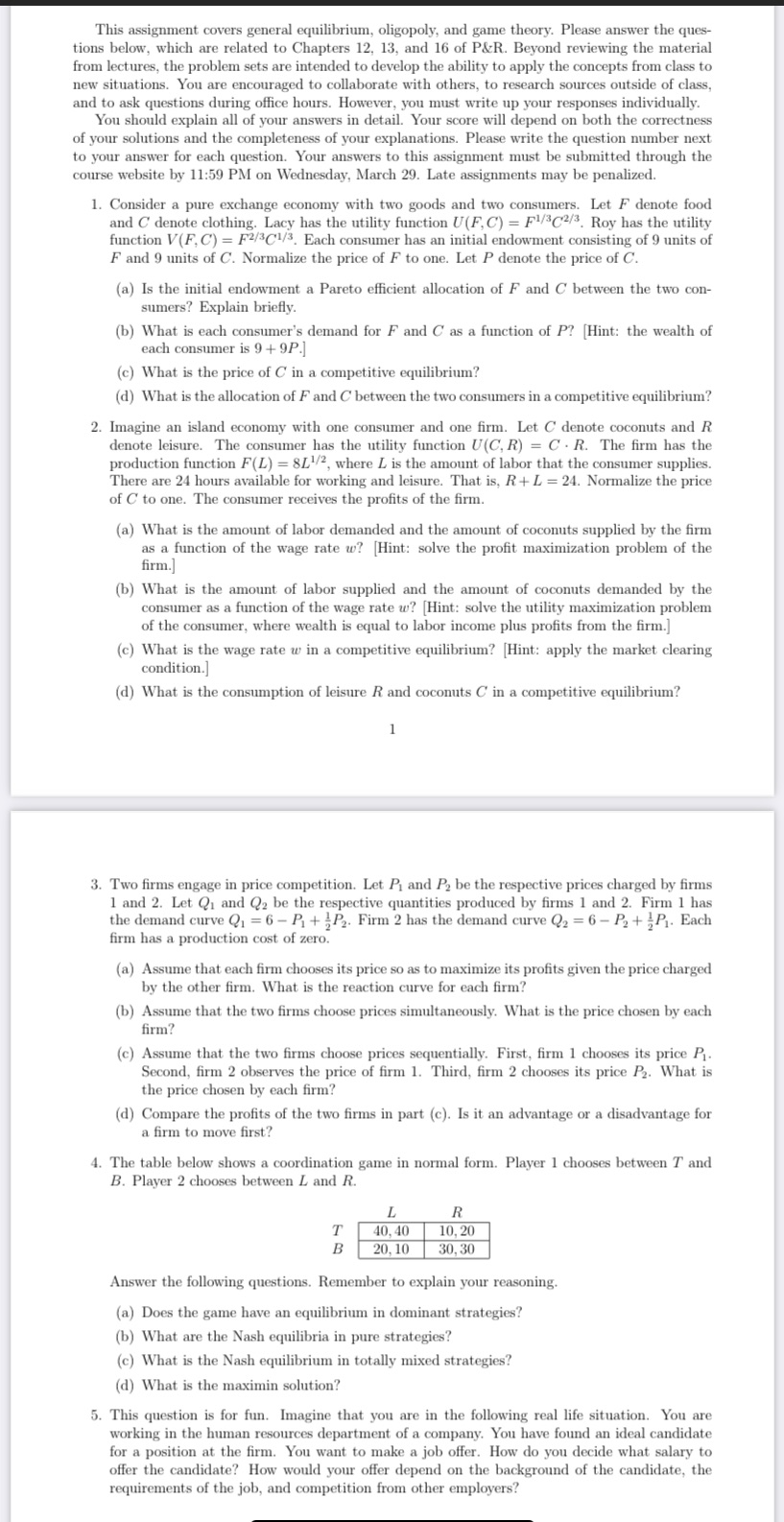
This assignment covers general equilibrium, oligopoly, and game theory. Please answer the ques- tions below, which are related to Chapters 12, 13, and 16 of P&R. Beyond reviewing the material from lectures, the problem sets are intended to develop the ability to apply the concepts from class to new situations. You are encouraged to collaborate with others, to research sources outside of class, and to ask questions during office hours. However, you must write up your responses individually. You should explain all of your answers in detail. Your score will depend on both the correctness of your solutions and the completeness of your explanations. Please write the question number next to your answer for each question. Your answers to this assignment must be submitted through the course website by 11:59 PM on Wednesday, March 29. Late assignments may be penalized. 1. Consider a pure exchange economy with two goods and two consumers. Let F denote food and C denote clothing. Lacy has the utility function U(F, C) = F1/SC2/3. Roy has the utility function V(F, C) = F2/3C1/3. Each consumer has an initial endowment consisting of 9 units of F and 9 units of C. Normalize the price of F to one. Let P denote the price of C. (a) Is the initial endowment a Pareto efficient allocation of F and C between the two con- sumers? Explain briefly. (b) What is each consumer's demand for F and C as a function of P? [Hint: the wealth of each consumer is 9 + 9P.] (c) What is the price of C in a competitive equilibrium? (d) What is the allocation of F and C between the two consumers in a competitive equilibrium? 2. Imagine an island economy with one consumer and one firm. Let C denote coconuts and R denote leisure. The consumer has the utility function U(C, R) = C . R. The firm has the production function F(L) = 8L /2, where L is the amount of labor that the consumer supplies. There are 24 hours available for working and leisure. That is, R + L = 24. Normalize the price of C to one. The consumer receives the profits of the firm. (a) What is the amount of labor demanded and the amount of coconuts supplied by the firm as a function of the wage rate w? Hint: solve the profit maximization problem of the firm. (b) What is the amount of labor supplied and the amount of coconuts demanded by the consumer as a function of the wage rate w? [Hint: solve the utility maximization problem of the consumer, where wealth is equal to labor income plus profits from the firm.] (c) What is the wage rate w in a competitive equilibrium? [Hint: apply the market clearing condition.] (d) What is the consumption of leisure R and coconuts C in a competitive equilibrium? 3. Two firms engage in price competition. Let Pi and P2 be the respective prices charged by firms 1 and 2. Let Q1 and Q2 be the respective quantities produced by firms 1 and 2. Firm 1 has the demand curve Q1 = 6 - P + 2P2. Firm 2 has the demand curve Q2 = 6 - P2 + 2P. Each firm has a production cost of zero. (a) Assume that each firm chooses its price so as to maximize its profits given the price charged by the other firm. What is the reaction curve for each firm? (b) Assume that the two firms choose prices simultaneously. What is the price chosen by each firm? (c) Assume that the two firms choose prices sequentially. First, firm 1 chooses its price P. Second, firm 2 observes the price of firm 1. Third, firm 2 chooses its price P2. What is the price chosen by each firm? (d) Compare the profits of the two firms in part (c). Is it an advantage or a disadvantage for a firm to move first? 4. The table below shows a coordination game in normal form. Player 1 chooses between T and B. Player 2 chooses between L and R. L R T 40, 40 10, 20 B 20, 10 30, 30 Answer the following questions. Remember to explain your reasoning. (a) Does the game have an equilibrium in dominant strategies? (b) What are the Nash equilibria in pure strategies? (c) What is the Nash equilibrium in totally mixed strategies? (d) What is the maximin solution? 5. This question is for fun. Imagine that you are in the following real life situation. You are working in the human resources department of a company. You have found an ideal candidate for a position at the firm. You want to make a job offer. How do you decide what salary to offer the candidate? How would your offer depend on the background of the candidate, the requirements of the job, and competition from other employers
Step by Step Solution
There are 3 Steps involved in it

Get step-by-step solutions from verified subject matter experts
 Study Help