



Question: This assignment is a generalization of the example of the publisher and reviewers, discussed in the textbook There is a publisher who needs to decide
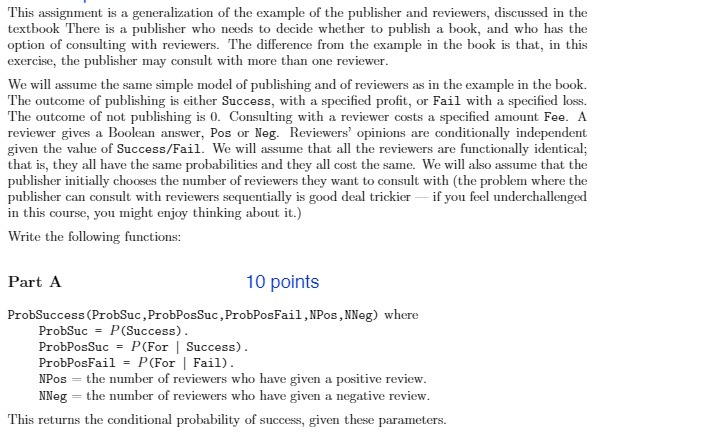
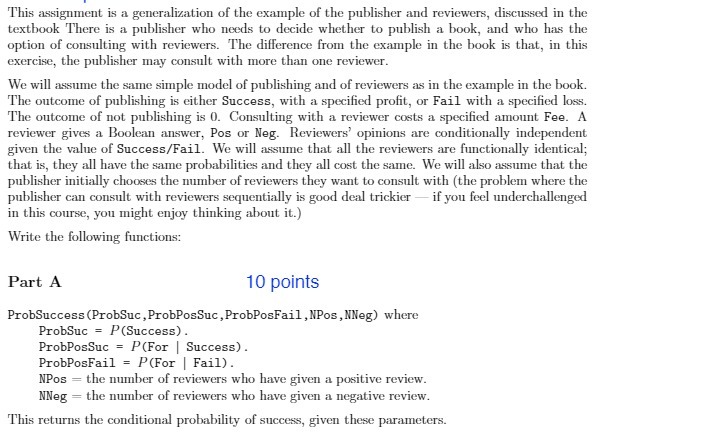
This assignment is a generalization of the example of the publisher and reviewers, discussed in the textbook There is a publisher who needs to decide whether to publish a book, and who has the option of consulting with reviewers. The difference from the example in the book is that, in this exercise, the publisher may consult with more than one reviewer. We will assume the same simple model of publishing and of reviewers as in the example in the book. The outcome of publishing is either Success, with a specified profit, or Fail with a specified loss. The outcome of not publishing is 0. Consulting with a reviewer costs a specified amount Fee. A reviewer gives a Boolean answer, Pos or Neg. Reviewers' opinions are conditionally independent given the value of Success/Fail. We will assume that all the reviewers are functionally identical; that is, they all have the same probabilities and they all cost the same. We will also assume that the publisher initially chooses the number of reviewers they want to consult with (the problem where the publisher can consult with reviewers sequentially is good deal trickier - if you feel underchallenged in this course, you might enjoy thinking about it.) Write the following functions: Part A 10 points ProbSuccess (ProbSuc, ProbPosSuc, ProbPosFail , NPos, NNeg) where ProbSuc = P(Success). ProbPosSuc = P(For | Success) . ProbPosFail = P(For | Fail). NPos = the number of reviewers who have given a positive review. NNeg = the number of reviewers who have given a negative review. This returns the conditional probability of success, given these parameters
Step by Step Solution
There are 3 Steps involved in it

Get step-by-step solutions from verified subject matter experts