







Question: this assignment is base on the pratical experiment .... the data should be done by tge student like timing etc.. is base of the rate
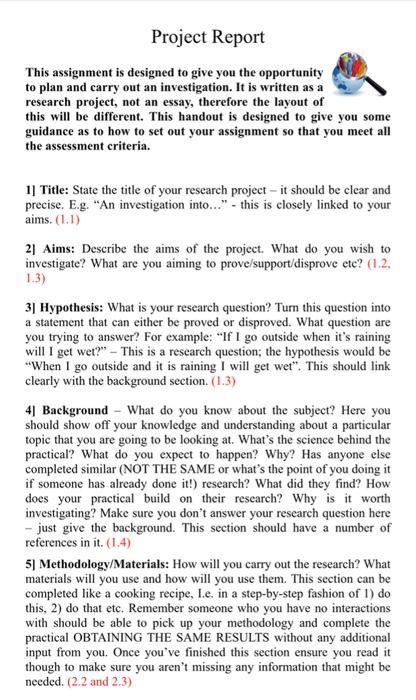
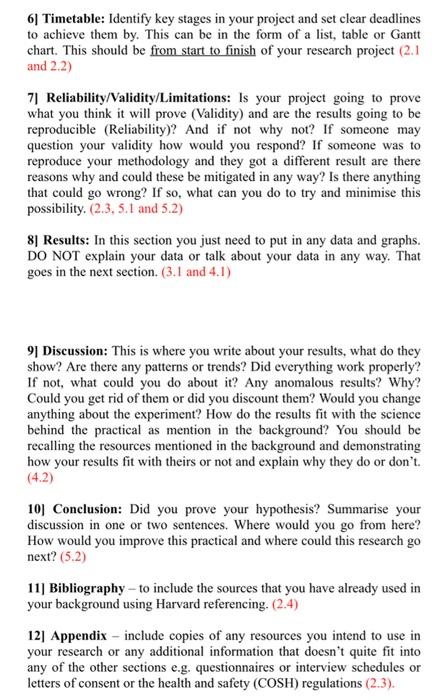
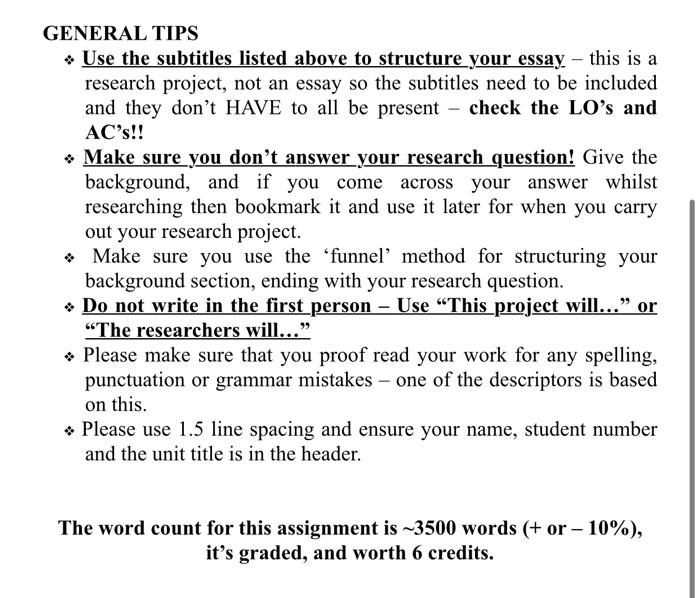
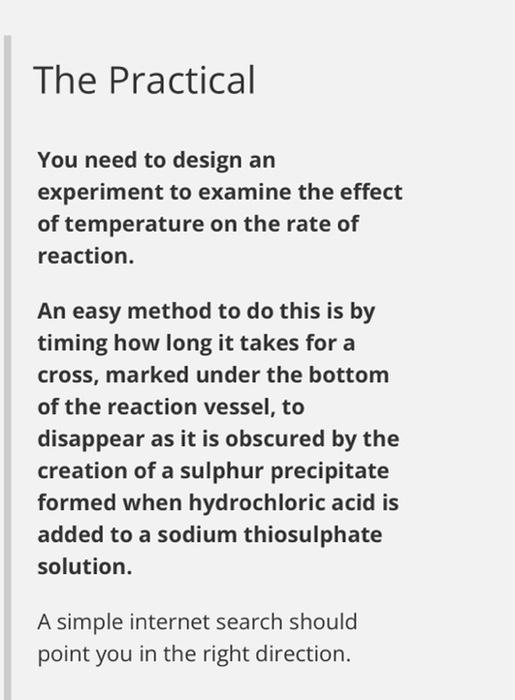
Project Report This assignment is designed to give you the opportunity to plan and carry out an investigation. It is written as a research project, not an essay, therefore the layout of this will be different. This handout is designed to give you some guidance as to how to set out your assignment so that you meet all the assessment criteria. 11 Title: State the title of your research project - it should be clear and precise. E.g. "An investigation into..." - this is closely linked to your aims. (1.1) 21 Aims: Describe the aims of the project. What do you wish to investigate? What are you aiming to prove/support/disprove etc? (1.2. 1.3) 3Hypothesis: What is your research question? Turn this question into a statement that can either be proved or disproved. What question are you trying to answer? For example: "If I go outside when it's raining will I get wet?" - This is a research question; the hypothesis would be When I go outside and it is raining I will get wet". This should link clearly with the background section (1.3) 41 Background - What do you know about the subject? Here you should show off your knowledge and understanding about a particular topic that you are going to be looking at. What's the science behind the practical? What do you expect to happen? Why? Has anyone else completed similar (NOT THE SAME or what's the point of you doing it if someone has already done it!) research? What did they find? How does your practical build on their research? Why is it worth investigating? Make sure you don't answer your research question here - just give the background. This section should have a number of references in it. (1.4) 5) Methodology/Materials: How will you carry out the research? What materials will you use and how will you use them. This section can be completed like a cooking recipe, I.e. in a step-by-step fashion of 1) do this, 2) do that etc. Remember someone who you have no interactions with should be able to pick up your methodology and complete the practical OBTAINING THE SAME RESULTS without any additional input from you. Once you've finished this section ensure you read it though to make sure you aren't missing any information that might be needed. (2.2 and 2.3) 6| Timetable: Identify key stages in your project and set clear deadlines to achieve them by. This can be in the form of a list, table or Gantt chart. This should be from start to finish of your research project (2.1 and 2.2) 7Reliability/Validity/Limitations: Is your project going to prove what you think it will prove (Validity) and are the results going to be reproducible (Reliability)? And if not why not? If someone may question your validity how would you respond? If someone was to reproduce your methodology and they got a different result are there reasons why and could these be mitigated in any way? Is there anything that could go wrong? If so, what can you do to try and minimise this possibility. (2.3, 5.1 and 5.2) 81 Results: In this section you just need to put in any data and graphs. DO NOT explain your data or talk about your data in any way. That goes in the next section. (3.1 and 4.1) 9] Discussion: This is where you write about your results, what do they show? Are there any patterns or trends? Did everything work properly? If not, what could you do about it? Any anomalous results? Why? Could you get rid of them or did you discount them? Would you change anything about the experiment? How do the results fit with the science behind the practical as mention in the background? You should be recalling the resources mentioned in the background and demonstrating how your results fit with theirs or not and explain why they do or don't. (4.2) 10) Conclusion: Did you prove your hypothesis? Summarise your discussion in one or two sentences. Where would you go from here? How would you improve this practical and where could this research go next? (5.2) 11] Bibliography - to include the sources that you have already used in your background using Harvard referencing. (2.4) 12] Appendix - include copies of any resources you intend to use in your research or any additional information that doesn't quite fit into any of the other sections e.g. questionnaires or interview schedules or letters of consent or the health and safety (COSH) regulations (2.3). GENERAL TIPS Use the subtitles listed above to structure your essay - this is a research project, not an essay so the subtitles need to be included and they don't HAVE to all be present - check the LO's and AC's!! Make sure you don't answer your research question! Give the background, and if you come across your answer whilst researching then bookmark it and use it later for when you carry out your research project. * Make sure you use the funnel method for structuring your background section, ending with your research question. * Do not write in the first person - Use This project will... or "The researchers will..." * Please make sure that you proof read your work for any spelling, punctuation or grammar mistakes - one of the descriptors is based on this. Please use 1.5 line spacing and ensure your name, student number and the unit title is in the header. The word count for this assignment is ~3500 words (+ or - 10%), it's graded, and worth 6 credits. The Practical You need to design an experiment to examine the effect of temperature on the rate of reaction. An easy method to do this is by timing how long it takes for a cross, marked under the bottom of the reaction vessel, to disappear as it is obscured by the creation of a sulphur precipitate formed when hydrochloric acid is added to a sodium thiosulphate solution. A simple internet search should point you in the right direction
Step by Step Solution
There are 3 Steps involved in it

Get step-by-step solutions from verified subject matter experts
 Study Help