Question: This assignment requires you to consider employment decisions made by companies from an ethical perspective. Retailer Abercrombie & Fitch has been criticized for different reasons
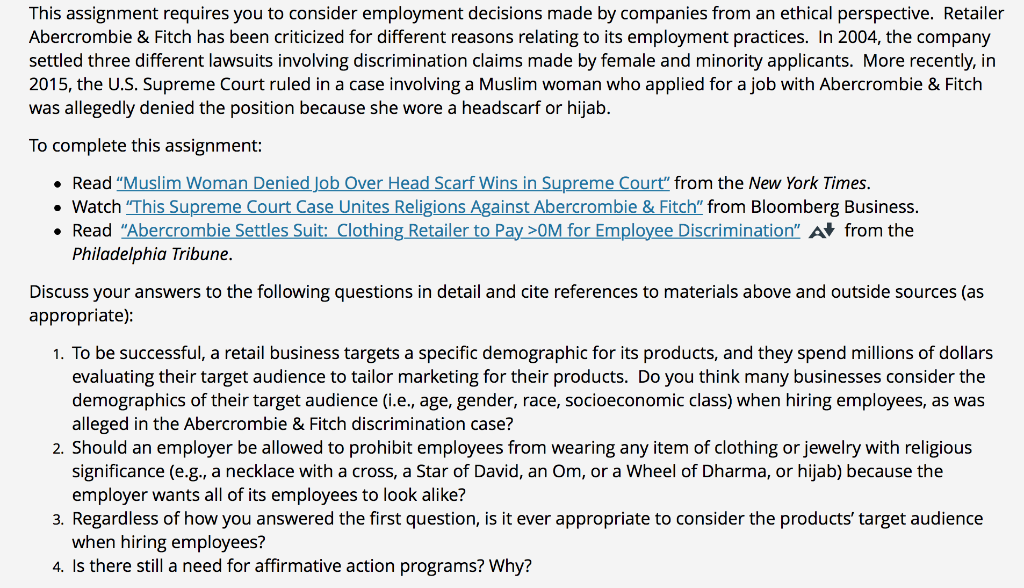
This assignment requires you to consider employment decisions made by companies from an ethical perspective. Retailer Abercrombie & Fitch has been criticized for different reasons relating to its employment practices. In 2004, the company settled three different lawsuits involving discrimination claims made by female and minority applicants. More recently, in 2015, the U.S. Supreme Court ruled in a case involving a Muslim woman who applied for a job with Abercrombie & Fitch was allegedly denied the position because she wore a headscarf or hijab. To complete this assignment: . Read "Muslim Woman Denied Job Over Head Scarf Wins in Supreme Court" from the New York Times. . Watch 'This Supreme Court Case Unites Religions Against Abercrombie & Fitch" from Bloomberg Business. Read "Abercrombie Settles Suit: Clothing Retailer to Pay >OM for Employee Discrimination" At from the Philadelphia Tribune. Discuss your answers to the following questions in detail and cite references to materials above and outside sources (as appropriate): 1. To be successful, a retail business targets a specific demographic for its products, and they spend millions of dollars evaluating their target audience to tailor marketing for their products. Do you think many businesses consider the demographics of their target audience (i.e., age, gender, race, socioeconomic class) when hiring employees, as was alleged in the Abercrombie & Fitch discrimination case? 2. Should an employer be allowed to prohibit employees from wearing any item of clothing or jewelry with religious significance (e.g., a necklace with a cross, a Star of David, an Om, or a Wheel of Dharma, or hijab) because the employer wants all of its employees to look alike? 3. Regardless of how you answered the first question, is it ever appropriate to consider the products' target audience when hiring employees? 4. Is there still a need for affirmative action programs? Why? This assignment requires you to consider employment decisions made by companies from an ethical perspective. Retailer Abercrombie & Fitch has been criticized for different reasons relating to its employment practices. In 2004, the company settled three different lawsuits involving discrimination claims made by female and minority applicants. More recently, in 2015, the U.S. Supreme Court ruled in a case involving a Muslim woman who applied for a job with Abercrombie & Fitch was allegedly denied the position because she wore a headscarf or hijab. To complete this assignment: . Read "Muslim Woman Denied Job Over Head Scarf Wins in Supreme Court" from the New York Times. . Watch 'This Supreme Court Case Unites Religions Against Abercrombie & Fitch" from Bloomberg Business. Read "Abercrombie Settles Suit: Clothing Retailer to Pay >OM for Employee Discrimination" At from the Philadelphia Tribune. Discuss your answers to the following questions in detail and cite references to materials above and outside sources (as appropriate): 1. To be successful, a retail business targets a specific demographic for its products, and they spend millions of dollars evaluating their target audience to tailor marketing for their products. Do you think many businesses consider the demographics of their target audience (i.e., age, gender, race, socioeconomic class) when hiring employees, as was alleged in the Abercrombie & Fitch discrimination case? 2. Should an employer be allowed to prohibit employees from wearing any item of clothing or jewelry with religious significance (e.g., a necklace with a cross, a Star of David, an Om, or a Wheel of Dharma, or hijab) because the employer wants all of its employees to look alike? 3. Regardless of how you answered the first question, is it ever appropriate to consider the products' target audience when hiring employees? 4. Is there still a need for affirmative action programs? Why




