







Question: This assignment requires you to create simulations for different scheduling algorithms commonly employed by operating systems to achieve multiprogramming. All problems in this assignment assume
-
-
This assignment requires you to create simulations for different scheduling algorithms commonly employed by operating systems to achieve multiprogramming. All problems in this assignment assume the following:
-
The simulations you will be creating are for a uniprocessor system (single CPU).
-
Processes in these simulations will require CPU bursts of one or more time units followed by I/O bursts of one or more time units. For simplicitys sake, when more than one process is executing its I/O burst at the same time, we will assume that the I/O bursts are using separate resources on the system and are not competing; there is no need to simulate processes waiting in an I/O queue for these simulations.
-
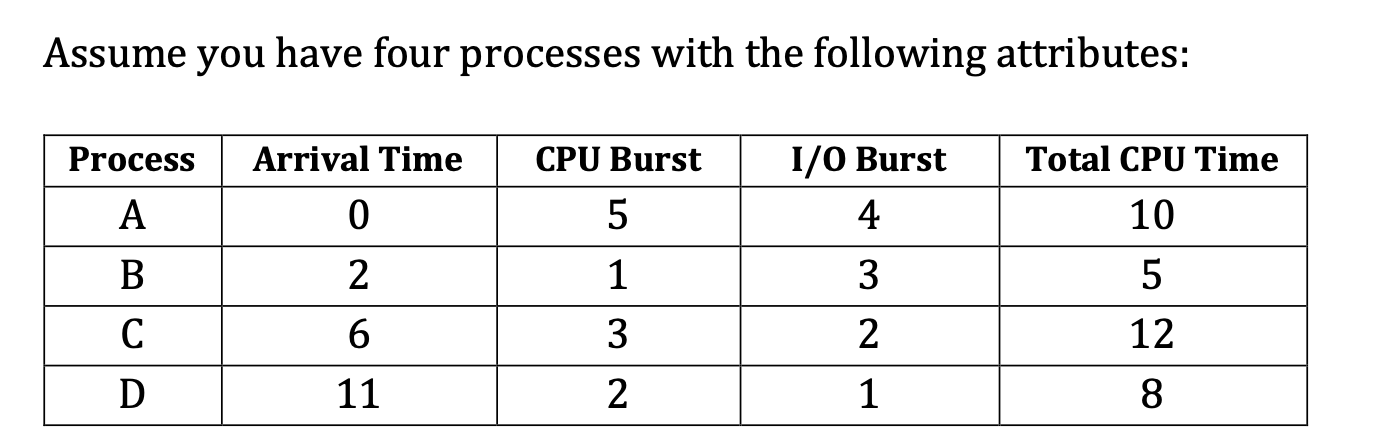
Assume you have four processes with the following attributes: (attached in the photo)
-
Perform a scheduling simulation for these four processes in the manner we covered in class, using the following algorithms:
-
First Come, First Served (FCFS)
-
Round Robin with Time Slice = 1
-
Round Robin with Time Slice = 3
-
For each simulation, if multiple processes would be placed into the ready queue at the same time, give the highest priority to a newly arriving process; the next highest priority to a process completing its blocked wait time (if two are unblocked at the same time, prefer the one that waited the longest); and finally, the lowest priority to a process that has just finished its time slice.
For each of the four simulations, you must submit the following items listed below:
-
A timeline of the simulation (you may draw these by hand and scan/photograph them, or create them electronically using your word processor or graphics program)
-
Calculate the turnaround time, queue waiting time, and response time for each process
-
Calculate the average turnaround time, average queue waiting time, and average response time among all processes
-
Calculate the percentage of idle time for the CPU overall
-
Calculate the number of context switches involved (including whole and half context
switches)
Finally, write a brief summary indicating which scheduling algorithm you think performed the best for this set of processes and give reasons supporting your opinion.
-
Shortest Job (CPU Burst Time) First (no pre-emption, as we covered in class)
-
Assume you have four processes with the following attributes: Process Total CPU Time A L 10 Arrival Time 0 2 6 CPU Burst 5 1 3 1/0 Burst 4 3 2 B 5 12
Step by Step Solution
There are 3 Steps involved in it

Get step-by-step solutions from verified subject matter experts
 Study Help