







Question: This case serves as a great example of when the values and beliefs of a firms management are incongruent with those of key shareholders. Use
This case serves as a great example of when the values and beliefs of a firms management are incongruent with those of key shareholders. Use thelecture notes to discuss the nature of the relationship between Cracker Barrels stockholders and its managers. What is the ethical course of action for the managers in this case?
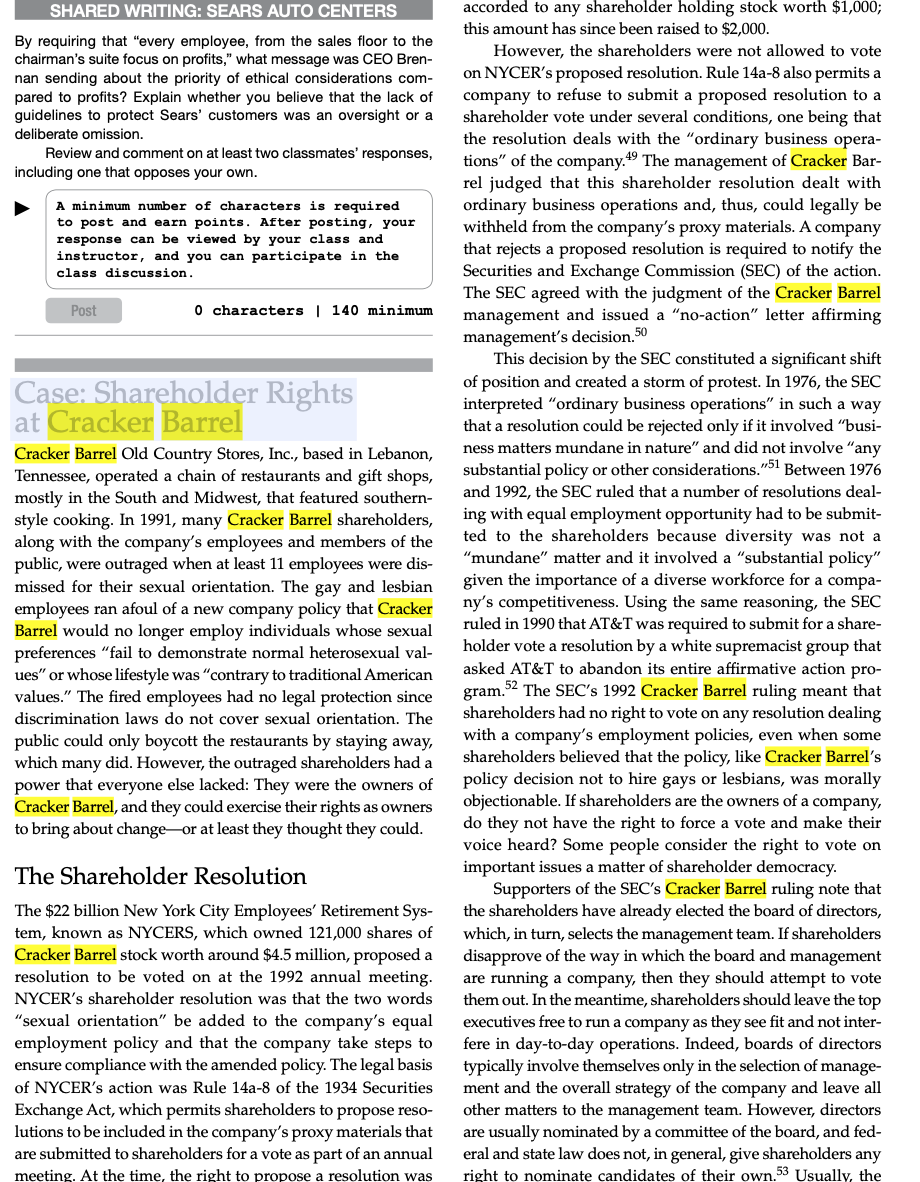
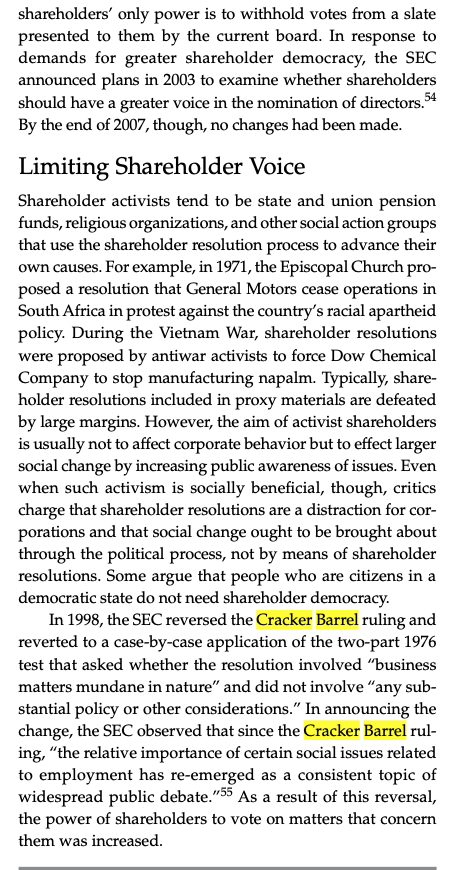
SHARED WRITING: SEARS AUTO CENTERS By requiring that "every employee, from the sales floor to the chairman's suite focus on profits," what message was CEO Bren- nan sending about the priority of ethical considerations com- pared to profits? Explain whether you believe that the lack of guidelines to protect Sears' customers was an oversight or a deliberate omission. Review and comment on at least two classmates' responses, including one that opposes your own. A minimum number of characters is required to post and earn points. After posting, your response can be viewed by your class and instructor, and you can participate in the class discussion. Post 0 characters | 140 minimum Case: Shareholder Rights at Cracker Barrel Cracker Barrel Old Country Stores, Inc., based in Lebanon, Tennessee, operated a chain of restaurants and gift shops, mostly in the South and Midwest, that featured southern- style cooking. In 1991, many Cracker Barrel shareholders, along with the company's employees and members of the public, were outraged when at least 11 employees were dis- missed for their sexual orientation. The gay and lesbian employees ran afoul of a new company policy that Cracker Barrel would no longer employ individuals whose sexual preferences "fail to demonstrate normal heterosexual val- ues" or whose lifestyle was "contrary to traditional American values." The fired employees had no legal protection since discrimination laws do not cover sexual orientation. The public could only boycott the restaurants by staying away, which many did. However, the outraged shareholders had a power that everyone else lacked: They were the owners of Cracker Barrel, and they could exercise their rights as owners to bring about change or at least they thought they could. The Shareholder Resolution The $22 billion New York City Employees' Retirement Sys- tem, known as NYCERS, which owned 121,000 shares of Cracker Barrel stock worth around $4.5 million, proposed a resolution to be voted on at the 1992 annual meeting. NYCER's shareholder resolution was that the two words "sexual orientation" be added to the company's equal employment policy and that the company take steps to ensure compliance with the amended policy. The legal basis of NYCER's action was Rule 14a-8 of the 1934 Securities Exchange Act, which permits shareholders to propose reso- lutions to be included in the company's proxy materials that are submitted to shareholders for a vote as part of an annual meeting. At the time, the right to propose a resolution was accorded to any shareholder holding stock worth $1,000; this amount has since been raised to $2,000. However, the shareholders were not allowed to vote on NYCER's proposed resolution. Rule 14a-8 also permits a company to refuse to submit a proposed resolution to a shareholder vote under several conditions, one being that the resolution deals with the "ordinary business opera- tions" of the company.49 The management of Cracker Bar- rel judged that this shareholder resolution dealt with ordinary business operations and, thus, could legally be withheld from the company's proxy materials. A company that rejects a proposed resolution is required to notify the Securities and Exchange Commission (SEC) of the action. The SEC agreed with the judgment of the Cracker Barrel management and issued a "no-action" letter affirming management's decision.50 This decision by the SEC constituted a significant shift of position and created a storm of protest. In 1976, the SEC interpreted "ordinary business operations" in such a way that a resolution could be rejected only if it involved "busi- ness matters mundane in nature" and did not involve "any substantial policy or other considerations."51 Between 1976 and 1992, the SEC ruled that a number of resolutions deal- ing with equal employment opportunity had to be submit- ted to the shareholders because diversity was not a "mundane" matter and it involved a "substantial policy" given the importance of a diverse workforce for a compa- ny's competitiveness. Using the same reasoning, the SEC ruled in 1990 that AT&T was required to submit for a share- holder vote a resolution by a white supremacist group that asked AT&T to abandon its entire affirmative action pro- gram.52 The SEC's 1992 Cracker Barrel ruling meant that shareholders had no right to vote on any resolution dealing with a company's employment policies, even when some shareholders believed that the policy, like Cracker Barrel's policy decision not to hire gays or lesbians, was morally objectionable. If shareholders are the owners of a company, do they not have the right to force a vote and make their voice heard? Some people consider the right to vote on important issues a matter of shareholder democracy. Supporters of the SEC's Cracker Barrel ruling note that the shareholders have already elected the board of directors, which, in turn, selects the management team. If shareholders disapprove of the way in which the board and management are running a company, then they should attempt to vote them out. In the meantime, shareholders should leave the top executives free to run a company as they see fit and not inter- fere in day-to-day operations. Indeed, boards of directors typically involve themselves only in the selection of manage- ment and the overall strategy of the company and leave all other matters to the management team. However, directors are usually nominated by a committee of the board, and fed- eral and state law does not, in general, give shareholders any right to nominate candidates of their own.53 Usually, the shareholders' only power is to withhold votes from a slate presented to them by the current board. In response to demands for greater shareholder democracy, the SEC announced plans in 2003 to examine whether shareholders should have a greater voice in the nomination of directors.5 By the end of 2007, though, no changes had been made. 54 Limiting Shareholder Voice Shareholder activists tend to be state and union pension funds, religious organizations, and other social action groups that use the shareholder resolution process to advance their own causes. For example, in 1971, the Episcopal Church pro- posed a resolution that General Motors cease operations in South Africa in protest against the country's racial apartheid policy. During the Vietnam War, shareholder resolutions were proposed by antiwar activists to force Dow Chemical Company to stop manufacturing napalm. Typically, share- holder resolutions included in proxy materials are defeated by large margins. However, the aim of activist shareholders is usually not to affect corporate behavior but to effect larger social change by increasing public awareness of issues. Even when such activism is socially beneficial, though, critics charge that shareholder resolutions are a distraction for cor- porations and that social change ought to be brought about through the political process, not by means of shareholder resolutions. Some argue that people who are citizens in a democratic state do not need shareholder democracy. In 1998, the SEC reversed the Cracker Barrel ruling and reverted to a case-by-case application of the two-part 1976 test that asked whether the resolution involved "business matters mundane in nature" and did not involve "any sub- stantial policy or other considerations." In announcing the change, the SEC observed that since the Cracker Barrel rul- ing, "the relative importance of certain social issues related to employment has re-emerged as a consistent topic of widespread public debate."55 As a result of this reversal, the power of shareholders to vote on matters that concern them was increasedStep by Step Solution
There are 3 Steps involved in it
1 Expert Approved Answer
Step: 1 Unlock

Question Has Been Solved by an Expert!
Get step-by-step solutions from verified subject matter experts
Step: 2 Unlock
Step: 3 Unlock
 Study Help