







Question: /* This class encapsulates a list of user-defined items that should be done- a TODO list. * Each item on the list is represented by

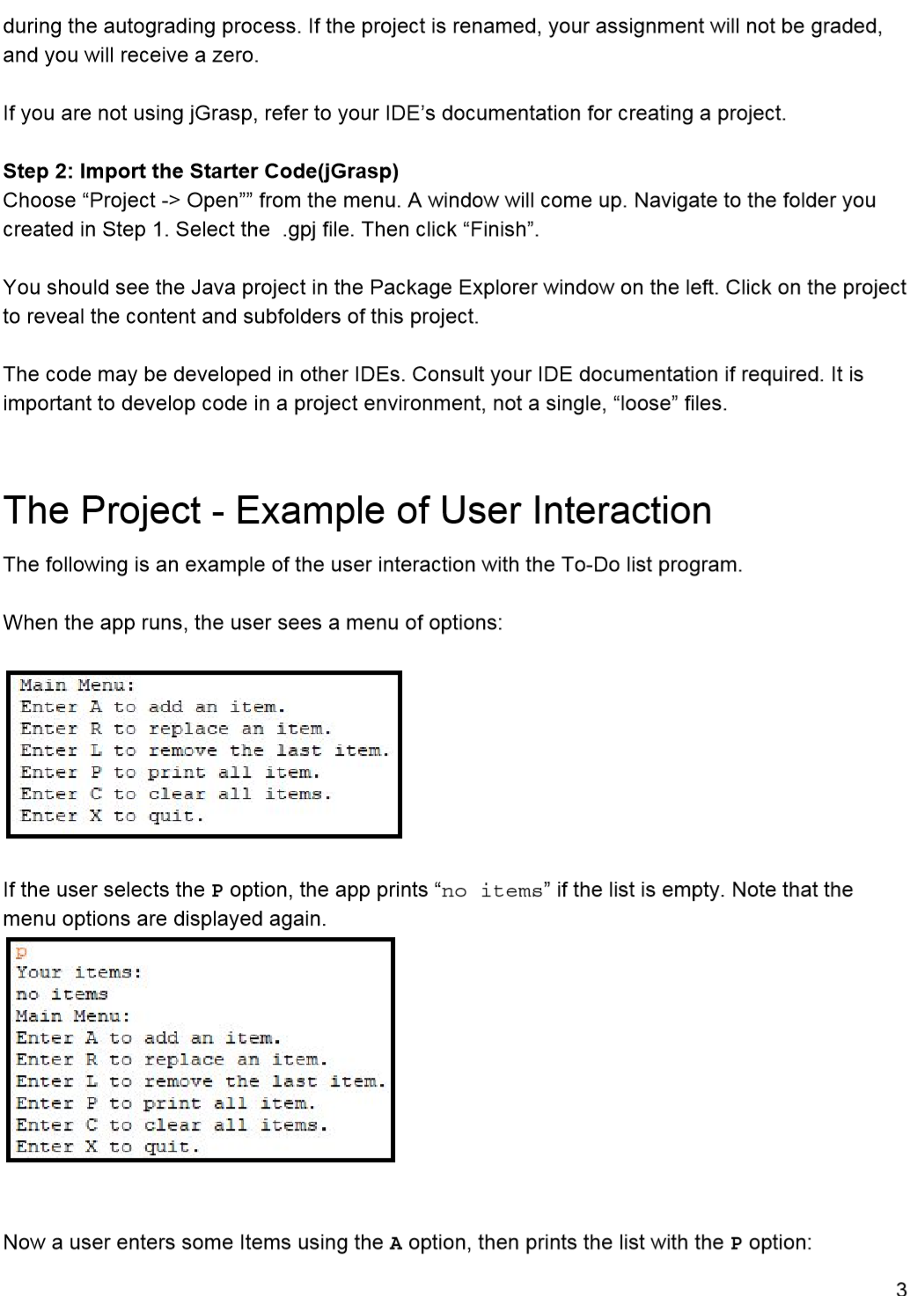
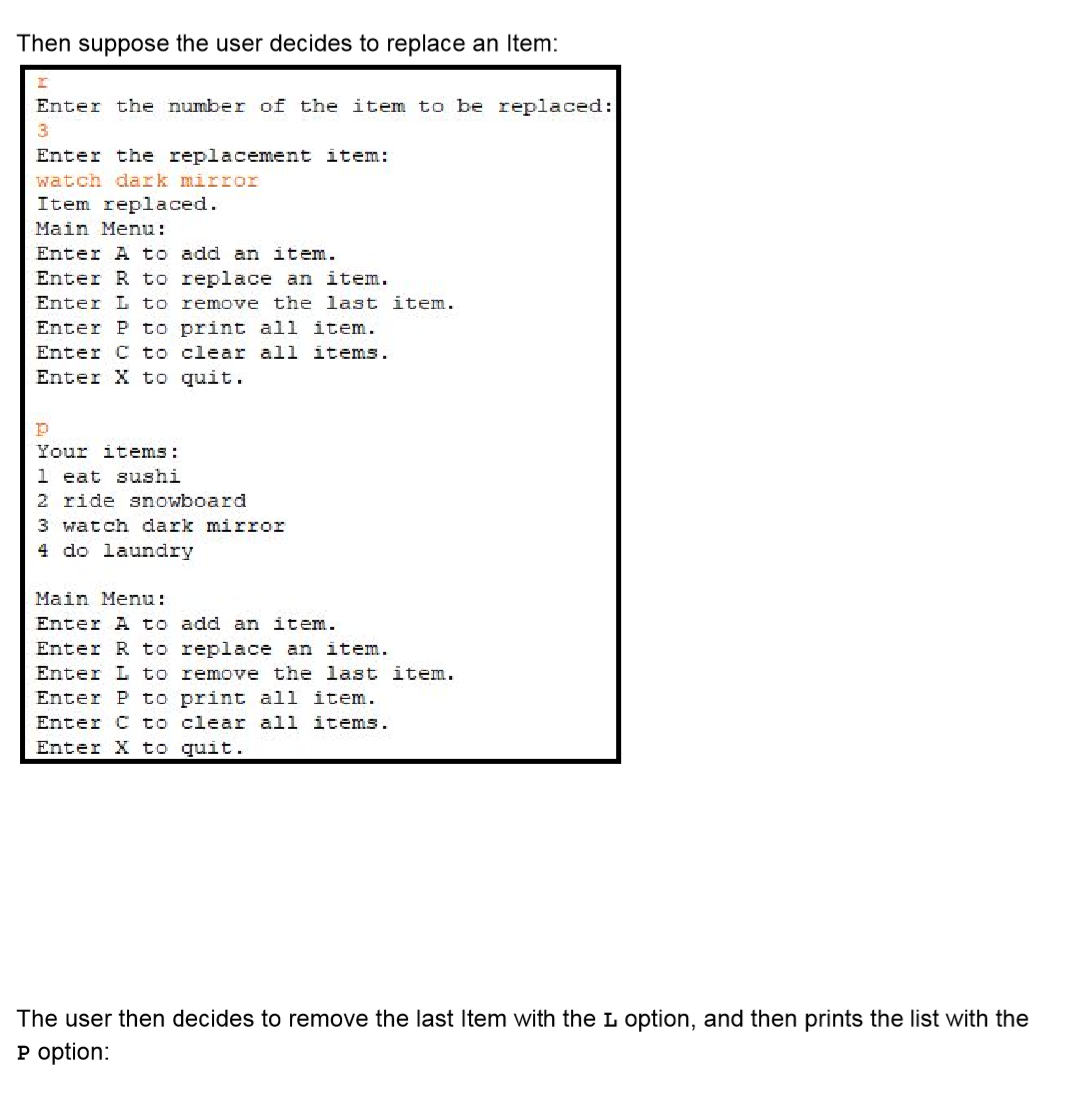
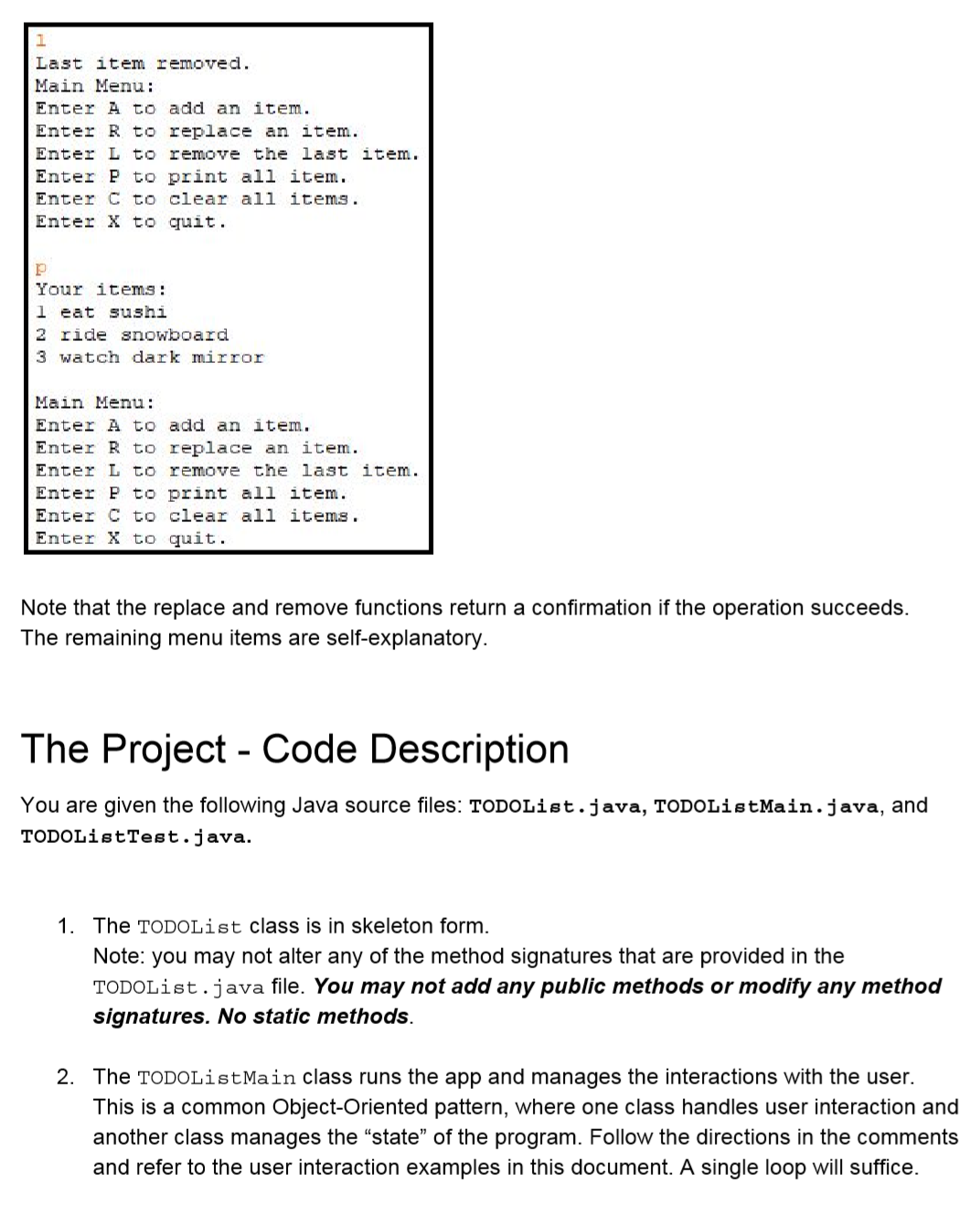
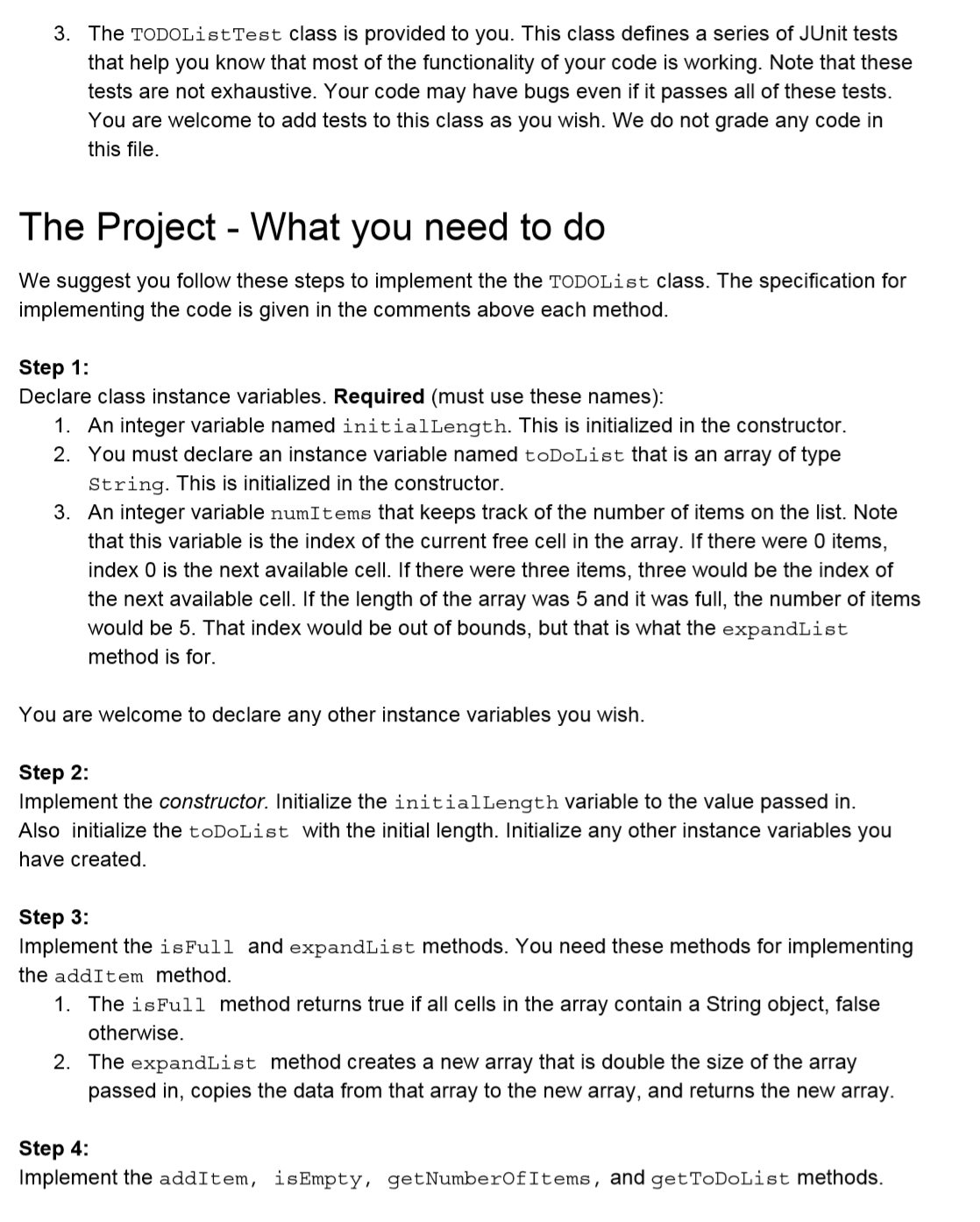
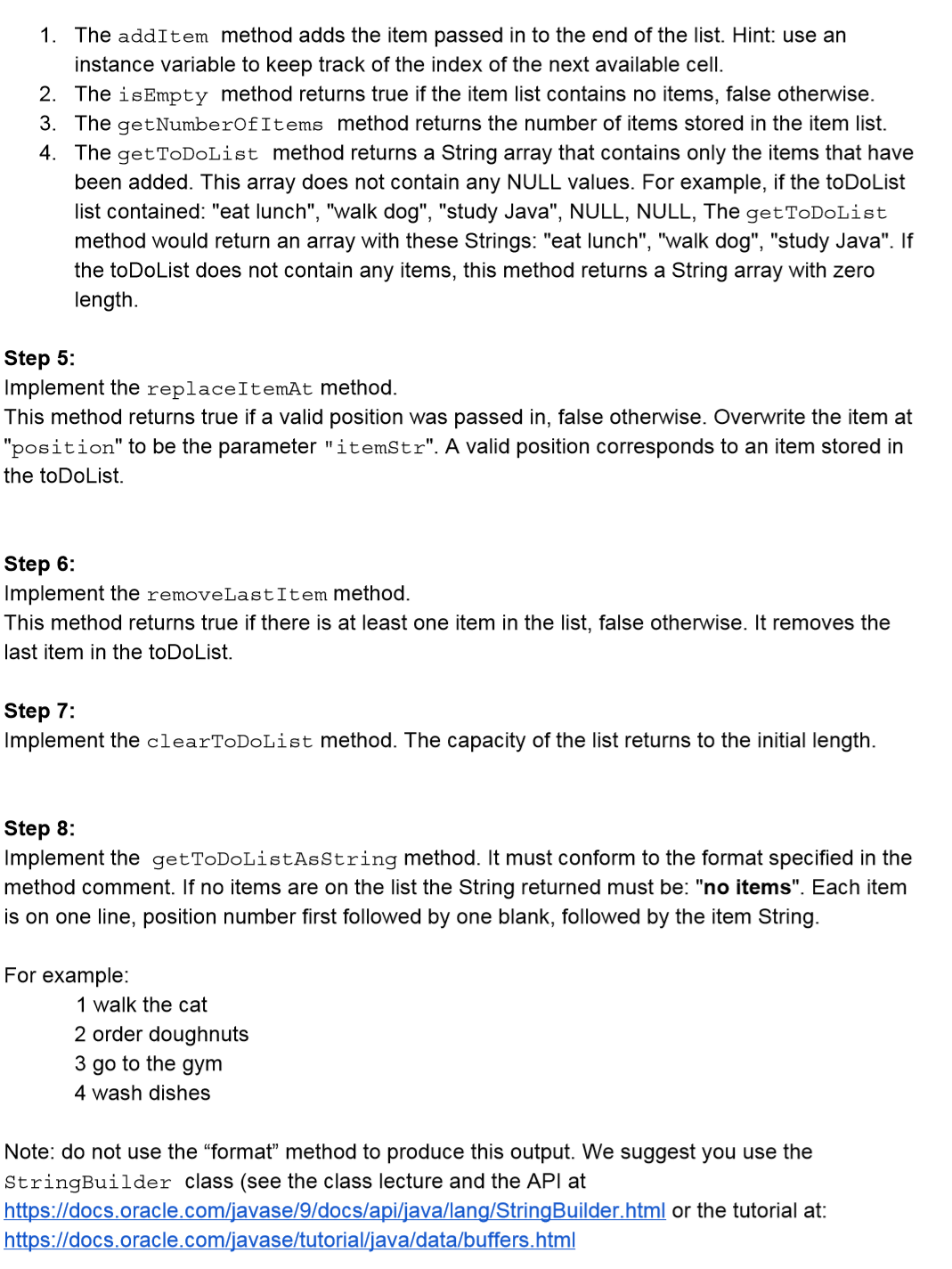
/* This class encapsulates a list of user-defined items that should be done- a "TODO" list. * Each item on the list is represented by a String object. * The list is implemented by a String array. The array is initialized in the constructor to an * initial length that is passed to the constructor. The initial array contains only NULL values. * A user adds an item (a String) to the list by calling the addItem method, passing in a String * that represents the to-do item. * Thus, the array may have fewer items (Strings) than its length. * * For example, assume the list has an initial length of 5. It looks like this: * NULL, NULL, NULL, NULL, NULL * * Then, a user adds three items. It looks like this: * "eat lunch", "walk dog", "study Java", NULL, NULL * * The length of the list is 5, the number of items is 3. The NULL values are unoccupied cells. * The capacity of the array is its length. The size of the data stored in the array is less than * or equal to its capacity. * * If a user wants to add more items to a list that has no more NULL values, i.e. no more room, * the expandArray method is called to double the length of the toDoList. The original Strings * are in the same positions, but the new array has double the capacity- more room for adding items. */ public class TODOList { /* YOUR Instance variable declarations here. */
/* Constructor that initializes the initialLength variable to the value passed in. * It also initializes the toDoList with the initial length. * Any other instance variables may be initialized as well. */ public TODOList(int initialLen){ } /* Add the item passed in to the end of the list. * For example, if the toDoList list contained: "eat lunch", "walk dog", * the next item added, "study Java", would result in this list: * "eat lunch", "walk dog", "study Java" * Suggestion: use instance variable to keep track of the index of the next available cell. */ public void addItem(String itemStr){ } /* Overwrite the item at "position" to be the parameter "itemStr". * Note: position is a positive integer > 0 that has to be a valid position * in the toDoList. A valid position corresponds to an item stored in the * toDoList. For example, if this was the list: 1 walk the cat 2 order doughnuts 3 go to the gym 4 wash dishes * valid positions would be 1, 2, 3, 4. All other integers are invalid. * This method returns true if a valid position was passed in, false otherwise. */ public boolean replaceItemAt(String itemStr, int position){ return false; } /* Remove the last item in the toDoList. * For example, if the toDoList list contained: "eat lunch", "walk dog", "study Java", * removing the last item would result in this list: * "eat lunch", "walk dog". * This method returns true if there is at least one item in the list, * false otherwise. */ public boolean removeLastItem(){ return false; } /* * This method returns the number of items stored in the item list. * The method returns a String array that contains only the items that have been added. * This array does not contain any NULL values. * For example, if the toDoList list contained: "eat lunch", "walk dog", "study Java", NULL, NULL, * the getToDoList method would return an array with these Strings: "eat lunch", "walk dog", "study Java". * If the toDoList does not contain any items, this method returns a String array with zero length. */ public String[] getToDoList(){ return null; } /* Remove all items from the list, resulting in an empty list. * The capacity of the list returns to the initial length. */ public void clearToDoList(){ } /* Returns a String representation of the current item list according to * these specifications: * Each item is on one line, position number first followed by one blank, * followed by the item String. * For example: 1 walk the cat 2 order doughnuts 3 go to the gym 4 wash dishes * If no items are on the list the String returned is: "no items". */ public String getToDoListAsString(){ return null; } /* Returns the number of items stored in the item list. */ public int getNumberOfItems(){ return 5000; } /* Returns true if the item list contains no items, false otherwise. */ public boolean isEmpty(){ return false; } /****** Private, "helper" method section ******/ /* Creates a new array that is double the size of the array passed in, copies the data * from that array to the new array, and returns the new array. * Note that the new array will contain the items from the previous array followed by NULL values. */ private String[] expandList(String[] inputList){ return null; } /* A full item list is an array where all cells contain an item. That * means there is no cell that contains NULL. * This method returns true if all cells in the array contain a String * object, false otherwise. */ private boolean isFull(){ return true; } }_______________________________________________________________________________________________________
import java.util.Scanner; /* This class runs a console interface between a user and * an instance of a ToDo List. */ public class TODOListMain { public static void main(String[] args){ System.out.println("TODO List"); // create an instance of a TODOList with initial size 5. // You may create any other variables you need as well.
//begin loop // print menu // conditional statements to handle user choices // end loop // print ending message and close scanner.
} }________________________________________________________________________________________________________-
/** Fixture initialization (common initialization
* for all tests). **/
@Before public void setUp() {
toDoList = new TODOList(4);
}
/** Test for required instance variable declarations. **/
@Test
public void initialLengthNameTest() {
Field[] fields = TODOList.class.getDeclaredFields();
boolean wasDeclared = false;
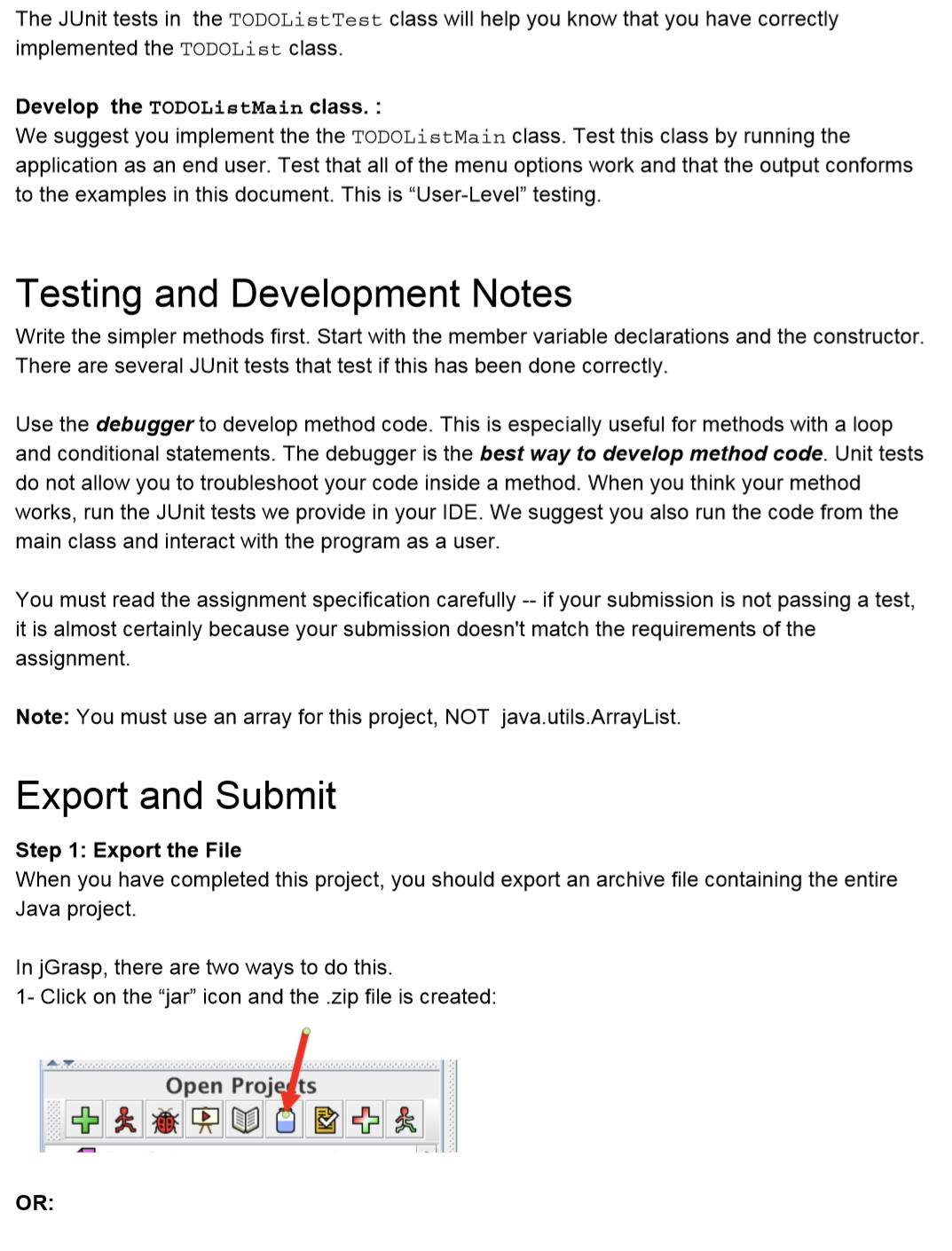
for(int i=0;i if(fields[i].getName().equals("initialLength")){ wasDeclared = true; } } assertEquals("Test 1: The instance variable initialLength has not been declared.", true, wasDeclared); } @Test public void toDoListNameTest() { Field[] fields = TODOList.class.getDeclaredFields(); boolean wasDeclared = false; for(int i=0;i if(fields[i].getName().equals("toDoList")){ wasDeclared = true; } } assertEquals("Test 2: The instance variable toDoList has not been declared.", true, wasDeclared); } @Test public void numItemsNameTest() { Field[] fields = TODOList.class.getDeclaredFields(); boolean wasDeclared = false; for(int i=0;i if(fields[i].getName().equals("numItems")){ wasDeclared = true; } } assertEquals("Test 3: The instance variable numItems has not been declared.", true, wasDeclared); } /** Test for required instance variable initializations in constructor. **/ @Test public void initialLengthTypeTest() { Field[] fields = TODOList.class.getDeclaredFields(); String varType = null; for(int i=0;i if(fields[i].getName().equals("initialLength")){ varType = fields[i].getType().getName(); } } assertEquals("Test 4: The instance variable initialLength has not been declared as an int.", "int", varType); } @Test public void toDoListTypeTest() { Field[] fields = TODOList.class.getDeclaredFields(); String varType = null; for(int i=0;i if(fields[i].getName().equals("toDoList")){ varType = fields[i].getType().getName(); } } assertEquals("Test 5: The instance variable toDoList has not been declared as an int.", "[Ljava.lang.String;", varType); } /** Test that the list has been created. **/ @Test public void initListTest() { String[] items = toDoList.getToDoList(); assertNotEquals("Test 6: The array is null- list may not have been initialized.", null, items); } /** Test the addItem method. **/ @Test public void addOneItemTest() { toDoList.addItem("walk the cat"); String[] items = toDoList.getToDoList(); assertEquals("Test 7: The item was not added.", "walk the cat", items[0]); } /** Test the addItem method-length of array. **/ @Test public void addOneItemLenOneTest() { toDoList.addItem("walk the cat"); String[] items = toDoList.getToDoList(); assertEquals("Test 8: Call to addItem- the list should contain one item.", 1, items.length); } /** Test the getNumberOfItems method on an empty list. **/ @Test public void initListSizeTest() { int len = toDoList.getNumberOfItems(); assertEquals("Test 9: The getNumberOfItems method should return 0 on an empty list.", 0, len); } /** Test the isEmpty method on an empty list. **/ @Test public void initListIsEmptyTest() { boolean empty = toDoList.isEmpty(); assertEquals("Test 10: The isEmpty method should return true on an empty list.", true, empty); } /** Test the getNumberOfItems method on a list with one item. **/ @Test public void oneItemListSizeTest() { toDoList.addItem("walk the cat"); int len = toDoList.getNumberOfItems(); assertEquals("Test 11: The getNumberOfItems method should return 1.", 1, len); } /** Test the replaceItemAt method. **/ @Test public void replaceItemAtTest() { toDoList.addItem("walk the cat"); toDoList.replaceItemAt("walk the dog", 1); String[] items = toDoList.getToDoList(); assertEquals("Test 12: The item \"walk the cat\" at position 1 was not replaced with \"walk the dog\".", "walk the dog", items[0]); } /** Test the removeLastItem method. **/ @Test public void removeLastItemTest() { toDoList.addItem("walk the cat"); toDoList.addItem("walk the dog"); toDoList.addItem("eat Halloween candy"); toDoList.addItem("make dentist appointment"); toDoList.removeLastItem(); String[] items = toDoList.getToDoList(); assertEquals("Test 13: The last item should be: \"eat Halloween candy\".", "eat Halloween candy", items[items.length-1]); } /** Test the clearToDoList method. **/ @Test public void clearItemsTest() { toDoList.addItem("walk the cat"); toDoList.addItem("walk the dog"); toDoList.addItem("eat Halloween candy"); toDoList.addItem("make dentist appointment"); toDoList.clearToDoList(); String[] items = toDoList.getToDoList(); assertEquals("Test 14: After adding items then calling clearToDoList, the item list should be empty.", 0, items.length); } /** Test the getToDoListAsString method on an empty list. **/ @Test public void initListGetItemStrTest() { String listStr = toDoList.getToDoListAsString(); assertEquals("Test 15: The getItemStr method should return \"no items\" on an empty list.", "no items", listStr.trim()); } /* Test private method expandList on empty list of length 5. */ @Test public void expandListTest1()throws Exception { Class classToCall = Class.forName("TODOList"); Method methodToExecute = classToCall.getDeclaredMethod("expandList", new Class[]{String[].class}); methodToExecute.setAccessible(true); String[] args = new String[5]; Object expandedListObj = methodToExecute.invoke(toDoList, new Object[]{args}); String[] expandedList = (String[])expandedListObj; int result = expandedList.length; assertEquals("Test 16: The expandList method did not create an array of double the length of the array passed in.", 10, result); } /* Test private method isFull on default list. */ @Test public void isFullTest1()throws Exception { Class classToCall = Class.forName("TODOList"); Method methodToExecute = classToCall.getDeclaredMethod("isFull"); methodToExecute.setAccessible(true); Boolean boolObj = (Boolean)methodToExecute.invoke(toDoList); boolean result = boolObj.booleanValue(); assertEquals("Test 17: The isFull method should return false on an array with NULL values.", false, result); } /** Test the isEmpty method on a list with one item. **/ @Test public void oneItemListIsEmptyTest() { toDoList.addItem("walk the cat"); boolean empty = toDoList.isEmpty(); assertEquals("Test 18: The isEmpty method should return false on list with one item.", false, empty); } /** Test the addItem method-length of array. **/ @Test public void addOneItemLenZeroTest() { toDoList.addItem("walk the cat"); String[] items = toDoList.getToDoList(); assertNotEquals("Test 19: Call to addItem- the item was not added.", 0, items.length); } /** Test the getItemStr method on a list with one item. **/ @Test public void oneItemListGetItemStrTest() { toDoList.addItem("walk the cat"); String listStr = toDoList.getToDoListAsString(); assertEquals("Test 20: The getItemStr method should return \"1 walk the cat\".", "1 walk the cat", listStr.trim()); } /* Remove the item and test getNumberOfItems. */ @Test public void oneItemListRemoveLastSizeTest() { toDoList.addItem("walk the cat"); toDoList.removeLastItem(); int len = toDoList.getNumberOfItems(); assertEquals("Test 21: The getNumberOfItems method should return 0 after adding and calling removeLastItem.", 0, len); } /* Remove the item and test isEmpty. */ @Test public void oneItemListRemoveLastIsEmptyTest() { toDoList.addItem("walk the cat"); toDoList.removeLastItem(); boolean empty = toDoList.isEmpty(); assertEquals("Test 22: The isEmpty method should return true after adding an item, then calling removeLastItem.", true, empty); } /** Test the getNumberOfItems method on populated list. **/ @Test public void getNumberOfItemsAfterAddsTest() { toDoList.addItem("walk the cat"); toDoList.addItem("walk the dog"); toDoList.addItem("eat Halloween candy"); toDoList.addItem("make dentist appointment"); int len = toDoList.getNumberOfItems(); assertEquals("Test 23: After adding 4 items the size of the list should be 4.", 4, len); } /** Test the replaceItemAt for a first item. **/ @Test public void replaceItemAtBeginTest() { toDoList.addItem("walk the cat"); toDoList.addItem("walk the dog"); toDoList.addItem("eat Halloween candy"); toDoList.addItem("make dentist appointment"); toDoList.replaceItemAt("Fry burgers", 1); String[] items = toDoList.getToDoList(); assertEquals("Test 24: The item \"walk the cat\" at position 1 was not replaced with \"Fry burgers\".", "Fry burgers", items[0]); } /** Test the replaceItemAt for a last item. **/ @Test public void replaceItemAtEndTest() { toDoList.addItem("walk the cat"); toDoList.addItem("walk the dog"); toDoList.addItem("eat Halloween candy"); toDoList.addItem("make dentist appointment"); toDoList.replaceItemAt("Fry burgers", 4); String[] items = toDoList.getToDoList(); assertEquals("Test 25: The item eat Halloween candy at position 4 was not replaced with Fry burgers.", "Fry burgers", items[3]); } /** Test the replaceItemAt for a middle item. **/ @Test public void replaceItemAtMiddleTest() { toDoList.addItem("walk the cat"); toDoList.addItem("walk the dog"); toDoList.addItem("eat Halloween candy"); toDoList.addItem("make dentist appointment"); toDoList.replaceItemAt("Fry burgers", 3); String[] items = toDoList.getToDoList(); assertEquals("Test 26: The item \"eat Halloween candy\" at position 3 was not replaced with \"Fry burgers\".", "Fry burgers", items[2]); } /** Test the replaceItemAt for a middle item returns true. **/ @Test public void replaceItemAtMiddleReturnsTrueTest() { toDoList.addItem("walk the cat"); toDoList.addItem("walk the dog"); toDoList.addItem("eat Halloween candy"); toDoList.addItem("make dentist appointment"); boolean res = toDoList.replaceItemAt("Fry burgers", 2); assertEquals("Test 27: Calling replaceElementAt on a valid index should return true.", true, res); } /** Test the replaceItemAt for a non-existent item returns false. **/ @Test public void replaceItemAtInvalidIndexTest() { toDoList.addItem("walk the cat"); toDoList.addItem("walk the dog"); toDoList.addItem("eat Halloween candy"); toDoList.addItem("make dentist appointment"); boolean res = toDoList.replaceItemAt("Fry burgers", 5); assertEquals("Test 28: Calling replaceElementAt on an index out of range should return false.", false, res); } /** Test the clearToDoList then isEmpty method. **/ @Test public void clearMultipleItemsThenIsEmptyTest() { toDoList.addItem("walk the cat"); toDoList.addItem("walk the dog"); toDoList.addItem("eat Halloween candy"); toDoList.addItem("make dentist appointment"); toDoList.clearToDoList(); boolean empty = toDoList.isEmpty(); assertEquals("Test 29: After adding items then calling clearToDoList, the isEmpty method should return true.", true, empty); } /** Test the clearToDoList then getNumberOfItems method. **/ @Test public void clearMultipleItemsThenGetSizeTest() { toDoList.addItem("walk the cat"); toDoList.addItem("walk the dog"); toDoList.addItem("eat Halloween candy"); toDoList.addItem("make dentist appointment"); toDoList.clearToDoList(); int len = toDoList.getNumberOfItems(); assertEquals("Test 30: After adding items then calling clearToDoList, the getNumberOfItems method should return 0.", 0, len); } /** Test the removeLast on list size 4. **/ @Test public void removeLastOnList4Test() { toDoList.addItem("walk the cat"); toDoList.addItem("walk the dog"); toDoList.addItem("eat Halloween candy"); toDoList.addItem("make dentist appointment"); toDoList.removeLastItem(); String[] items = toDoList.getToDoList(); assertEquals("Test 31: Testing removeLastItem: The last item should be \"eat Halloween candy\".", "eat Halloween candy", items[2]); } /** Test the removeLast until list is empty. **/ @Test public void removeLastOnList4UntilEmptyTest() { toDoList.addItem("walk the cat"); toDoList.addItem("walk the dog"); toDoList.addItem("eat Halloween candy"); toDoList.addItem("make dentist appointment"); toDoList.removeLastItem(); toDoList.removeLastItem(); toDoList.removeLastItem(); toDoList.removeLastItem(); String[] items = toDoList.getToDoList(); assertEquals("Test 32: Testing removeLastItem: The item list should be empty.", 0, items.length); } /** Test the removeLast returns true on non-empty list. **/ @Test public void removeLastOnList4NonEmptyTest() { toDoList.addItem("walk the cat"); toDoList.addItem("walk the dog"); toDoList.addItem("eat Halloween candy"); toDoList.addItem("make dentist appointment"); toDoList.removeLastItem(); toDoList.removeLastItem(); toDoList.removeLastItem(); boolean result = toDoList.removeLastItem(); assertEquals("Test 33: The call to removeLastItem should return true on a non-empty list.", true, result); } /** Test the removeLast after list is empty. **/ @Test public void removeLastOnList4AfterEmptyTest() { toDoList.addItem("walk the cat"); toDoList.addItem("walk the dog"); toDoList.addItem("eat Halloween candy"); toDoList.addItem("make dentist appointment"); toDoList.removeLastItem(); toDoList.removeLastItem(); toDoList.removeLastItem(); toDoList.removeLastItem(); boolean result = toDoList.removeLastItem(); assertEquals("Test 34: The call to removeLastItem should return false on an empty list.", false, result); } /* Test private method expandList on list with data. */ @Test public void expandListTest2()throws Exception { Class classToCall = Class.forName("TODOList"); Method methodToExecute = classToCall.getDeclaredMethod("expandList", new Class[]{String[].class}); methodToExecute.setAccessible(true); String[] args = {"walk the cat", "walk the dog", "eat Halloween candy", "make dentist appointment"}; Object expandedListObj = methodToExecute.invoke(toDoList, new Object[]{args}); String[] expandedList = (String[])expandedListObj; String result = expandedList[0]; assertEquals("Test 35: The expandList method did not correctly copy the data from the array passed in.", "walk the cat", result); } /* Test private method expandList on list with data. */ @Test public void expandListTest3()throws Exception { Class classToCall = Class.forName("TODOList"); Method methodToExecute = classToCall.getDeclaredMethod("expandList", new Class[]{String[].class}); methodToExecute.setAccessible(true); String[] args = {"walk the cat", "walk the dog", "eat Halloween candy", "make dentist appointment"}; Object expandedListObj = methodToExecute.invoke(toDoList, new Object[]{args}); String[] expandedList = (String[])expandedListObj; String result = expandedList[3]; assertEquals("Test 36: The expandList method did not correctly copy the data from the array passed in.", "make dentist appointment", result); } /* Test private method expandList on list with data. */ @Test public void expandListTest4()throws Exception { Class classToCall = Class.forName("TODOList"); Method methodToExecute = classToCall.getDeclaredMethod("expandList", new Class[]{String[].class}); methodToExecute.setAccessible(true); String[] args = {"walk the cat", "walk the dog", "eat Halloween candy", "make dentist appointment"}; Object expandedListObj = methodToExecute.invoke(toDoList, new Object[]{args}); String[] expandedList = (String[])expandedListObj; String result = expandedList[4]; assertEquals("Test 37: The expandList method did not correctly copy the data from the array passed in.", null, result); } /* Test private method isFull after adding one item. */ @Test public void isFullTest2()throws Exception { toDoList = new TODOList(2); toDoList.addItem("walk the cat"); Class classToCall = Class.forName("TODOList"); Method methodToExecute = classToCall.getDeclaredMethod("isFull"); methodToExecute.setAccessible(true); Boolean boolObj = (Boolean)methodToExecute.invoke(toDoList); boolean result = boolObj.booleanValue(); assertEquals("Test 38: The isFull method should return false on an array with NULL values.", false, result); } /* Test private method isFull on full list. */ @Test public void isFullTest3()throws Exception { toDoList = new TODOList(2); toDoList.addItem("walk the cat"); toDoList.addItem("walk the dog"); Class classToCall = Class.forName("TODOList"); Method methodToExecute = classToCall.getDeclaredMethod("isFull"); methodToExecute.setAccessible(true); Boolean boolObj = (Boolean)methodToExecute.invoke(toDoList); boolean result = boolObj.booleanValue(); assertEquals("Test 39: The isFull method should return true on an array without NULL values.", true, result); } /** Test that the list has been initialized in constructor. **/ @Test public void initListConstructorTest2() throws Exception{ int randLen = (int)(Math.random()*6+1); toDoList = new TODOList(randLen); for(int i=0;i toDoList.addItem("walk the cat"); Class classToCall = Class.forName("TODOList"); Method methodToExecute = classToCall.getDeclaredMethod("isFull"); methodToExecute.setAccessible(true); Boolean boolObj = (Boolean)methodToExecute.invoke(toDoList); boolean result = boolObj.booleanValue(); assertEquals("Test 40: The item list length may not have been initialized in the constructor.", true, result); } }
Step by Step Solution
There are 3 Steps involved in it

Get step-by-step solutions from verified subject matter experts
 Study Help