







Question: This code was in the DLinkedList.h for part A // Template doubly linked list class using code from // Data Structures and Algorithms in C++,
This code was in the DLinkedList.h for part A
// Template doubly linked list class using code from // Data Structures and Algorithms in C++, Goodrich, Tamassia, and Mount, 2nd Ed., 2011. // #pragma once #includeusing namespace std; template class DLinkedList; // forward declaration to be used when declaring DNode template class DNode { // doubly linked list node private: E elem; // node element value DNode *prev; // previous node in the list DNode *next; // next node in the list friend class DLinkedList ; // provide SLinkedList access }; template class DLinkedList { // a doubly linked list public: DLinkedList(); // empty list constructor ~DLinkedList(); // destructor bool empty() const; // is list empty? E& front(); // get front element E& back(); // get back element void addFront(const E& e); // add to front of list void addBack(const E& e); // add to back of list void removeFront(); // remove from front void removeBack(); // remove from back int size() const; // list size private: // local type definitions int n; // number of items DNode * header; // header sentinel DNode * trailer; // trailer sentinel protected: void add(DNode * v, const E& e); // insert new node before v void remove(DNode * v); // remove node v }; template DLinkedList ::DLinkedList() { // constructor n = 0; // initially empty header = new DNode ; // create sentinels trailer = new DNode ; header->next = trailer; // have them point to each other trailer->prev = header; } template bool DLinkedList ::empty() const // is list empty? { return (header->next == trailer); } template E& DLinkedList ::front() // return front element { if (empty()) throw length_error("empty list"); return header->next->elem; } template E& DLinkedList ::back() // get back element { if (empty()) throw length_error("empty list"); return trailer->prev->elem; } template DLinkedList ::~DLinkedList() { // destructor while (!empty()) removeFront(); // remove all but sentinels delete header; // remove the sentinels delete trailer; } template void DLinkedList ::add(DNode * v, const E& e) { DNode * u = new DNode ; // create a new node for e u->elem = e; u->next = v; // link u in between v u->prev = v->prev; // ...and v->prev v->prev->next = u; v->prev = u; n++; } template void DLinkedList ::addFront(const E& e) // add to front of list { add(header->next, e); } template void DLinkedList ::addBack(const E& e) // add to back of list { add(trailer, e); } template void DLinkedList ::remove(DNode * v) { // remove node v DNode * u = v->prev; // predecessor DNode * w = v->next; // successor u->next = w; // unlink v from list w->prev = u; delete v; n--; } template void DLinkedList ::removeFront() // remove from font { if (empty()) throw length_error("empty list"); remove(header->next); } template void DLinkedList ::removeBack() // remove from back { if (empty()) throw length_error("empty list"); remove(trailer->prev); } template int DLinkedList ::size() const { // list size return n; }
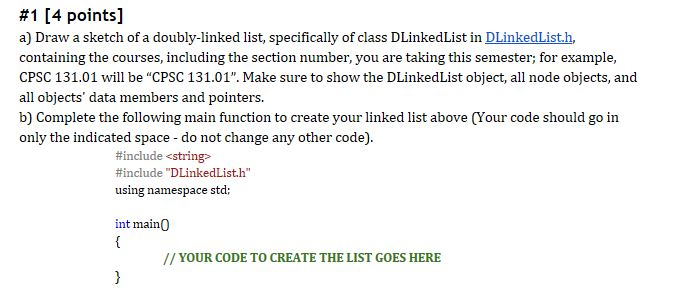
#1 [4 points] a) Draw a sketch of a doubly-linked list, specifically of class DLinkedList in DLinkedList.h, containing the courses, including the section number, you are taking this semester; for example, CPSC 131.01 will be "CPSC 131.01". Make sure to show the DLinkedList object, all node objects, and all objects' data members and pointers b) Complete the following main function to create your linked list above (Your code should go in only the indicated space do not change any other code). # include
Step by Step Solution
There are 3 Steps involved in it

Get step-by-step solutions from verified subject matter experts
 Study Help