





Question: This exercise aims to estimate cost function of drones flying in low urban airspace, with emphasis on the trade-off between horizontal and vertical travel costs.
This exercise aims to estimate cost function of
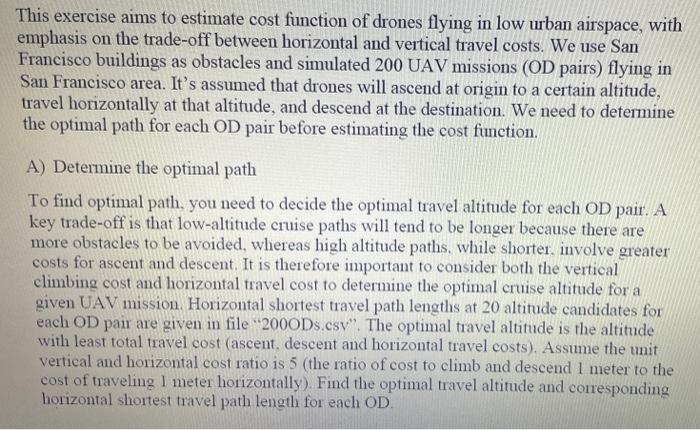
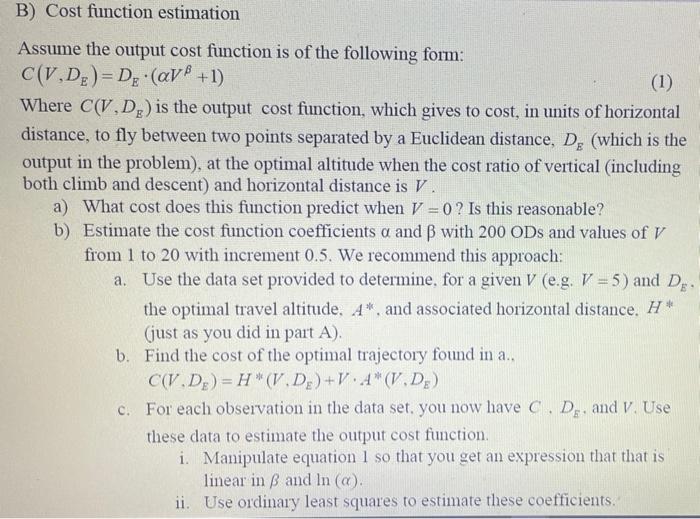
This exercise aims to estimate cost function of drones flying in low urban airspace, with emphasis on the trade-off between horizontal and vertical travel costs. We use San Francisco buildings as obstacles and simulated 200 UAV missions (OD pairs) flying in San Francisco area. It's assumed that drones will ascend at origin to a certain altitude, travel horizontally at that altitude, and descend at the destination. We need to determine the optimal path for each OD pair before estimating the cost function. A) Determine the optimal path To find optimal path, you need to decide the optimal travel altitude for each OD pair. A key trade-off is that low-altitude cruise paths will tend to be longer because there are more obstacles to be avoided, whereas high altitude paths, while shorter, involve greater costs for ascent and descent. It is therefore important to consider both the vertical climbing cost and horizontal travel cost to determine the optimal cruise altitude for a given UAV mission. Horizontal shortest travel path lengths at 20 altitude candidates for each OD pair are given in file 2000Ds.csv". The optimal travel altitude is the altitude with least total travel cost (ascent, descent and horizontal travel costs). Assume the unit vertical and horizontal cost ratio is 5 (the ratio of cost to climb and descend 1 meter to the cost of traveling I meter horizontally). Find the optimal travel altitude and corresponding horizontal shortest travel path length for each OD. B) Cost function estimation Assume the output cost function is of the following form: C(V.DE)= D. (av +1) (1) Where C(V.DE) is the output cost function, which gives to cost, in units of horizontal distance, to fly between two points separated by a Euclidean distance, Dg (which is the output in the problem), at the optimal altitude when the cost ratio of vertical (including both climb and descent) and horizontal distance is V. a) What cost does this function predict when V =0 ? Is this reasonable? b) Estimate the cost function coefficients a and B with 200 ODs and values of V from 1 to 20 with increment 0.5. We recommend this approach: a. Use the data set provided to determine, for a given V (e.g. V = 5) and Dr. the optimal travel altitude. A*. and associated horizontal distance. H* (just as you did in part A). b. Find the cost of the optimal trajectory found in a., CV Dg) = H (V.Dg)+VA (V.D,) c. For each observation in the data set, you now have c . Do and V. Use these data to estimate the output cost function i. Manipulate equation I so that you get an expression that that is linear in B and In (). ii. Use ordinary least squares to estimate these coefficients

Step by Step Solution

There are 3 Steps involved in it

1 Expert Approved Answer
Step: 1 Unlock blur-text-image

Question Has Been Solved by an Expert!

Get step-by-step solutions from verified subject matter experts

Step: 2 Unlock
Step: 3 Unlock

Students Have Also Explored These Related General Management Questions!