





Question: This exercise, inspired by the discussions in [155], highlights one of the known limitations of the leave-one-out model evaluation procedure. Let us consider a data
This exercise, inspired by the discussions in
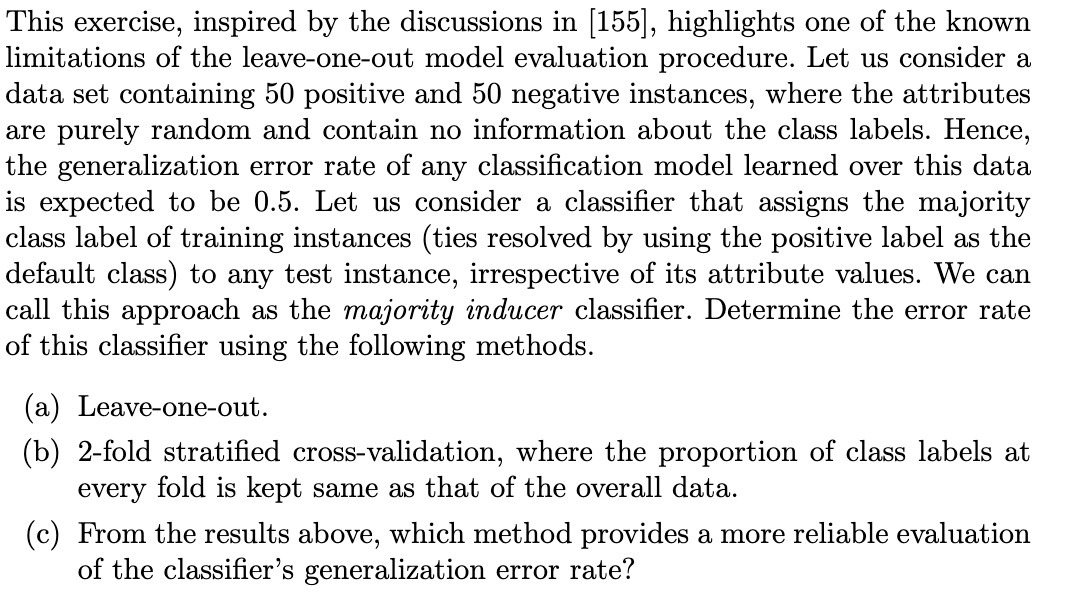
This exercise, inspired by the discussions in [155], highlights one of the known limitations of the leave-one-out model evaluation procedure. Let us consider a data set containing 50 positive and 50 negative instances, where the attributes are purely random and contain no information about the class labels. Hence, the generalization error rate of any classification model learned over this data is expected to be 0.5. Let us consider a classifier that assigns the majority class label of training instances (ties resolved by using the positive label as the default class) to any test instance, irrespective of its attribute values. We can call this approach as the majority inducer classifier. Determine the error rate of this classifier using the following methods. (a) Leave-one-out. (b) 2-fold stratified cross-validation, where the proportion of class labels at every fold is kept same as that of the overall data. (c) From the results above, which method provides a more reliable evaluation of the classifier's generalization error rate

Step by Step Solution

There are 3 Steps involved in it

1 Expert Approved Answer
Step: 1 Unlock blur-text-image

Question Has Been Solved by an Expert!

Get step-by-step solutions from verified subject matter experts

Step: 2 Unlock
Step: 3 Unlock

Students Have Also Explored These Related Mathematics Questions!