







Question: This homework is for problems. Please show your work. Do not just write down the final answers. I suggest you use formulas to solve the
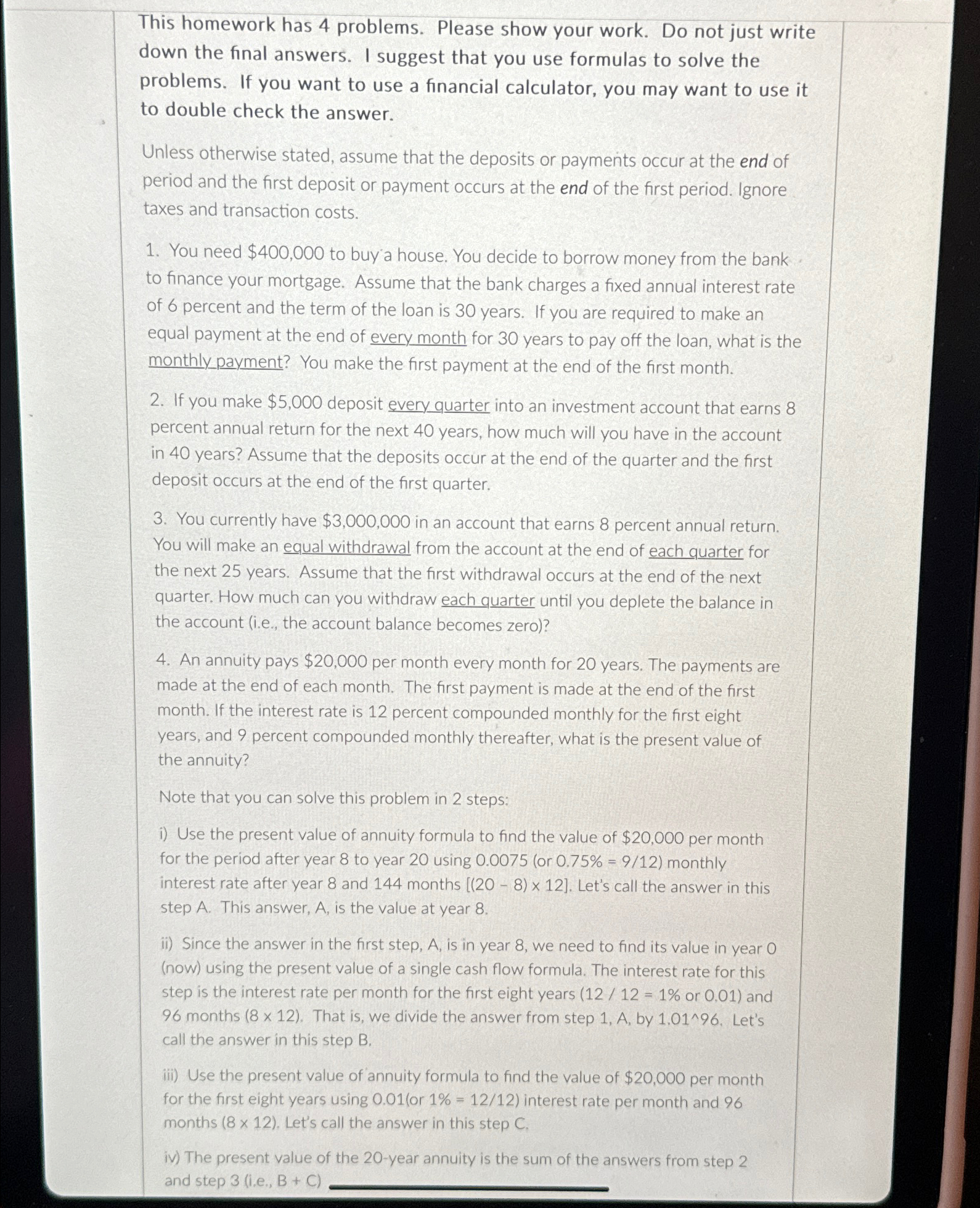
This homework is for problems. Please show your work. Do not just write down the final answers. I suggest you use formulas to solve the problems. If you want to use a financial calculator, you may want to use it to double check your answer.
Unless otherwise stated, assume that the deposits or payments occur at the end of the period and the first deposit or payment occurs at the end of the first period period. Ignore taxes and transaction cost.
Problem one. You need $ to buy a house. You decide to borrow money from the bank to finance your mortgage. Assume that the bank charges a fixed annual interest rate of in the term of the loan is years. If you're required to make an equal payment at the end of every month for years to pay off the loan, what is the monthly payment you make your first payment at the end of the first month
Probelm two.
If you make $ deposit every quarter into an investment account that earns annual return for the next years, how much will you have in the account in years? Assume that the deposits occur at the end of the quarter in the first deposit occurs at the end of the first quarter.
Problem three You currently have $ in an account that earns annual return. You will make an equal withdrawal from the account at the end of each quarter for the next years. As soon that the first draw occurs at the end of the next quarter. How much can you withdraw each quarter until you deplete the balance in the account?
Problem four. In annuity pays $ per month every month for years. The payments are made at the end of each month. The first payment is made at the end of the first month. If the interest rate is compounded monthly for the first eight years and compounded monthly thereafter, what is the present value of the annuity?
Note: you can solve this problem is two steps.
i use the present value of annuity formula to find the value of $ per month for the period after year eight to year using or monthly interest rate after year eight and months x Let's call the answer in the step a This is answer a is the value at your eight.
ii since answering the first step, a is in year eight, we will need to find its value in year zero now using the present value of a single cash flow formula. The interest rate for this step is the interestrate per month for the first eight years or and months x
That is we divide the answer from step one, a by Let's call the answer in this step B
iii use the present value of annuity formula to find the value of $ per month for the first eight years using or interest rate per month and months x Let's call the answer to the step C
iv the present value of the annuity is a sum of the answers from step two and step three BC
Step by Step Solution
There are 3 Steps involved in it
1 Expert Approved Answer
Step: 1 Unlock

Question Has Been Solved by an Expert!
Get step-by-step solutions from verified subject matter experts
Step: 2 Unlock
Step: 3 Unlock
 Study Help