







Question: This is a 1 question with components please try to do it all 4. (40 points) Consider the following expenditure function Ep,u) for Bob, where
 This is a 1 question with components please try to do it all
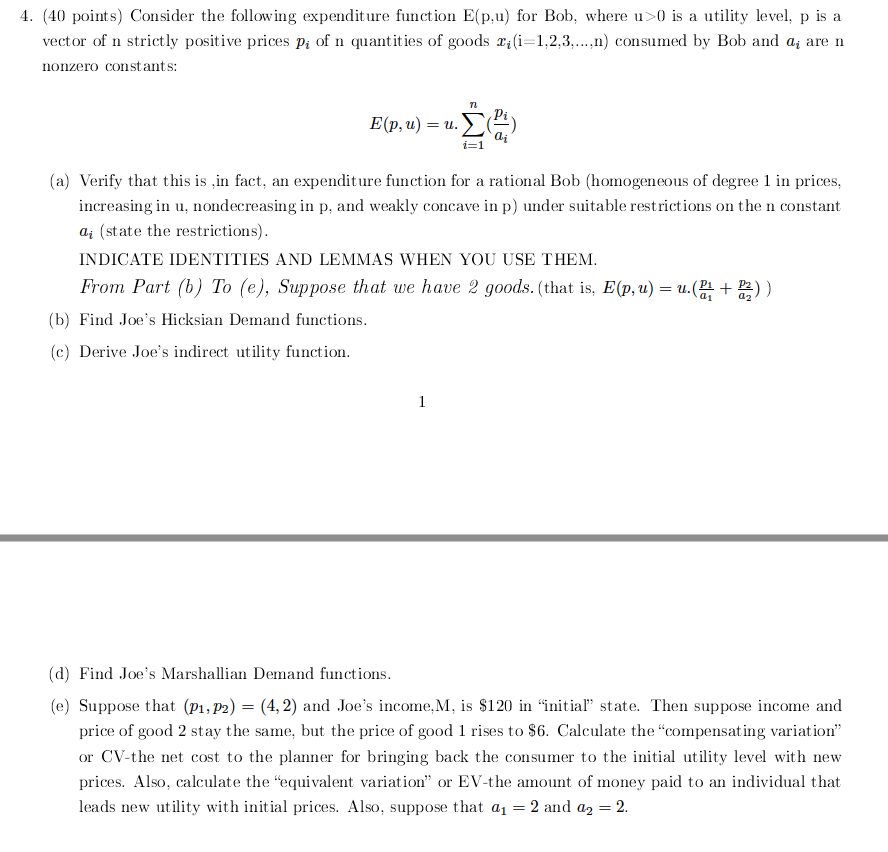
4. (40 points) Consider the following expenditure function Ep,u) for Bob, where u>0 is a utility level, p is a vector of n strictly positive prices Pi of n quantities of goods x;(i=1,2,3,...n) consumed by Bob and a; are n nonzero constants: T2 Ep,u) = u. = i=1 (a) Verify that this is , in fact, an expenditure function for a rational Bob (homogeneous of degree 1 in prices, increasing in u, nondecreasing in p, and weakly concave in p) under suitable restrictions on the n constant ai (state the restrictions). INDICATE IDENTITIES AND LEMMAS WHEN YOU USE THEM. From Part (6) To (e), Suppose that we have 2 goods. (that is, E(p, u) = u.(+ b ) ) (b) Find Joe's Hicksian Demand functions. (c) Derive Joe's indirect utility function. =. 1 (d) Find Joe's Marshallian Demand functions. (e) Suppose that (P1, P2) = (4, 2) and Joe's income, M, is $120 in "initial state. Then suppose income and price of good 2 stay the same, but the price of good 1 rises to $6. Calculate the compensating variation" or CV-the net cost to the planner for bringing back the consumer to the initial utility level with new prices. Also, calculate the "equivalent variation" or EV-the amount of money paid to an individual that leads new utility with initial prices. Also, suppose that a1 = 2 and a2 = = 2. 4. (40 points) Consider the following expenditure function Ep,u) for Bob, where u>0 is a utility level, p is a vector of n strictly positive prices Pi of n quantities of goods x;(i=1,2,3,...n) consumed by Bob and a; are n nonzero constants: T2 Ep,u) = u. = i=1 (a) Verify that this is , in fact, an expenditure function for a rational Bob (homogeneous of degree 1 in prices, increasing in u, nondecreasing in p, and weakly concave in p) under suitable restrictions on the n constant ai (state the restrictions). INDICATE IDENTITIES AND LEMMAS WHEN YOU USE THEM. From Part (6) To (e), Suppose that we have 2 goods. (that is, E(p, u) = u.(+ b ) ) (b) Find Joe's Hicksian Demand functions. (c) Derive Joe's indirect utility function. =. 1 (d) Find Joe's Marshallian Demand functions. (e) Suppose that (P1, P2) = (4, 2) and Joe's income, M, is $120 in "initial state. Then suppose income and price of good 2 stay the same, but the price of good 1 rises to $6. Calculate the compensating variation" or CV-the net cost to the planner for bringing back the consumer to the initial utility level with new prices. Also, calculate the "equivalent variation" or EV-the amount of money paid to an individual that leads new utility with initial prices. Also, suppose that a1 = 2 and a2 = = 2
Step by Step Solution
There are 3 Steps involved in it

Get step-by-step solutions from verified subject matter experts
 Study Help