







Question: this is a Analitics class. Perform Hierarchical Clustering using the fields room_type, borough, number_of_reviews, and availability_365 as [ Y Columns ). Set the number of
this is a Analitics class. 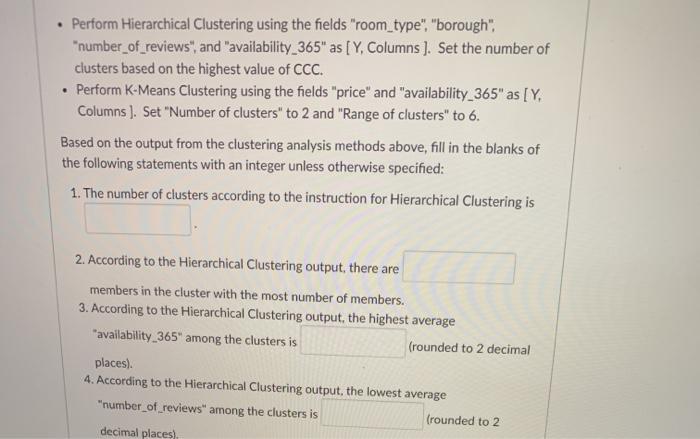
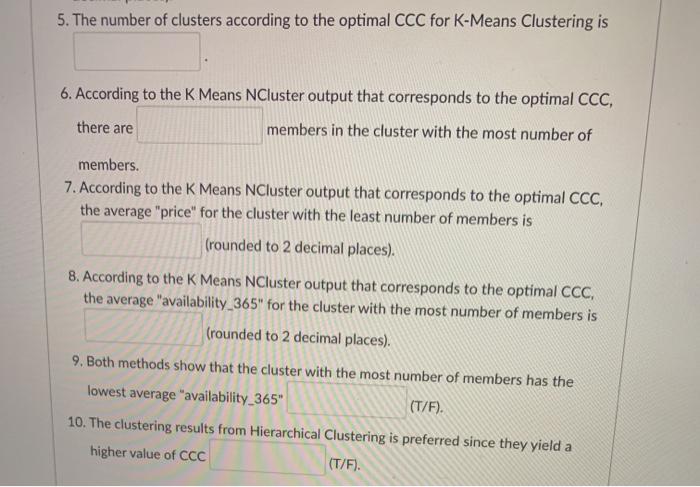
Perform Hierarchical Clustering using the fields "room_type", "borough", "number_of_reviews", and "availability_365" as [ Y Columns ). Set the number of clusters based on the highest value of CCC. Perform K-Means Clustering using the fields "price" and "availability_365" as [Y, Columns ). Set "Number of clusters" to 2 and "Range of clusters" to 6. Based on the output from the clustering analysis methods above, fill in the blanks of the following statements with an integer unless otherwise specified: 1. The number of clusters according to the instruction for Hierarchical Clustering is 2. According to the Hierarchical Clustering output, there are members in the cluster with the most number of members. 3. According to the Hierarchical Clustering output, the highest average "availability_365" among the clusters is (rounded to 2 decimal places). 4. According to the Hierarchical Clustering output, the lowest average "number_of_reviews" among the clusters is (rounded to 2 decimal places 5. The number of clusters according to the optimal CCC for K-Means Clustering is 6. According to the K Means NCluster output that corresponds to the optimal CCC, there are members in the cluster with the most number of members. 7. According to the K Means NCluster output that corresponds to the optimal CCC, the average "price" for the cluster with the least number of members is (rounded to 2 decimal places). 8. According to the K Means NCluster output that corresponds to the optimal CCC, the average "availability_365" for the cluster with the most number of members is (rounded to 2 decimal places). 9. Both methods show that the cluster with the most number of members has the lowest average "availability_365" (T/F). 10. The clustering results from Hierarchical Clustering is preferred since they yield a higher value of CCC (T/F). Perform Hierarchical Clustering using the fields "room_type", "borough", "number_of_reviews", and "availability_365" as [ Y Columns ). Set the number of clusters based on the highest value of CCC. Perform K-Means Clustering using the fields "price" and "availability_365" as [Y, Columns ). Set "Number of clusters" to 2 and "Range of clusters" to 6. Based on the output from the clustering analysis methods above, fill in the blanks of the following statements with an integer unless otherwise specified: 1. The number of clusters according to the instruction for Hierarchical Clustering is 2. According to the Hierarchical Clustering output, there are members in the cluster with the most number of members. 3. According to the Hierarchical Clustering output, the highest average "availability_365" among the clusters is (rounded to 2 decimal places). 4. According to the Hierarchical Clustering output, the lowest average "number_of_reviews" among the clusters is (rounded to 2 decimal places 5. The number of clusters according to the optimal CCC for K-Means Clustering is 6. According to the K Means NCluster output that corresponds to the optimal CCC, there are members in the cluster with the most number of members. 7. According to the K Means NCluster output that corresponds to the optimal CCC, the average "price" for the cluster with the least number of members is (rounded to 2 decimal places). 8. According to the K Means NCluster output that corresponds to the optimal CCC, the average "availability_365" for the cluster with the most number of members is (rounded to 2 decimal places). 9. Both methods show that the cluster with the most number of members has the lowest average "availability_365" (T/F). 10. The clustering results from Hierarchical Clustering is preferred since they yield a higher value of CCC (T/F)
Step by Step Solution
There are 3 Steps involved in it
1 Expert Approved Answer
Step: 1 Unlock

Question Has Been Solved by an Expert!
Get step-by-step solutions from verified subject matter experts
Step: 2 Unlock
Step: 3 Unlock
 Study Help