Question: This is a case study about Consumer protection law. can you put 3-4 questions related to it with their answers ? CONSUMER PROTECTION: COMBATTING FOOD
This is a case study about Consumer protection law. can you put 3-4 questions related to it with their answers ?
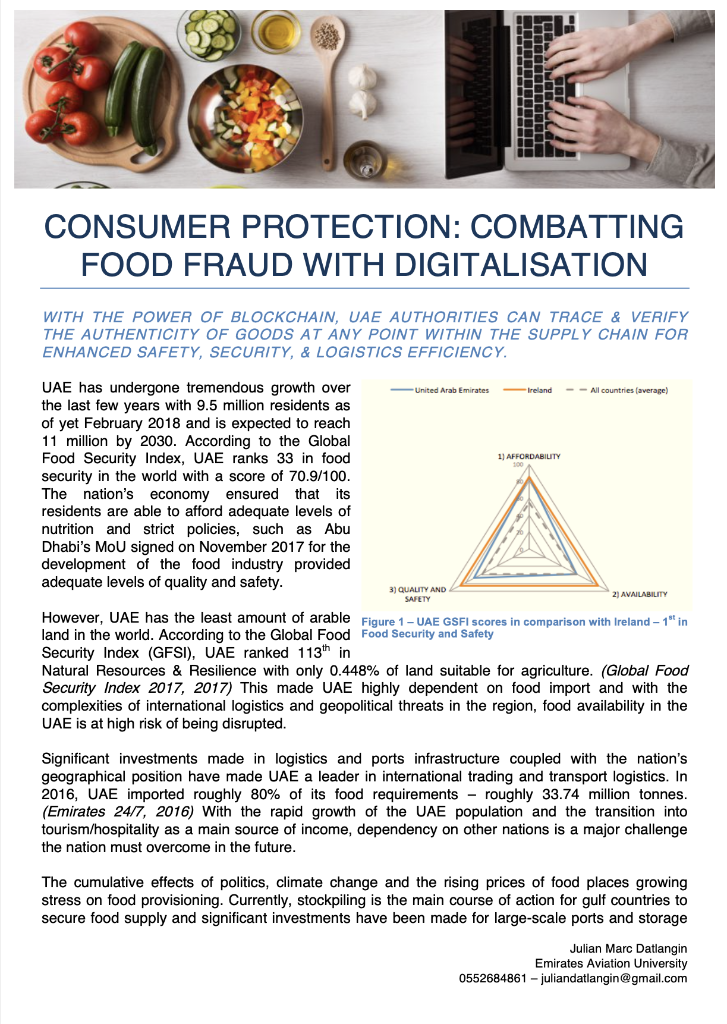
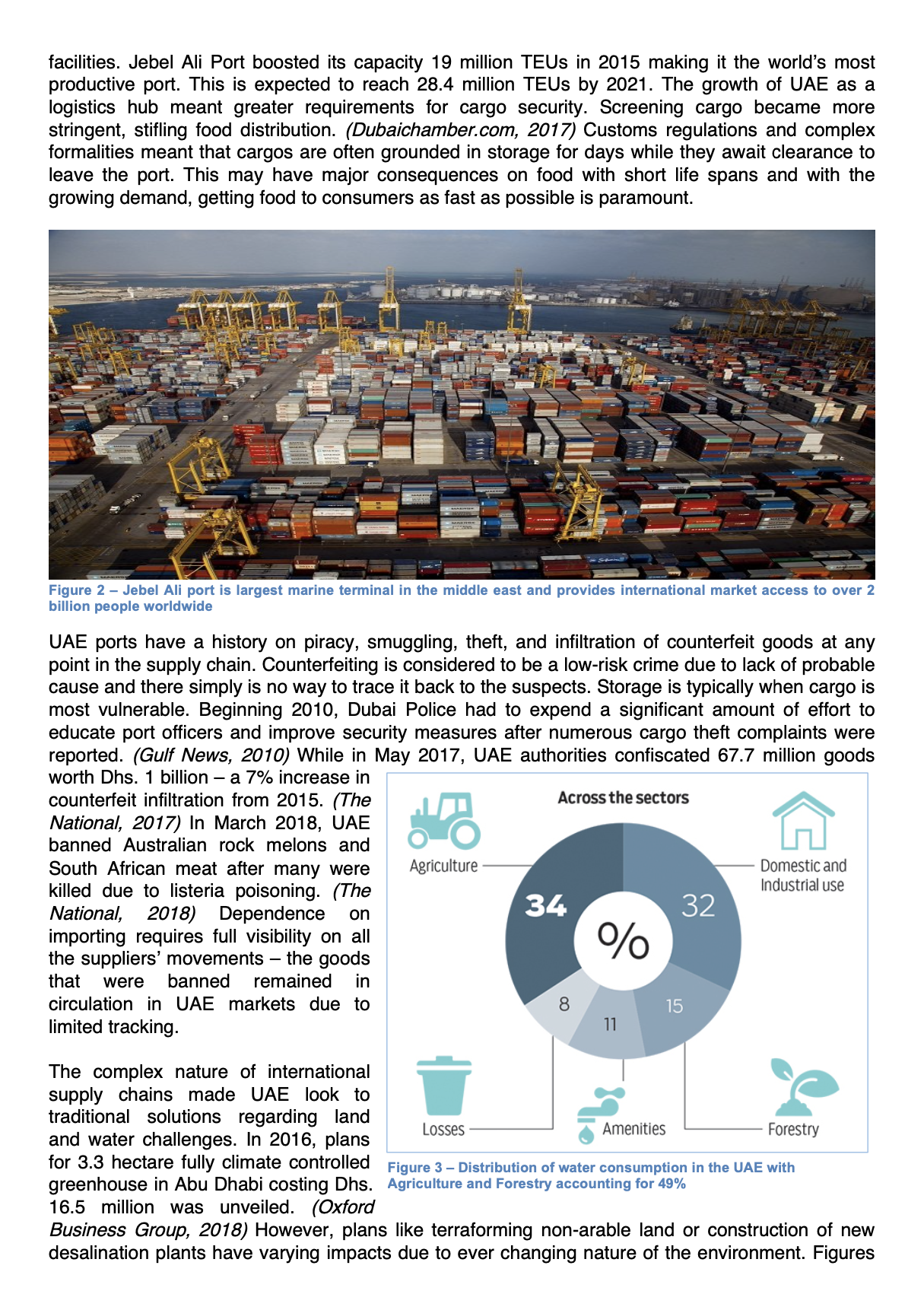
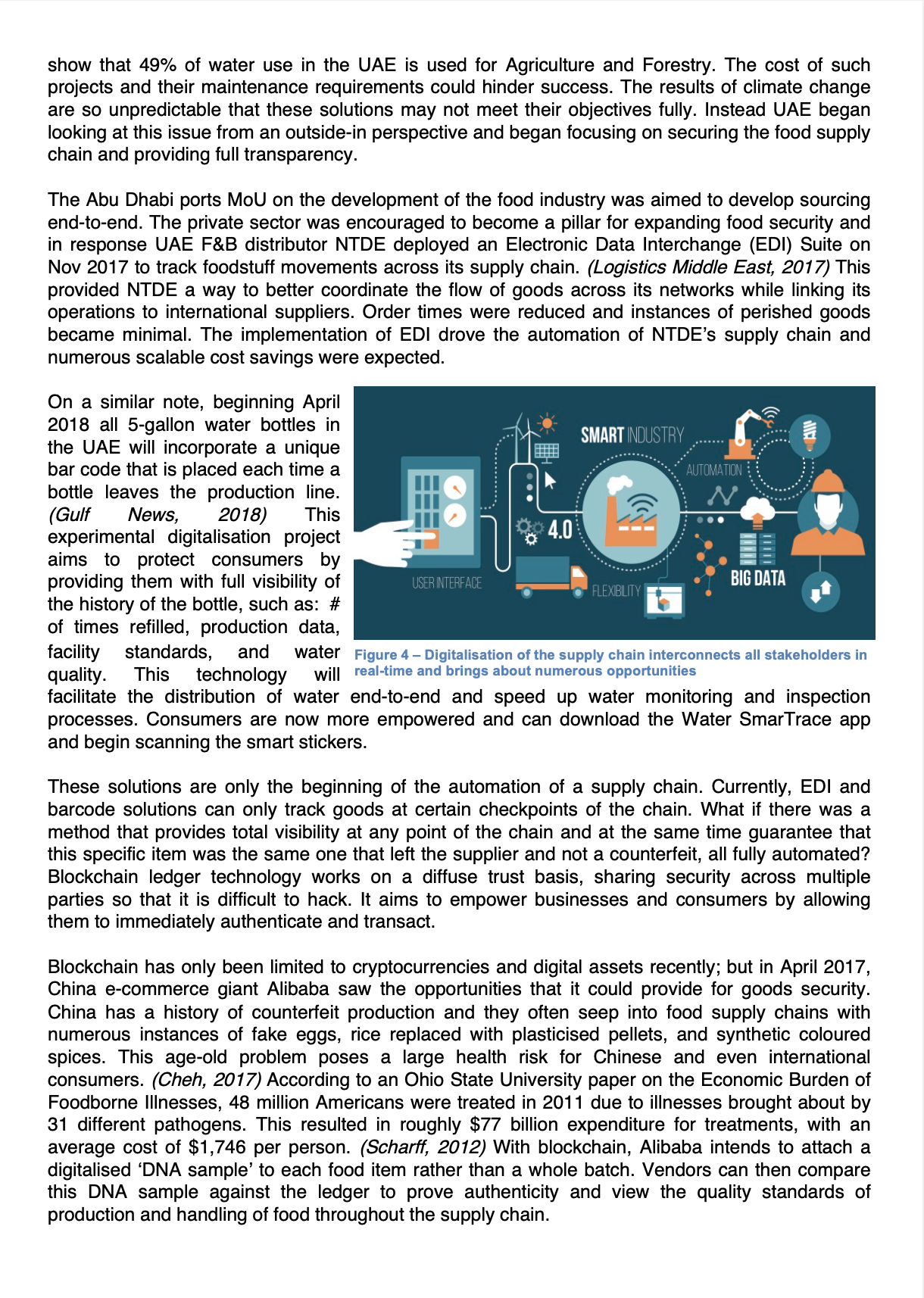
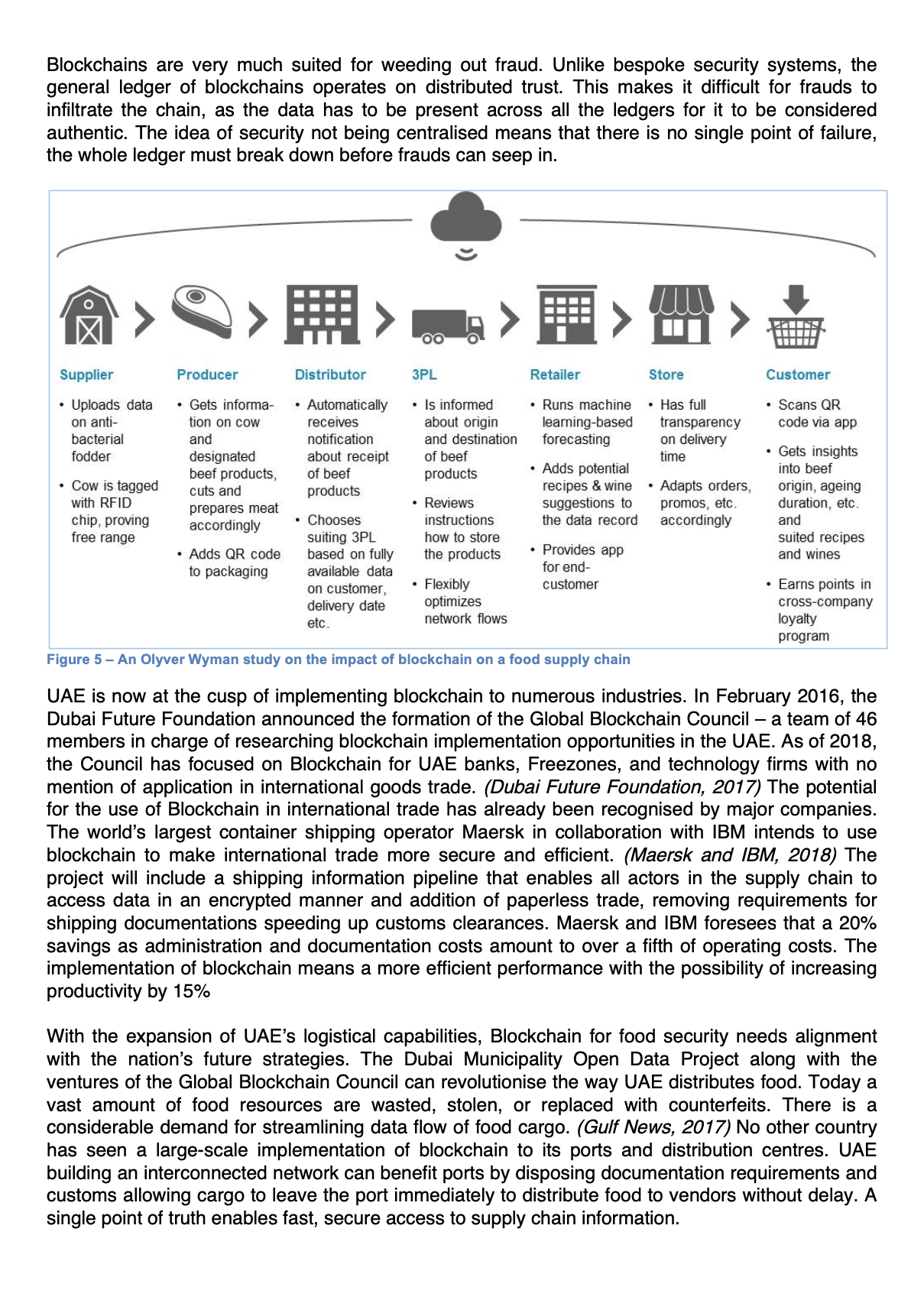
CONSUMER PROTECTION: COMBATTING FOOD FRAUD WITH DIGITALISATION WITH THE POWER OF BLOCKCHAIN, UAE AUTHORITIES CAN TRACE & VERIFY THE AUTHENTICITY OF GOODS AT ANY POINT WITHIN THE SUPPLY CHAIN FOR ENHANCED SAFETY, SECURITY, & LOGISTICS EFFICIENCY. United Arab Emirates Ireland --All countries (average) 1) AFFORDABILITY UAE has undergone tremendous growth over the last few years with 9.5 million residents as of yet February 2018 and is expected to reach 11 million by 2030. According to the Global Food Security Index, UAE ranks 33 in food security in the world with a score of 70.9/100. The nation's economy ensured that its residents are able to afford adequate levels of nutrition and strict policies, such as Abu Dhabi's MoU signed on November 2017 for the development of the food industry provided adequate levels of quality and safety. 3) QUALITY AND SAFETY 2) AVAILABILITY However, UAE has the least amount of arable Figure 1 - UAE GSFI scores in comparison with Ireland - 1" in land in the world. According to the Global Food Food Security and Safety Security Index (GFSI), UAE ranked 113th in Natural Resources & Resilience with only 0.448% of land suitable for agriculture. (Global Food Security Index 2017, 2017) This made UAE highly dependent on food import and with the complexities of international logistics and geopolitical threats in the region, food availability in the UAE is at high risk of being disrupted. Significant investments made in logistics and ports infrastructure coupled with the nation's geographical position have made UAE a leader in international trading and transport logistics. In 2016, UAE imported roughly 80% of its food requirements - roughly 33.74 million tonnes. (Emirates 24/7, 2016) With the rapid growth of the UAE population and the transition into tourism/hospitality as a main source of income, dependency on other nations is a major challenge the nation must overcome in the future. The cumulative effects of politics, climate change and the rising prices of food places growing stress on food provisioning. Currently, stockpiling is the main course of action for gulf countries to secure food supply and significant investments have been made for large-scale ports and storage Julian Marc Datlangin Emirates Aviation University 0552684861 - juliandatlangin@gmail.com facilities. Jebel Ali Port boosted its capacity 19 million TEUs in 2015 making it the world's most productive port. This is expected to reach 28.4 million TEUs by 2021. The growth of UAE as a logistics hub meant greater requirements for cargo security. Screening cargo became more stringent, stifling food distribution. (Dubaichamber.com, 2017) Customs regulations and complex formalities meant that cargos are often grounded in storage for days while they await clearance to leave the port. This may have major consequences on food with short life spans and with the growing demand, getting food to consumers as fast as possible is paramount. Figure 2 - Jebel Ali port is largest marine terminal in the middle east and provides international market access to over 2 billion people worldwide UAE ports have a history on piracy, smuggling, theft, and infiltration of counterfeit goods at any point in the supply chain. Counterfeiting is considered to be a low-risk crime due to lack of probable cause and there simply is no way to trace it back to the suspects. Storage is typically when cargo is most vulnerable. Beginning 2010, Dubai Police had to expend a significant amount of effort to educate port officers and improve security measures after numerous cargo theft complaints were reported. (Gulf News, 2010) While in May 2017, UAE authorities confiscated 67.7 million goods worth Dhs. 1 billion - a 7% increase in counterfeit infiltration from 2015. (The Across the sectors National, 2017) In March 2018, UAE banned Australian rock melons and South African meat after many were Agriculture Domestic and killed due to listeria poisoning. (The Industrial use National, 2018) Dependence 34 32 importing requires full visibility on all the suppliers' movements - the goods that were banned remained in circulation in UAE markets due to 15 limited tracking. 11 on % 8 The complex nature of international supply chains made UAE look to traditional solutions regarding land Losses Amenities Forestry and water challenges. In 2016, plans for 3.3 hectare fully climate controlled Figure 3 - Distribution of water consumption in the UAE with greenhouse in Abu Dhabi costing Dhs. Agriculture and Forestry accounting for 49% 16.5 million was unveiled. (Oxford Business Group, 2018) However, plans like terraforming non-arable land or construction of new desalination plants have varying impacts due to ever changing nature of the environment. Figures show that 49% of water use in the UAE is used for Agriculture and Forestry. The cost of such projects and their maintenance requirements could hinder success. The results of climate change are so unpredictable that these solutions may not meet their objectives fully. Instead UAE began looking at this issue from an outside-in perspective and began focusing on securing the food supply chain and providing full transparency. The Abu Dhabi ports MoU on the development of the food industry was aimed to develop sourcing end-to-end. The private sector was encouraged to become a pillar for expanding food security and in response UAE F&B distributor NTDE deployed an Electronic Data Interchange (EDI) Suite on Nov 2017 to track foodstuff movements across its supply chain. (Logistics Middle East, 2017) This provided NTDE a way to better coordinate the flow of goods across its networks while linking its operations to international suppliers. Order times were reduced and instances of perished goods became minimal. The implementation of EDI drove the automation of NTDE's supply chain and numerous scalable cost savings were expected. On a similar note, beginning April 2018 all 5-gallon water bottles in SMART INDUSTRY the UAE will incorporate a unique bar code that is placed each time a AUTOMATION bottle leaves the production line. N (Gulf News, 2018) This 4.0 experimental digitalisation project aims to protect consumers by providing them with full visibility of USER NTERFACE BIG DATA FLEXIBILITY the history of the bottle, such as: # of times refilled, production data, facility standards, and water Figure 4 Digitalisation of the supply chain interconnects all stakeholders in quality. This technology will real-time and brings about numerous opportunities facilitate the distribution of water end-to-end and speed up water monitoring and inspection processes. Consumers are now more empowered and can download the Water SmarTrace app and begin scanning the smart stickers. These solutions are only the beginning of the automation of a supply chain. Currently, EDI and barcode solutions can only track goods at certain checkpoints of the chain. What if there was a method that provides total visibility at any point of the chain and at the same time guarantee that this specific item was the same one that left the supplier and not a counterfeit, all fully automated? Blockchain ledger technology works on a diffuse trust basis, sharing security across multiple parties so that it is difficult to hack. It aims to empower businesses and consumers by allowing them to immediately authenticate and transact. Blockchain has only been limited to cryptocurrencies and digital assets recently; but in April 2017, China e-commerce giant Alibaba saw the opportunities that it could provide for goods security. China has a history of counterfeit production and they often seep into food supply chains with numerous instances of fake eggs, rice replaced with plasticised pellets, and synthetic coloured spices. This age-old problem poses a large health risk for Chinese and even international consumers. (Cheh, 2017) According to an Ohio State University paper on the Economic Burden of Foodborne Illnesses, 48 million Americans were treated in 2011 due to illnesses brought about by 31 different pathogens. This resulted in roughly $77 billion expenditure for treatments, with an average cost of $1,746 per person. (Scharff, 2012) With blockchain, Alibaba intends to attach a digitalised 'DNA sample' to each food item rather than a whole batch. Vendors can then compare this DNA sample against the ledger to prove authenticity and view the quality standards of production and handling of food throughout the supply chain. Blockchains are very much suited for weeding out fraud. Unlike bespoke security systems, the general ledger of blockchains operates on distributed trust. This makes it difficult for frauds to infiltrate the chain, as the data has to be present across all the ledgers for it to be considered authentic. The idea of security not being centralised means that there is no single point of failure, the whole ledger must break down before frauds can seep in. oo LI Supplier Producer Distributor 3PL Retailer Store Customer . Uploads data on anti- bacterial fodder Runs machine learning-based forecasting Scans QR code via app Gets informa- tion on cow and designated beef products, cuts and prepares meat accordingly Automatically receives notification about receipt of beef products Is informed about origin and destination of beef products Has full transparency on delivery time Cow is tagged with RFID chip, proving free range Adds potential recipes & wine suggestions to the data record Reviews instructions how to store the products Adapts orders, promos, etc. accordingly Gets insights into beef origin, ageing duration, etc. and suited recipes and wines Adds QR code to packaging Chooses suiting 3PL based on fully available data on customer, delivery date etc. Provides app for end- customer Flexibly optimizes network flows Earns points in cross-company loyalty program Figure 5 - An Olyver Wyman study on the impact of blockchain on a food supply chain UAE is now at the cusp of implementing blockchain to numerous industries. In February 2016, the Dubai Future Foundation announced the formation of the Global Blockchain Council - a team of 46 members in charge of researching blockchain implementation opportunities in the UAE. As of 2018, the Council has focused on Blockchain for UAE banks, Freezones, and technology firms with no mention of application in international goods trade. (Dubai Future Foundation, 2017) The potential for the use of Blockchain in international trade has already been recognised by major companies. The world's largest container shipping operator Maersk in collaboration with IBM intends to use blockchain to make international trade more secure and efficient. (Maersk and IBM, 2018) The project will include a shipping information pipeline that enables all actors in the supply chain to access data in an encrypted manner and addition of paperless trade, removing requirements for shipping documentations speeding up customs clearances. Maersk and IBM foresees that a 20% savings as administration and documentation costs amount to over a fifth of operating costs. The implementation of blockchain means a more efficient performance with the possibility of increasing productivity by 15% With the expansion of UAE's logistical capabilities, Blockchain for food security needs alignment with the nation's future strategies. The Dubai Municipality Open Data Project along with the ventures of the Global Blockchain Council can revolutionise the way UAE distributes food. Today a vast amount of food resources are wasted, stolen, or replaced with counterfeits. There is a considerable demand for streamlining data flow of food cargo. (Gulf News, 2017) No other country has seen a large-scale implementation of blockchain to its ports and distribution centres. UAE building an interconnected network can benefit ports by disposing documentation requirements and customs allowing cargo to leave the port immediately to distribute food to vendors without delay. A single point of truth enables fast, secure access to supply chain information. UAE has already felt the impact of digitalisation on its supply chain. In 2012, UAE Customs announced that the implementation of Data Sharing has helped the department efficiently analyse 15 million cargoes through intelligence gathering. The Platform assisted Dubai Customs officials seize 6,987 illegal shipments (The National, 2012). The constant threat that counterfeit food presents to consumers is ever present. UAE along with blockchain can lead the global supply chain and seize new untapped opportunities of a rapidly changing digital world. Name: Julian Marc Datlangin University: Emirates Aviation University Mobile Number: 0552684861 E-mail: juliandatlangin@gmail.com REFERENCES Cheh, S. (2017). Alibaba takes on China's fake food scams with blockchain technology. [online] Tech Wire Asia. Available at: http://techwireasia.com/2017/04/alibaba-takes-chinas-fake-food-scams-blockchain-technology/ [Accessed 31 Mar. 2018]. Dubai Future Foundation. (2017). Global Blockchain Council - Dubai Future Foundation. [online] Available at: http://www.dubaifuture.gov.ae/our-initiatives/global-blockchain-councill [Accessed 31 Mar. 2018]. Dubaichamber.com. (2017). Expansion, investments expected to drive UAE logistics sector growth / Dubai Chamber. [online] Available at: http://www.dubaichamber.com/whats-happening/chamber_news/expansion-investments-expected-to-drive-uae- logistics-sector-growth [Accessed 31 Mar. 2018]. Emirates 24/7 (2016). UAE imports 80% of its food needs: Al Mansouri. Global Food Security Index 2017. (2017). Measuring Food Security and the Impact of Resource Risks. Economist Intelligence Unit. Gulf News (2010). Police provide help to combat cargo theft. Gulf News (2017). What is blockchain, and why do the UAE and Saudi Arabia want to use it?. Gulf News (2018). Track your water bottles in Dubai. Logistics Middle East. (2017). UAE F&B distributor deploys EDI for food logistics. [online] Available at: https://www.logisticsmiddleeast.com/article-13681-uae-fb-distributor-deploys-edi-for-food-logistics (Accessed 31 Mar. 2018]. Maersk and IBM (2018). Maersk and IBM to form joint venture applying blockchain to improve global trade and digitise supply chains. Oxford Business Group (2018). Investment in sustainable farming and new technology supports Abu Dhabi's efforts to boost local agricultural production. [online] Oxford Business Group. Available at: https://oxfordbusinessgroup.comews/investment- sustainable-farming-and-new-technology-supports-abu-dhabi's-efforts-boost-local [Accessed 31 Mar. 2018]. Scharff, R. (2012). Economic Burden from Health Losses Due to Foodborne Illness in the United States. Journal of Food Protection, 75(1), pp. 123-131. The National (2012). Data sharing 'has helped Customs reduce smuggling'. The National (2017). Dubai seizes Dh1bn worth of fake goods. The National (2018). UAE bans South African meat from two firms following listeria outbreak. CONSUMER PROTECTION: COMBATTING FOOD FRAUD WITH DIGITALISATION WITH THE POWER OF BLOCKCHAIN, UAE AUTHORITIES CAN TRACE & VERIFY THE AUTHENTICITY OF GOODS AT ANY POINT WITHIN THE SUPPLY CHAIN FOR ENHANCED SAFETY, SECURITY, & LOGISTICS EFFICIENCY. United Arab Emirates Ireland --All countries (average) 1) AFFORDABILITY UAE has undergone tremendous growth over the last few years with 9.5 million residents as of yet February 2018 and is expected to reach 11 million by 2030. According to the Global Food Security Index, UAE ranks 33 in food security in the world with a score of 70.9/100. The nation's economy ensured that its residents are able to afford adequate levels of nutrition and strict policies, such as Abu Dhabi's MoU signed on November 2017 for the development of the food industry provided adequate levels of quality and safety. 3) QUALITY AND SAFETY 2) AVAILABILITY However, UAE has the least amount of arable Figure 1 - UAE GSFI scores in comparison with Ireland - 1" in land in the world. According to the Global Food Food Security and Safety Security Index (GFSI), UAE ranked 113th in Natural Resources & Resilience with only 0.448% of land suitable for agriculture. (Global Food Security Index 2017, 2017) This made UAE highly dependent on food import and with the complexities of international logistics and geopolitical threats in the region, food availability in the UAE is at high risk of being disrupted. Significant investments made in logistics and ports infrastructure coupled with the nation's geographical position have made UAE a leader in international trading and transport logistics. In 2016, UAE imported roughly 80% of its food requirements - roughly 33.74 million tonnes. (Emirates 24/7, 2016) With the rapid growth of the UAE population and the transition into tourism/hospitality as a main source of income, dependency on other nations is a major challenge the nation must overcome in the future. The cumulative effects of politics, climate change and the rising prices of food places growing stress on food provisioning. Currently, stockpiling is the main course of action for gulf countries to secure food supply and significant investments have been made for large-scale ports and storage Julian Marc Datlangin Emirates Aviation University 0552684861 - juliandatlangin@gmail.com facilities. Jebel Ali Port boosted its capacity 19 million TEUs in 2015 making it the world's most productive port. This is expected to reach 28.4 million TEUs by 2021. The growth of UAE as a logistics hub meant greater requirements for cargo security. Screening cargo became more stringent, stifling food distribution. (Dubaichamber.com, 2017) Customs regulations and complex formalities meant that cargos are often grounded in storage for days while they await clearance to leave the port. This may have major consequences on food with short life spans and with the growing demand, getting food to consumers as fast as possible is paramount. Figure 2 - Jebel Ali port is largest marine terminal in the middle east and provides international market access to over 2 billion people worldwide UAE ports have a history on piracy, smuggling, theft, and infiltration of counterfeit goods at any point in the supply chain. Counterfeiting is considered to be a low-risk crime due to lack of probable cause and there simply is no way to trace it back to the suspects. Storage is typically when cargo is most vulnerable. Beginning 2010, Dubai Police had to expend a significant amount of effort to educate port officers and improve security measures after numerous cargo theft complaints were reported. (Gulf News, 2010) While in May 2017, UAE authorities confiscated 67.7 million goods worth Dhs. 1 billion - a 7% increase in counterfeit infiltration from 2015. (The Across the sectors National, 2017) In March 2018, UAE banned Australian rock melons and South African meat after many were Agriculture Domestic and killed due to listeria poisoning. (The Industrial use National, 2018) Dependence 34 32 importing requires full visibility on all the suppliers' movements - the goods that were banned remained in circulation in UAE markets due to 15 limited tracking. 11 on % 8 The complex nature of international supply chains made UAE look to traditional solutions regarding land Losses Amenities Forestry and water challenges. In 2016, plans for 3.3 hectare fully climate controlled Figure 3 - Distribution of water consumption in the UAE with greenhouse in Abu Dhabi costing Dhs. Agriculture and Forestry accounting for 49% 16.5 million was unveiled. (Oxford Business Group, 2018) However, plans like terraforming non-arable land or construction of new desalination plants have varying impacts due to ever changing nature of the environment. Figures show that 49% of water use in the UAE is used for Agriculture and Forestry. The cost of such projects and their maintenance requirements could hinder success. The results of climate change are so unpredictable that these solutions may not meet their objectives fully. Instead UAE began looking at this issue from an outside-in perspective and began focusing on securing the food supply chain and providing full transparency. The Abu Dhabi ports MoU on the development of the food industry was aimed to develop sourcing end-to-end. The private sector was encouraged to become a pillar for expanding food security and in response UAE F&B distributor NTDE deployed an Electronic Data Interchange (EDI) Suite on Nov 2017 to track foodstuff movements across its supply chain. (Logistics Middle East, 2017) This provided NTDE a way to better coordinate the flow of goods across its networks while linking its operations to international suppliers. Order times were reduced and instances of perished goods became minimal. The implementation of EDI drove the automation of NTDE's supply chain and numerous scalable cost savings were expected. On a similar note, beginning April 2018 all 5-gallon water bottles in SMART INDUSTRY the UAE will incorporate a unique bar code that is placed each time a AUTOMATION bottle leaves the production line. N (Gulf News, 2018) This 4.0 experimental digitalisation project aims to protect consumers by providing them with full visibility of USER NTERFACE BIG DATA FLEXIBILITY the history of the bottle, such as: # of times refilled, production data, facility standards, and water Figure 4 Digitalisation of the supply chain interconnects all stakeholders in quality. This technology will real-time and brings about numerous opportunities facilitate the distribution of water end-to-end and speed up water monitoring and inspection processes. Consumers are now more empowered and can download the Water SmarTrace app and begin scanning the smart stickers. These solutions are only the beginning of the automation of a supply chain. Currently, EDI and barcode solutions can only track goods at certain checkpoints of the chain. What if there was a method that provides total visibility at any point of the chain and at the same time guarantee that this specific item was the same one that left the supplier and not a counterfeit, all fully automated? Blockchain ledger technology works on a diffuse trust basis, sharing security across multiple parties so that it is difficult to hack. It aims to empower businesses and consumers by allowing them to immediately authenticate and transact. Blockchain has only been limited to cryptocurrencies and digital assets recently; but in April 2017, China e-commerce giant Alibaba saw the opportunities that it could provide for goods security. China has a history of counterfeit production and they often seep into food supply chains with numerous instances of fake eggs, rice replaced with plasticised pellets, and synthetic coloured spices. This age-old problem poses a large health risk for Chinese and even international consumers. (Cheh, 2017) According to an Ohio State University paper on the Economic Burden of Foodborne Illnesses, 48 million Americans were treated in 2011 due to illnesses brought about by 31 different pathogens. This resulted in roughly $77 billion expenditure for treatments, with an average cost of $1,746 per person. (Scharff, 2012) With blockchain, Alibaba intends to attach a digitalised 'DNA sample' to each food item rather than a whole batch. Vendors can then compare this DNA sample against the ledger to prove authenticity and view the quality standards of production and handling of food throughout the supply chain. Blockchains are very much suited for weeding out fraud. Unlike bespoke security systems, the general ledger of blockchains operates on distributed trust. This makes it difficult for frauds to infiltrate the chain, as the data has to be present across all the ledgers for it to be considered authentic. The idea of security not being centralised means that there is no single point of failure, the whole ledger must break down before frauds can seep in. oo LI Supplier Producer Distributor 3PL Retailer Store Customer . Uploads data on anti- bacterial fodder Runs machine learning-based forecasting Scans QR code via app Gets informa- tion on cow and designated beef products, cuts and prepares meat accordingly Automatically receives notification about receipt of beef products Is informed about origin and destination of beef products Has full transparency on delivery time Cow is tagged with RFID chip, proving free range Adds potential recipes & wine suggestions to the data record Reviews instructions how to store the products Adapts orders, promos, etc. accordingly Gets insights into beef origin, ageing duration, etc. and suited recipes and wines Adds QR code to packaging Chooses suiting 3PL based on fully available data on customer, delivery date etc. Provides app for end- customer Flexibly optimizes network flows Earns points in cross-company loyalty program Figure 5 - An Olyver Wyman study on the impact of blockchain on a food supply chain UAE is now at the cusp of implementing blockchain to numerous industries. In February 2016, the Dubai Future Foundation announced the formation of the Global Blockchain Council - a team of 46 members in charge of researching blockchain implementation opportunities in the UAE. As of 2018, the Council has focused on Blockchain for UAE banks, Freezones, and technology firms with no mention of application in international goods trade. (Dubai Future Foundation, 2017) The potential for the use of Blockchain in international trade has already been recognised by major companies. The world's largest container shipping operator Maersk in collaboration with IBM intends to use blockchain to make international trade more secure and efficient. (Maersk and IBM, 2018) The project will include a shipping information pipeline that enables all actors in the supply chain to access data in an encrypted manner and addition of paperless trade, removing requirements for shipping documentations speeding up customs clearances. Maersk and IBM foresees that a 20% savings as administration and documentation costs amount to over a fifth of operating costs. The implementation of blockchain means a more efficient performance with the possibility of increasing productivity by 15% With the expansion of UAE's logistical capabilities, Blockchain for food security needs alignment with the nation's future strategies. The Dubai Municipality Open Data Project along with the ventures of the Global Blockchain Council can revolutionise the way UAE distributes food. Today a vast amount of food resources are wasted, stolen, or replaced with counterfeits. There is a considerable demand for streamlining data flow of food cargo. (Gulf News, 2017) No other country has seen a large-scale implementation of blockchain to its ports and distribution centres. UAE building an interconnected network can benefit ports by disposing documentation requirements and customs allowing cargo to leave the port immediately to distribute food to vendors without delay. A single point of truth enables fast, secure access to supply chain information. UAE has already felt the impact of digitalisation on its supply chain. In 2012, UAE Customs announced that the implementation of Data Sharing has helped the department efficiently analyse 15 million cargoes through intelligence gathering. The Platform assisted Dubai Customs officials seize 6,987 illegal shipments (The National, 2012). The constant threat that counterfeit food presents to consumers is ever present. UAE along with blockchain can lead the global supply chain and seize new untapped opportunities of a rapidly changing digital world. Name: Julian Marc Datlangin University: Emirates Aviation University Mobile Number: 0552684861 E-mail: juliandatlangin@gmail.com REFERENCES Cheh, S. (2017). Alibaba takes on China's fake food scams with blockchain technology. [online] Tech Wire Asia. Available at: http://techwireasia.com/2017/04/alibaba-takes-chinas-fake-food-scams-blockchain-technology/ [Accessed 31 Mar. 2018]. Dubai Future Foundation. (2017). Global Blockchain Council - Dubai Future Foundation. [online] Available at: http://www.dubaifuture.gov.ae/our-initiatives/global-blockchain-councill [Accessed 31 Mar. 2018]. Dubaichamber.com. (2017). Expansion, investments expected to drive UAE logistics sector growth / Dubai Chamber. [online] Available at: http://www.dubaichamber.com/whats-happening/chamber_news/expansion-investments-expected-to-drive-uae- logistics-sector-growth [Accessed 31 Mar. 2018]. Emirates 24/7 (2016). UAE imports 80% of its food needs: Al Mansouri. Global Food Security Index 2017. (2017). Measuring Food Security and the Impact of Resource Risks. Economist Intelligence Unit. Gulf News (2010). Police provide help to combat cargo theft. Gulf News (2017). What is blockchain, and why do the UAE and Saudi Arabia want to use it?. Gulf News (2018). Track your water bottles in Dubai. Logistics Middle East. (2017). UAE F&B distributor deploys EDI for food logistics. [online] Available at: https://www.logisticsmiddleeast.com/article-13681-uae-fb-distributor-deploys-edi-for-food-logistics (Accessed 31 Mar. 2018]. Maersk and IBM (2018). Maersk and IBM to form joint venture applying blockchain to improve global trade and digitise supply chains. Oxford Business Group (2018). Investment in sustainable farming and new technology supports Abu Dhabi's efforts to boost local agricultural production. [online] Oxford Business Group. Available at: https://oxfordbusinessgroup.comews/investment- sustainable-farming-and-new-technology-supports-abu-dhabi's-efforts-boost-local [Accessed 31 Mar. 2018]. Scharff, R. (2012). Economic Burden from Health Losses Due to Foodborne Illness in the United States. Journal of Food Protection, 75(1), pp. 123-131. The National (2012). Data sharing 'has helped Customs reduce smuggling'. The National (2017). Dubai seizes Dh1bn worth of fake goods. The National (2018). UAE bans South African meat from two firms following listeria outbreak









 Study Help