







Question: This is a cryptography question from the book Introduction to Modern Cryptography by Katz and Lindell. If needed, please refer to the textbook's online pdf
This is a cryptography question from the book Introduction to Modern Cryptography by Katz and Lindell. If needed, please refer to the textbook's online pdf (http://www.cs.sfu.ca/CourseCentral/404/abulatov/exercises/sol4-15.pdf (Exercise 8.3) to answer the question.
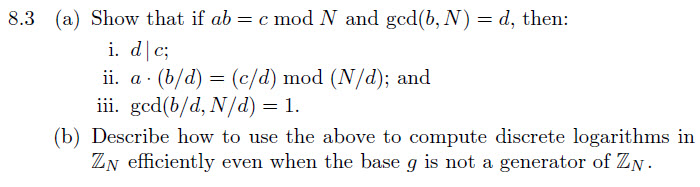
8.3 (a) Show that if ab c mod N and gcd(b, NY) d, then i. d c 11 a (b/d) (c/ mod (N/d); and iii. gcd(b/d, N/d) 1. (b) Describe how to use the above to compute discrete logarithms in N efficiently even when the base g is not a generator of ZN 8.3 (a) Show that if ab c mod N and gcd(b, NY) d, then i. d c 11 a (b/d) (c/ mod (N/d); and iii. gcd(b/d, N/d) 1. (b) Describe how to use the above to compute discrete logarithms in N efficiently even when the base g is not a generator of ZN
Step by Step Solution
There are 3 Steps involved in it

Get step-by-step solutions from verified subject matter experts
 Study Help