Question: This is a Linear Algebra Question. Both the QUESTION and SOLUTION are shown below: I only have a question regarding part b). I have included
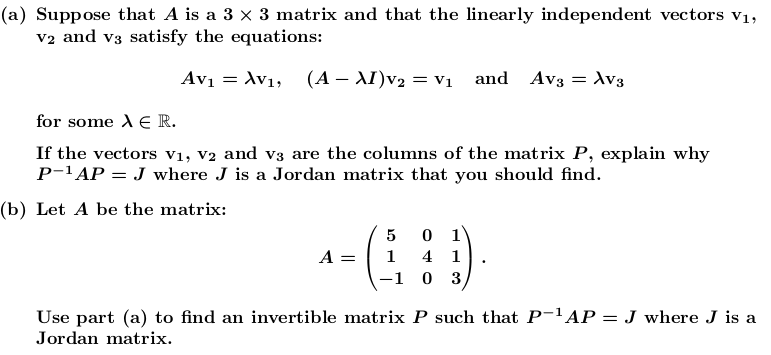
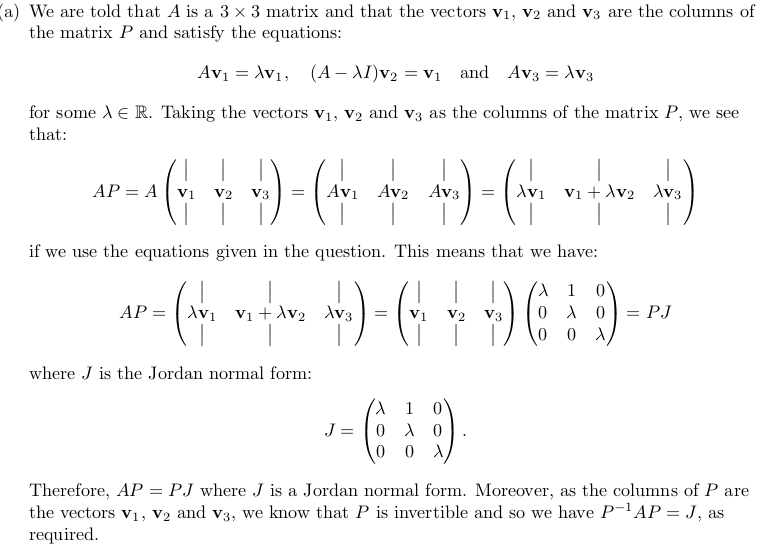
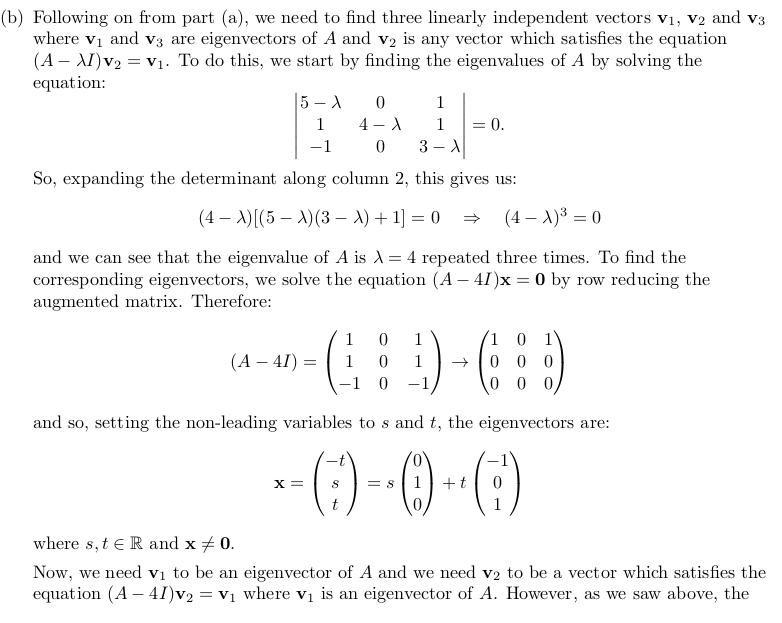
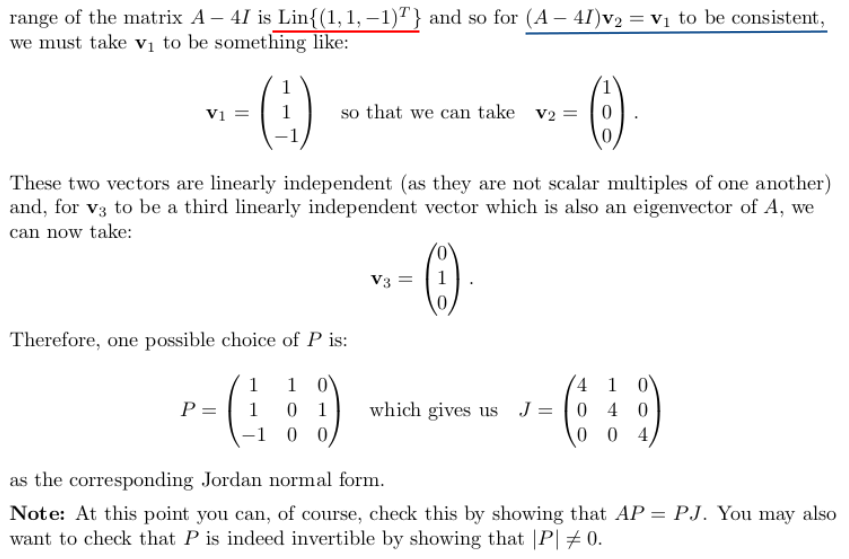
This is a Linear Algebra Question. Both the QUESTION and SOLUTION are shown below:
I only have a question regarding part b). I have included part a) for clarity.
Question regarding RED underlined text below
- I do not understand where ?Lin{(1,1,?1)T}? is obtained from
Question regarding BLUE underlined text below
- Show how ?(A?4I)v2?=v1?? is consistent ? Why is it consistent ?
Please explain clearly showing each step as thoroughly as possible.
If you are using hand-written notes, then please ensure they are tidy and legible as untidy written notes are difficult to interpret.
Alternatively use LaTeX.
QUESTION
(a) Suppose that A is a 3 x 3 matrix and that the linearly independent vectors v1, v2 and v3 satisfy the equations: Av1 = Avi; (A - XI)v2 = v1 and Avg = AV3 for some X E R. If the vectors v1, v2 and vs are the columns of the matrix P, explain why P-1AP = J where J is a Jordan matrix that you should find. (b) Let A be the matrix: 5 O A = 1 4 1 O 3 Use part (a) to find an invertible matrix P such that PAP = J where J is a Jordan matrix.{a} We are told that A is a 3 X 3 matrix and that the vectors V1, V2 and V3 are the columns of the matrix P and satisfy the equations: AV1 2 AV], [A AUVQ 2 V1 and AV3 = AV3 for some A E R. Taking the vectors V1, V2 and V3 as the columns of the matrix P, we see that: APZA V1 V2 V3 2 AV] AVQ AV3 2 AV] V1+AV2 AV3 if we use the equations given in the question. This means that we have: ( I I I ) (I I I) (A 1 AP: AV] V1 +AV2 lVg 2 V1 V2 V3 0 A I I I I I I '3' '3' where J is the Jordan normal form: .'HCIC: A11} J=A 00):. Therefore, AP 2 PJ where J is a Jordan normal form. Moreover, as the columns of P are the vectors V1, V2 and V3, we know that P is invertible and so we have P_1AP = J, as required. (b) Following on from part (a), we need to find three linearly independent vectors v1, v2 and v3 where v1 and v3 are eigenvectors of A and v2 is any vector which satisfies the equation (A - XI) v2 = v1. To do this, we start by finding the eigenvalues of A by solving the equation: 5 - X 1 = 0. 3 - X So, expanding the determinant along column 2, this gives us: (4 - X)[(5 - X)(3 - A) + 1]=0 = (4-1)3=0 and we can see that the eigenvalue of A is A = 4 repeated three times. To find the corresponding eigenvectors, we solve the equation (A -4/)x =0 by row reducing the augmented matrix. Therefore: (A - 41) = 0 0 and so, setting the non-leading variables to s and t, the eigenvectors are: X = where s, te R and x * 0. Now, we need v1 to be an eigenvector of A and we need v2 to be a vector which satisfies the equation (A-41)v2 = vi where v1 is an eigenvector of A. However, as we saw above, therange of the matrix A 41' is Lin{(1,1,1)T} and so for (A 41hr; 2 v1 to be consistent, we must take v1 to be something like: 1 1 v1 = (I) sothat we can take V2 = () . 1 0 These two vectors are linearly independent {as they are not scalar multiples of one another) and, for V3 to he a third linearly independent vector which is also an eigenvector of A, we can now take: 0 V3 = 1 . 0 Therefore, one possible choice of P is: 1 1 I] 4 1 l} P = 1 [l 1 which gives us J = 4 0 1 0 [I 0 [I 4 as the corresponding Jordan normal form. Note: At this point you can, of course, check this by showing that AP = PJ. You may also want to check that P is indeed invertible by showing that |P| 34E 0









 Study Help