







Question: This is a MATLAB Ccode Problem 20 Solution Six MATLAB Grade Mal Mpotong bao ASC210 Project 2 - www mounts/3033821021/problem/345710 problem solutionsew Brian Kouse Mpoki
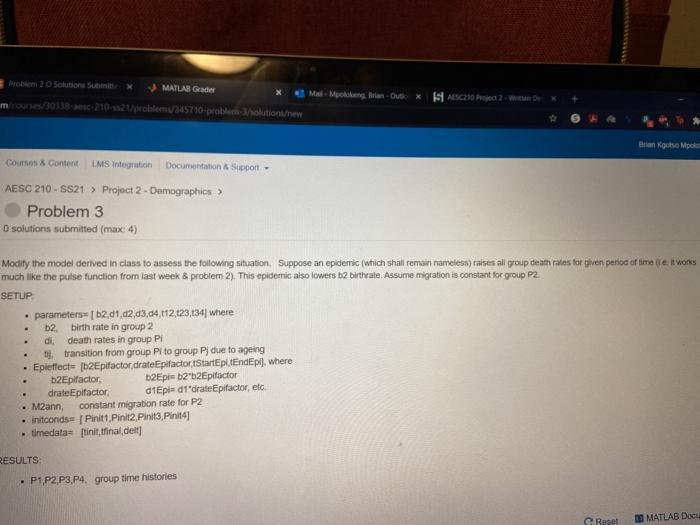
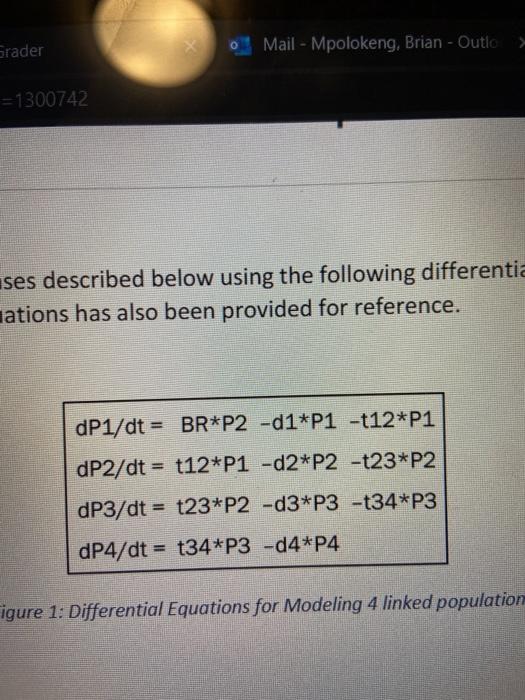
Problem 20 Solution Six MATLAB Grade Mal Mpotong bao ASC210 Project 2 - www mounts/3033821021/problem/345710 problem solutionsew Brian Kouse Mpoki Course Content LMS Integration Documentation & Support AESC 210-SS21 > Project 2-Demographics > Problem 3 O solutions submitted (max 4) - . Modity the model derived in class to assess the following situation. Suppose an epideric (which shall remain nameless) raises all group death rates for giver period of time lle tworks much like the pulse function from last week & problem 2). This epidemic also lowers b2 birtheate. Assume migration is constant for group P2. SETUP parameters= [62.01,12,13,04,112,123,134] where b2 birth rate in group 2 di death rates in group PI o transition from group Pi to group PJ due to ageing Epleffect [b2Epifactor,drateEpifactor StartEp. tEndEpil, where b2Epifactor D2Epie b2b2Epifactor drateEpifactor d1 Epi=d1"drateEpifactor, etc Mann, constant migration rate for P2 Initconds [Pinit1 Pinit2. Pinit3 Pinit4) . timedata= [tinit,tfinal delt . RESULTS P1,P2 P3, P4, group time histories e Reset MATLAB Docu Grader Mail - Mpolokeng, Brian - Outlo > =1300742 ses described below using the following differentia nations has also been provided for reference. dP1/dt = BR*P2 -d1*P1 -t12*P1 dP2/dt = t12*P1 -d2*P2 -t23*P2 dP3/dt = t23*P2 -d3*P3 -t34*P3 dP4/dt = t34*P3 -d4*P4 igure 1: Differential Equations for Modeling 4 linked population Problem 20 Solution Six MATLAB Grade Mal Mpotong bao ASC210 Project 2 - www mounts/3033821021/problem/345710 problem solutionsew Brian Kouse Mpoki Course Content LMS Integration Documentation & Support AESC 210-SS21 > Project 2-Demographics > Problem 3 O solutions submitted (max 4) - . Modity the model derived in class to assess the following situation. Suppose an epideric (which shall remain nameless) raises all group death rates for giver period of time lle tworks much like the pulse function from last week & problem 2). This epidemic also lowers b2 birtheate. Assume migration is constant for group P2. SETUP parameters= [62.01,12,13,04,112,123,134] where b2 birth rate in group 2 di death rates in group PI o transition from group Pi to group PJ due to ageing Epleffect [b2Epifactor,drateEpifactor StartEp. tEndEpil, where b2Epifactor D2Epie b2b2Epifactor drateEpifactor d1 Epi=d1"drateEpifactor, etc Mann, constant migration rate for P2 Initconds [Pinit1 Pinit2. Pinit3 Pinit4) . timedata= [tinit,tfinal delt . RESULTS P1,P2 P3, P4, group time histories e Reset MATLAB Docu Grader Mail - Mpolokeng, Brian - Outlo > =1300742 ses described below using the following differentia nations has also been provided for reference. dP1/dt = BR*P2 -d1*P1 -t12*P1 dP2/dt = t12*P1 -d2*P2 -t23*P2 dP3/dt = t23*P2 -d3*P3 -t34*P3 dP4/dt = t34*P3 -d4*P4 igure 1: Differential Equations for Modeling 4 linked population
Step by Step Solution
There are 3 Steps involved in it

Get step-by-step solutions from verified subject matter experts
 Study Help