







Question: This is a python program. One of the most useful things that you can use Python to do is clean up or convert data in
This is a python program.
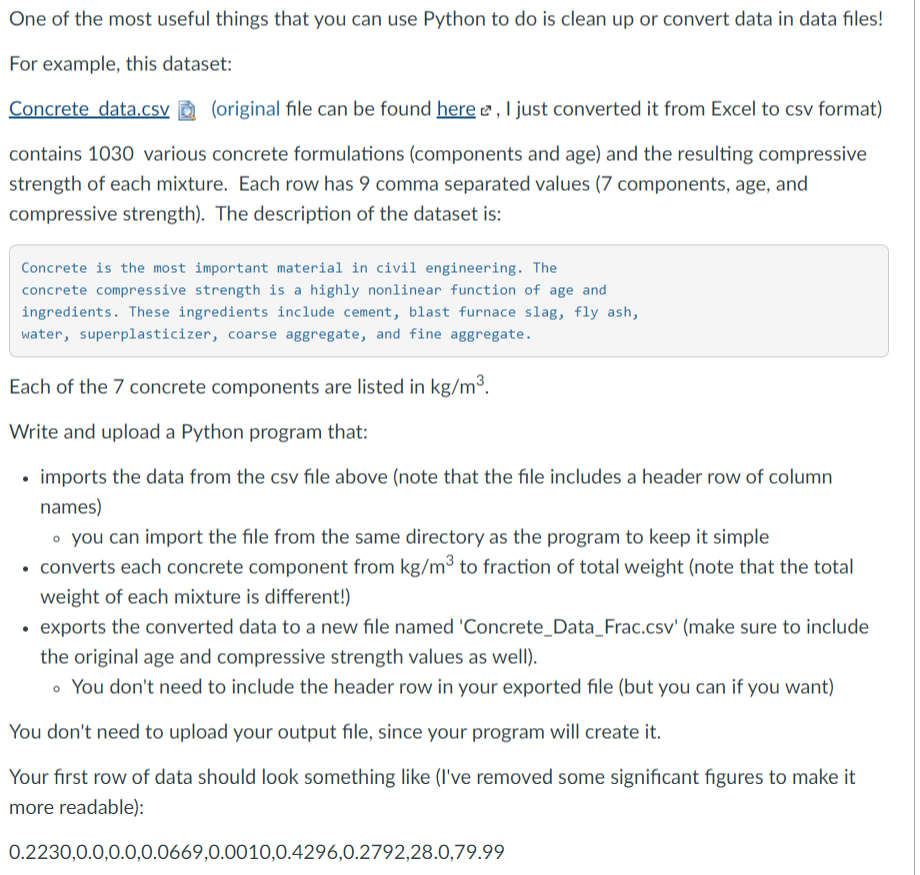
One of the most useful things that you can use Python to do is clean up or convert data in data files! For example, this dataset: Concrete data.csv (original file can be found here, I just converted it from Excel to csv format) contains 1030 various concrete formulations (components and age) and the resulting compressive strength of each mixture. Each row has 9 comma separated values (7 components, age, and compressive strength). The description of the dataset is: Concrete is the most important material in civil engineering. The concrete compressive strength is a highly nonlinear function of age and ingredients. These ingredients include cement, blast furnace slag, fly ash, water, superplasticizer, coarse aggregate, and fine aggregate. Each of the 7 concrete components are listed in kg/m3. Write and upload a Python program that: imports the data from the csv file above (note that the file includes a header row of column names) o you can import the file from the same directory as the program to keep it simple converts each concrete component from kg/m3 to fraction of total weight (note that the total weight of each mixture is different!) exports the converted data to a new file named 'Concrete_Data_Frac.csv' (make sure to include the original age and compressive strength values as well). . You don't need to include the header row in your exported file (but you can if you want) You don't need to upload your output file, since your program will create it. Your first row of data should look something like (I've removed some significant figures to make it more readable): 0.2230,0.0,0.0,0.0669,0.0010,0.4296,0.2792,28.0,79.99
Step by Step Solution
There are 3 Steps involved in it

Get step-by-step solutions from verified subject matter experts
 Study Help