







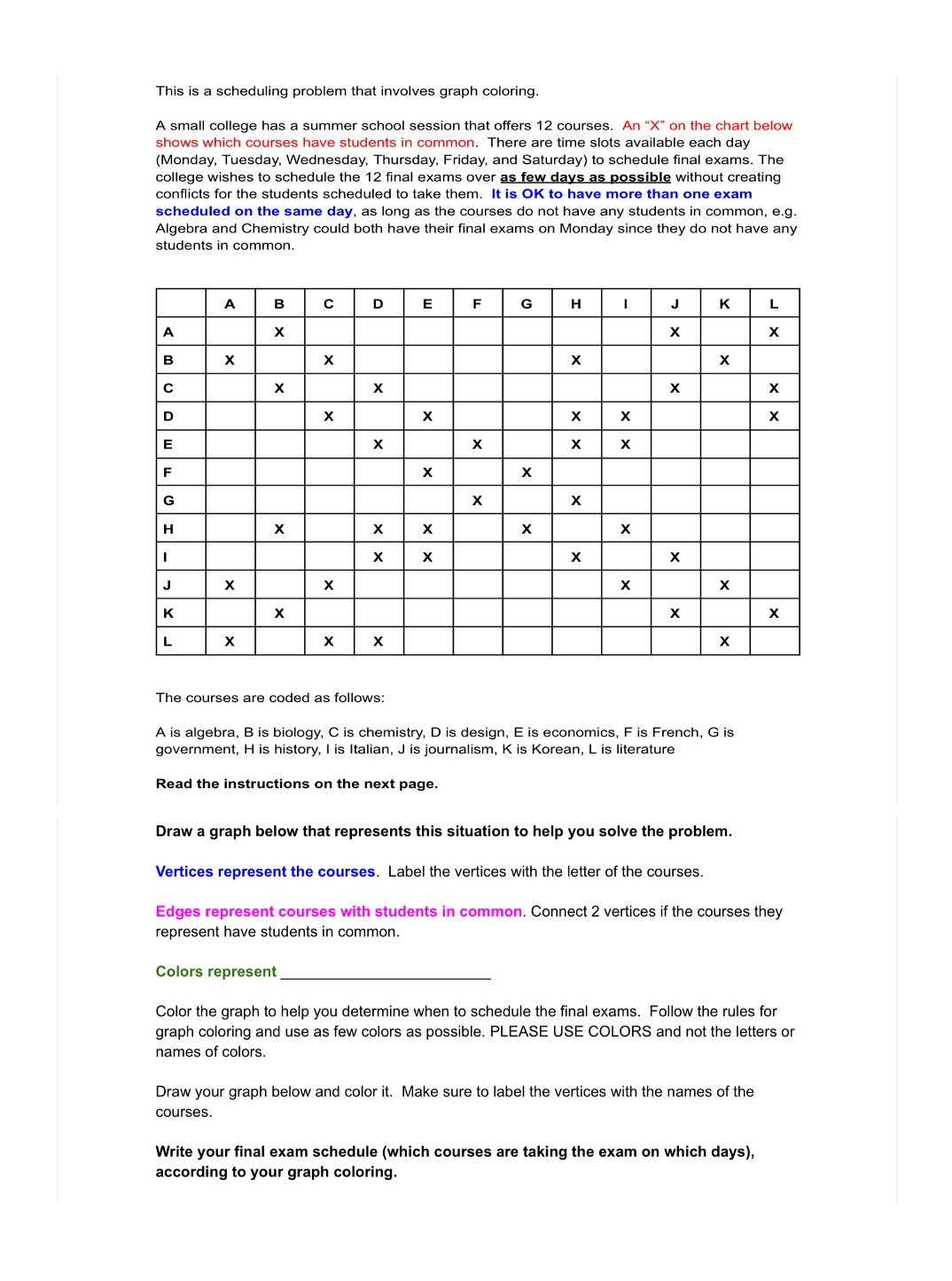
Question: This is a scheduling problem that involves graph coloring. A small college has a summer school session that offers 1 2 courses. An x
This is a scheduling problem that involves graph coloring.
A small college has a summer school session that offers courses. An on the chart below
shows which courses have students in common. There are time slots available each day
Monday Tuesday, Wednesday, Thursday, Friday, and Saturday to schedule final exams. The
college wishes to schedule the final exams over as few days as possible without creating
conflicts for the students scheduled to take them. It is OK to have more than one exam
scheduled on the same day, as long as the courses do not have any students in common, eg
Algebra and Chemistry could both have their final exams on Monday since they do not have any
students in common.
The courses are coded as follows:
A is algebra, B is biology, C is chemistry, D is design, is economics, is French, is
government, is history, I is Italian, is journalism, is Korean, is literature
Read the instructions on the next page.
Draw a graph below that represents this situation to help you solve the problem.
Vertices represent the courses. Label the vertices with the letter of the courses.
Edges represent courses with students in common. Connect vertices if the courses they
represent have students in common.
Colors represent
Color the graph to help you determine when to schedule the final exams. Follow the rules for
graph coloring and use as few colors as possible. PLEASE USE COLORS and not the letters or
names of colors.
Draw your graph below and color it Make sure to label the vertices with the names of the
courses.
Write your final exam schedule which courses are taking the exam on which days
according to your graph coloring.
Step by Step Solution
There are 3 Steps involved in it
1 Expert Approved Answer
Step: 1 Unlock

Question Has Been Solved by an Expert!
Get step-by-step solutions from verified subject matter experts
Step: 2 Unlock
Step: 3 Unlock
 Study Help