







Question: (This is a three-step problem. In the first part, you will solve the numerical problem. In the second part (multiple dropdown menu type), you will
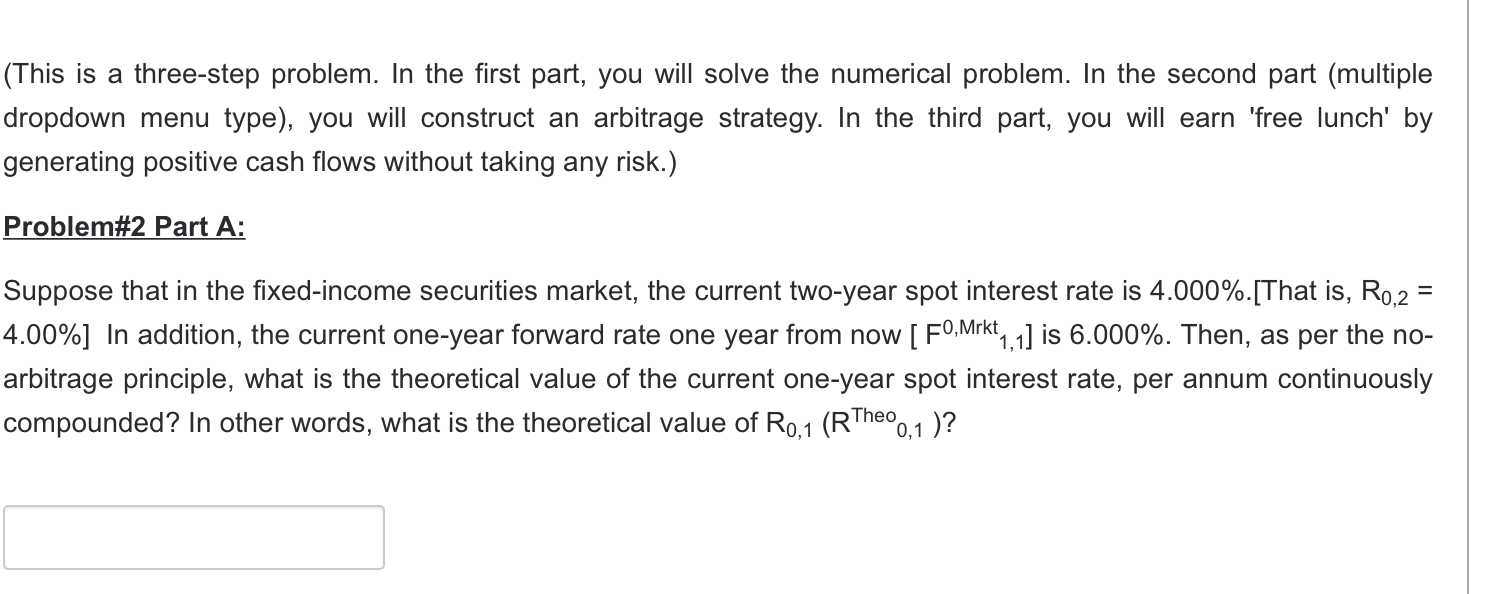
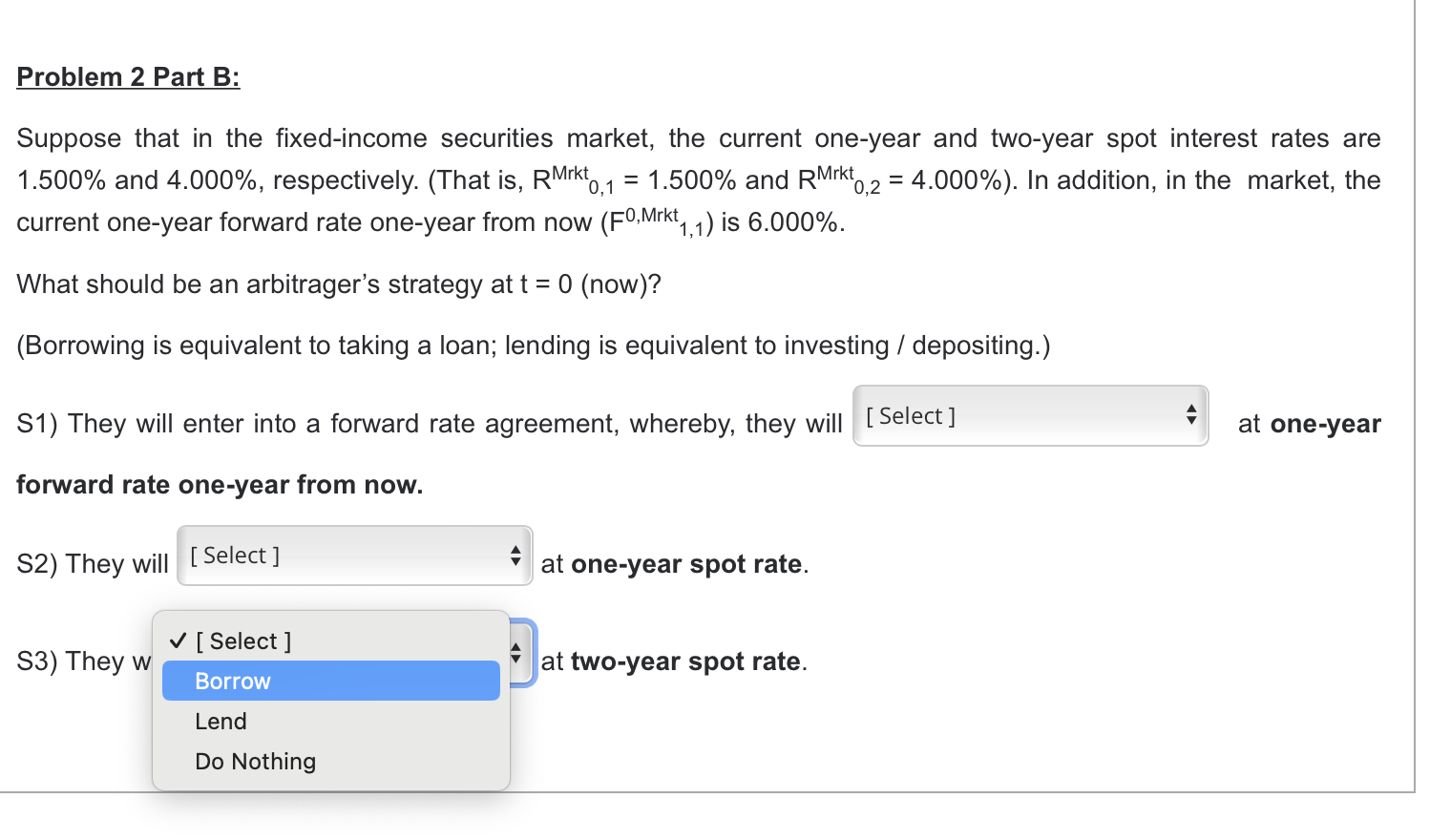
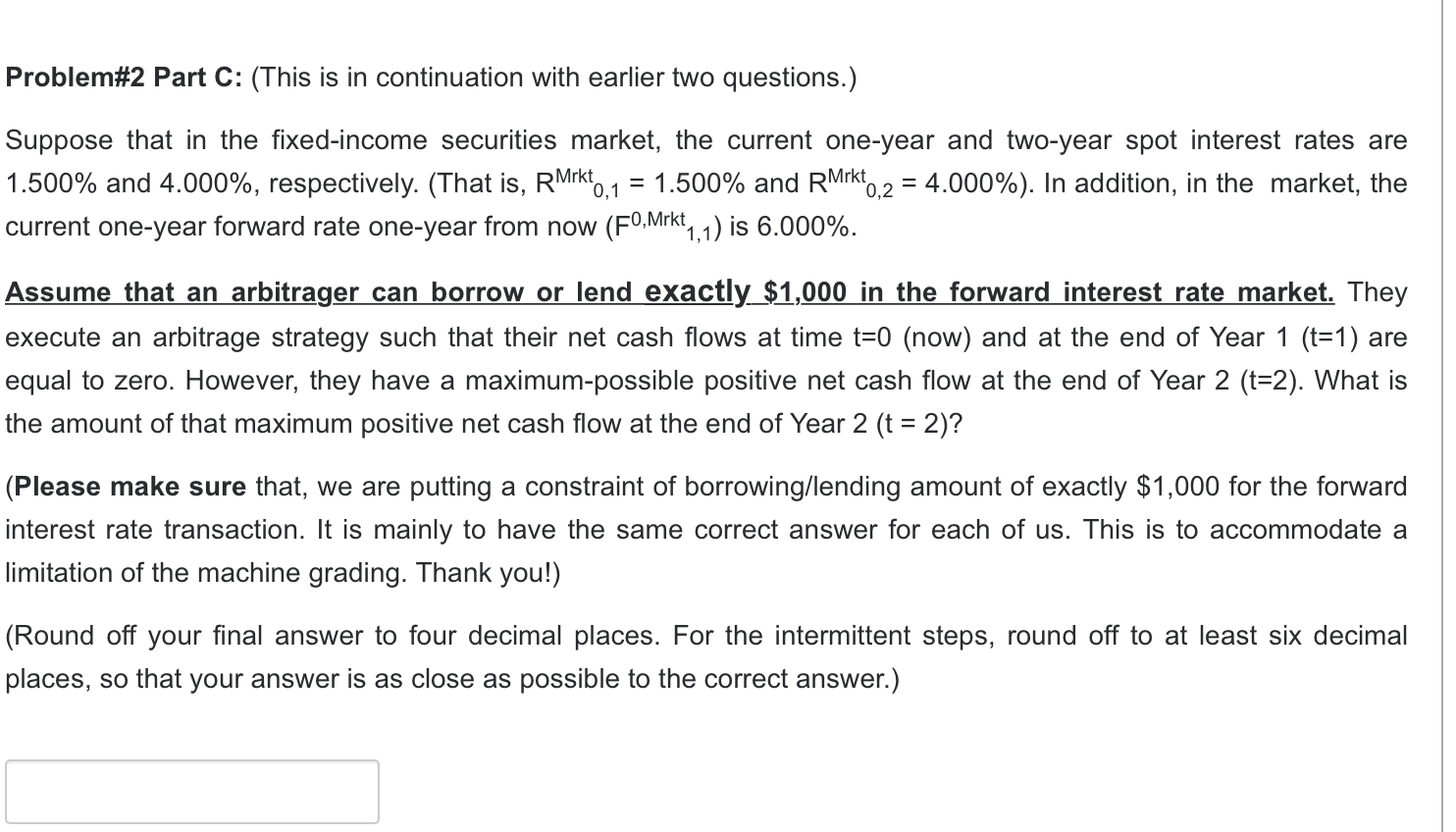
(This is a three-step problem. In the first part, you will solve the numerical problem. In the second part (multiple dropdown menu type), you will construct an arbitrage strategy. In the third part, you will earn 'free lunch' by generating positive cash flows without taking any risk.) Problem\#2 Part A: Suppose that in the fixed-income securities market, the current two-year spot interest rate is 4.000%. [That is, R0,2= 4.00% ] In addition, the current one-year forward rate one year from now [ F0,Mrkt1,1 is 6.000%. Then, as per the noarbitrage principle, what is the theoretical value of the current one-year spot interest rate, per annum continuously compounded? In other words, what is the theoretical value of R0,1(R0,1Theo)? Suppose that in the fixed-income securities market, the current one-year and two-year spot interest rates are 1.500% and 4.000%, respectively. (That is, RMrkt0,1=1.500% and RMrkt0,2=4.000% ). In addition, in the market, the current one-year forward rate one-year from now (F0,Mrkt1,1) is 6.000%. What should be an arbitrager's strategy at t=0 (now)? (Borrowing is equivalent to taking a loan; lending is equivalent to investing / depositing.) S1) They will enter into a forward rate agreement, whereby, they will at one-year forward rate one-year from now. S2) They will at one-year spot rate. S3) They w at two-year spot rate. Lend Do Nothing Problem\#2 Part C: (This is in continuation with earlier two questions.) Suppose that in the fixed-income securities market, the current one-year and two-year spot interest rates are 1.500% and 4.000%, respectively. (That is, RMrkt0,1=1.500% and RMrkt0,2=4.000% ). In addition, in the market, the current one-year forward rate one-year from now (F0,Mrkt1,1) is 6.000%. Assume that an arbitrager can borrow or lend exactly $1,000 in the forward interest rate market. They execute an arbitrage strategy such that their net cash flows at time t=0 (now) and at the end of Year 1 ( t=1 ) are equal to zero. However, they have a maximum-possible positive net cash flow at the end of Y ear 2(t=2). What is the amount of that maximum positive net cash flow at the end of Year 2(t=2)? (Please make sure that, we are putting a constraint of borrowing/lending amount of exactly $1,000 for the forward interest rate transaction. It is mainly to have the same correct answer for each of us. This is to accommodate a limitation of the machine grading. Thank you!) (Round off your final answer to four decimal places. For the intermittent steps, round off to at least six decimal places, so that your answer is as close as possible to the correct answer.) (This is a three-step problem. In the first part, you will solve the numerical problem. In the second part (multiple dropdown menu type), you will construct an arbitrage strategy. In the third part, you will earn 'free lunch' by generating positive cash flows without taking any risk.) Problem\#2 Part A: Suppose that in the fixed-income securities market, the current two-year spot interest rate is 4.000%. [That is, R0,2= 4.00% ] In addition, the current one-year forward rate one year from now [ F0,Mrkt1,1 is 6.000%. Then, as per the noarbitrage principle, what is the theoretical value of the current one-year spot interest rate, per annum continuously compounded? In other words, what is the theoretical value of R0,1(R0,1Theo)? Suppose that in the fixed-income securities market, the current one-year and two-year spot interest rates are 1.500% and 4.000%, respectively. (That is, RMrkt0,1=1.500% and RMrkt0,2=4.000% ). In addition, in the market, the current one-year forward rate one-year from now (F0,Mrkt1,1) is 6.000%. What should be an arbitrager's strategy at t=0 (now)? (Borrowing is equivalent to taking a loan; lending is equivalent to investing / depositing.) S1) They will enter into a forward rate agreement, whereby, they will at one-year forward rate one-year from now. S2) They will at one-year spot rate. S3) They w at two-year spot rate. Lend Do Nothing Problem\#2 Part C: (This is in continuation with earlier two questions.) Suppose that in the fixed-income securities market, the current one-year and two-year spot interest rates are 1.500% and 4.000%, respectively. (That is, RMrkt0,1=1.500% and RMrkt0,2=4.000% ). In addition, in the market, the current one-year forward rate one-year from now (F0,Mrkt1,1) is 6.000%. Assume that an arbitrager can borrow or lend exactly $1,000 in the forward interest rate market. They execute an arbitrage strategy such that their net cash flows at time t=0 (now) and at the end of Year 1 ( t=1 ) are equal to zero. However, they have a maximum-possible positive net cash flow at the end of Y ear 2(t=2). What is the amount of that maximum positive net cash flow at the end of Year 2(t=2)? (Please make sure that, we are putting a constraint of borrowing/lending amount of exactly $1,000 for the forward interest rate transaction. It is mainly to have the same correct answer for each of us. This is to accommodate a limitation of the machine grading. Thank you!) (Round off your final answer to four decimal places. For the intermittent steps, round off to at least six decimal places, so that your answer is as close as possible to the correct answer.)
Step by Step Solution
There are 3 Steps involved in it

Get step-by-step solutions from verified subject matter experts
 Study Help