







Question: This is a typical logistics model, with the corresponding network shown in the attached spreadsheet. Each net supplier's net outflow cannot exceed the capacity shown
This is a typical logistics model, with the corresponding network shown in the attached spreadsheet. Each net supplier's net outflow cannot exceed the capacity shown in its node, each net demander's net inflow must be at least the demand shown in its node, and each transshipment point must have a net outflow (and net inflow) of 0. The unit shipping costs are shown on the arcs, and the common arc capacity in the network is 1,100. The correct model and the optimal solution are shown in the attached spreadsheet. Let the common arc capacity vary from 600 to 3,000 in increments of 100. Which of the following is true of the resulting optimal solutions? Click here to reference the data needed to answer the question.
|
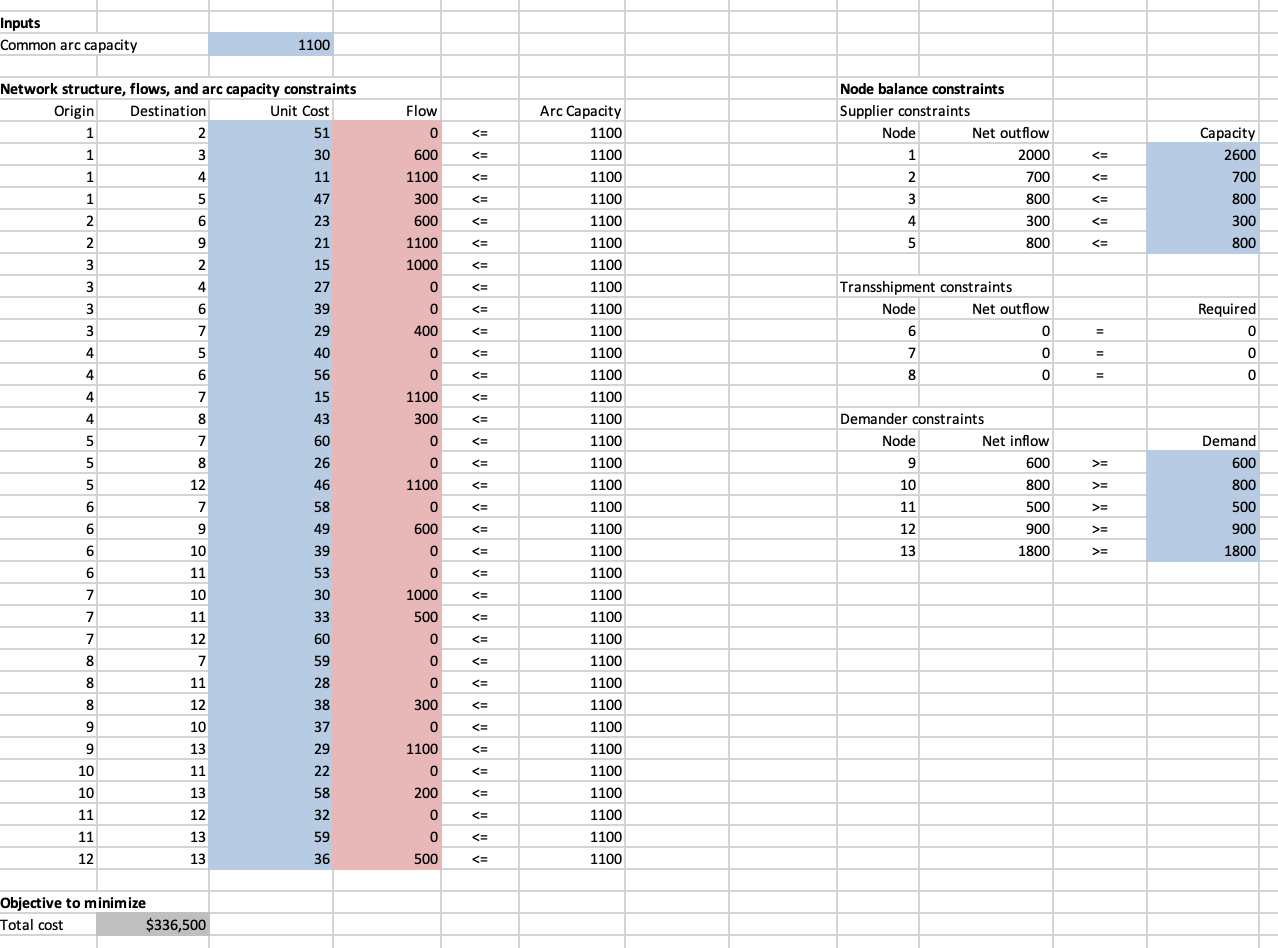
Inputs Common arc capacity 1100 Network structure, flows, and arc capacity constraints Node balance constraints \begin{tabular}{rl|r} 1000 & = & 600 \\ \hline 10 & 800 & >= & 800 \\ 11 & 500 & >= & 500 \\ \hline 12 & 900 & >= & 900 \\ \hline 13 & 1800 & >= & 1800 \end{tabular} 53 33 60 59 28 38 37 29 22 58 32 Objective to minimize Total cost $336,500 Inputs Common arc capacity 1100 Network structure, flows, and arc capacity constraints Node balance constraints \begin{tabular}{rl|r} 1000 & = & 600 \\ \hline 10 & 800 & >= & 800 \\ 11 & 500 & >= & 500 \\ \hline 12 & 900 & >= & 900 \\ \hline 13 & 1800 & >= & 1800 \end{tabular} 53 33 60 59 28 38 37 29 22 58 32 Objective to minimize Total cost $336,500
Step by Step Solution
There are 3 Steps involved in it

Get step-by-step solutions from verified subject matter experts
 Study Help