Question: This is a typical logistics model, with the corresponding network shown in the attached spreadsheet. Each net supplier's net outflow cannot exceed the capacity shown
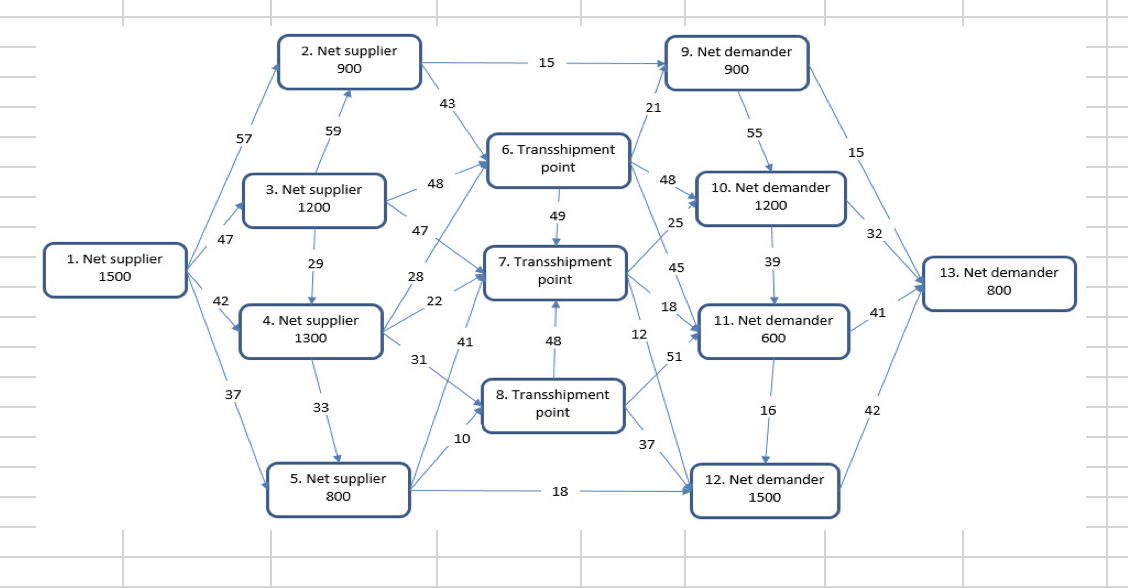
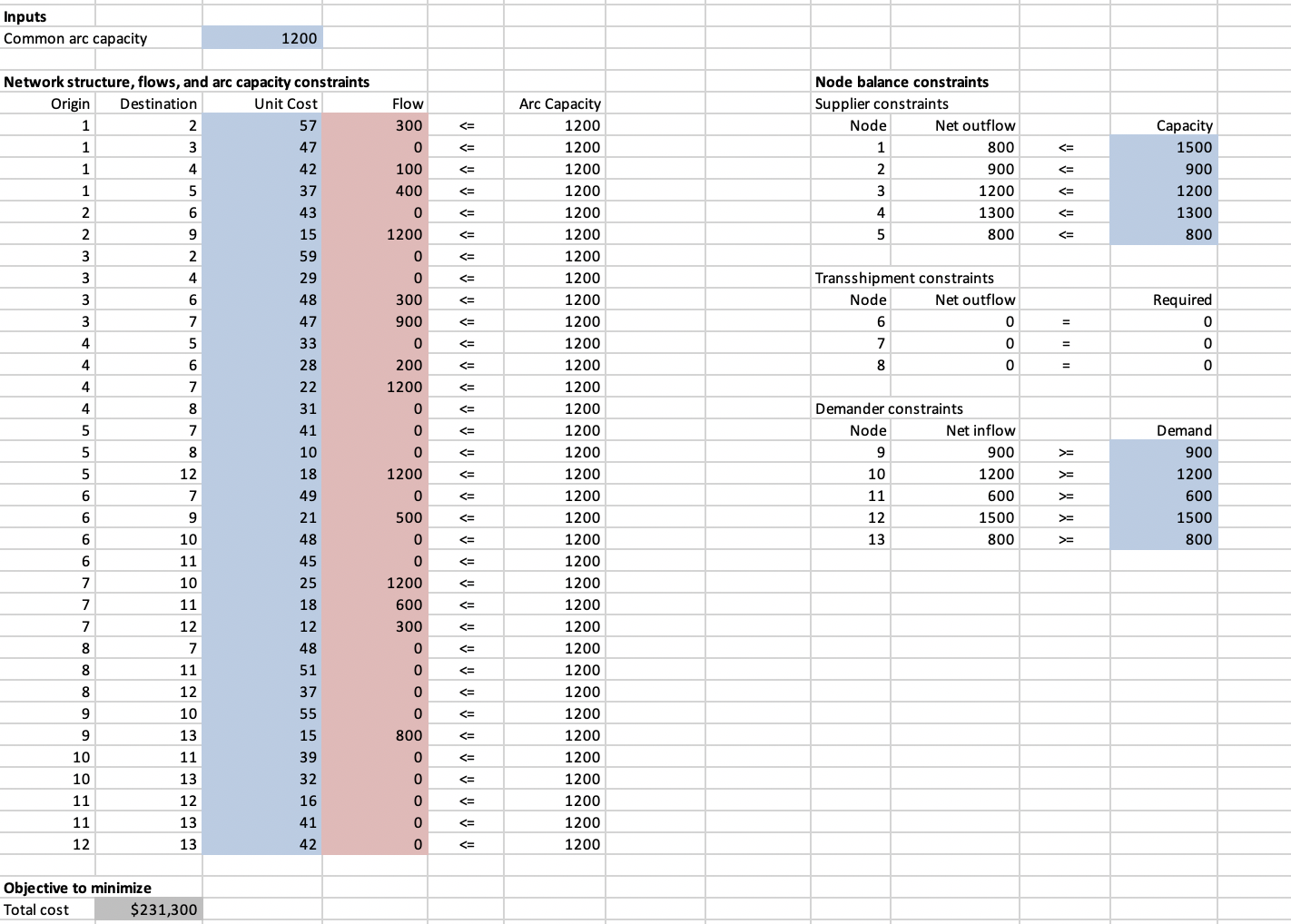
This is a typical logistics model, with the corresponding network shown in the attached spreadsheet. Each net supplier's net outflow cannot exceed the capacity shown in its node, each net demander's net inflow must be at least the demand shown in its node, and each transshipment point must have a net outflow (and net inflow) of 0. The unit shipping costs are shown on the arcs, and the common arc capacity in the network is 1,200. The correct model and the optimal solution are shown in the attached spreadsheet.
Let the common arc capacity vary from 600 to 2,000 in increments of 100. Which of the following is true of the resulting optimal solutions?
| a. For each of these common arc capacities, each supplier's capacity constraint is binding except for supplier 1's, and all demand constraints are binding. | |
|
| | b. When the common arc capacity is at least 1,600, the optimal total cost is the same as if there were no arc capacity constraints. | |
|
| | c. Even when the common arc capacity is 1,500 or less, there is at least one arc with flow equal to this capacity. | |
|
| | d. All of these choices are true. |
|
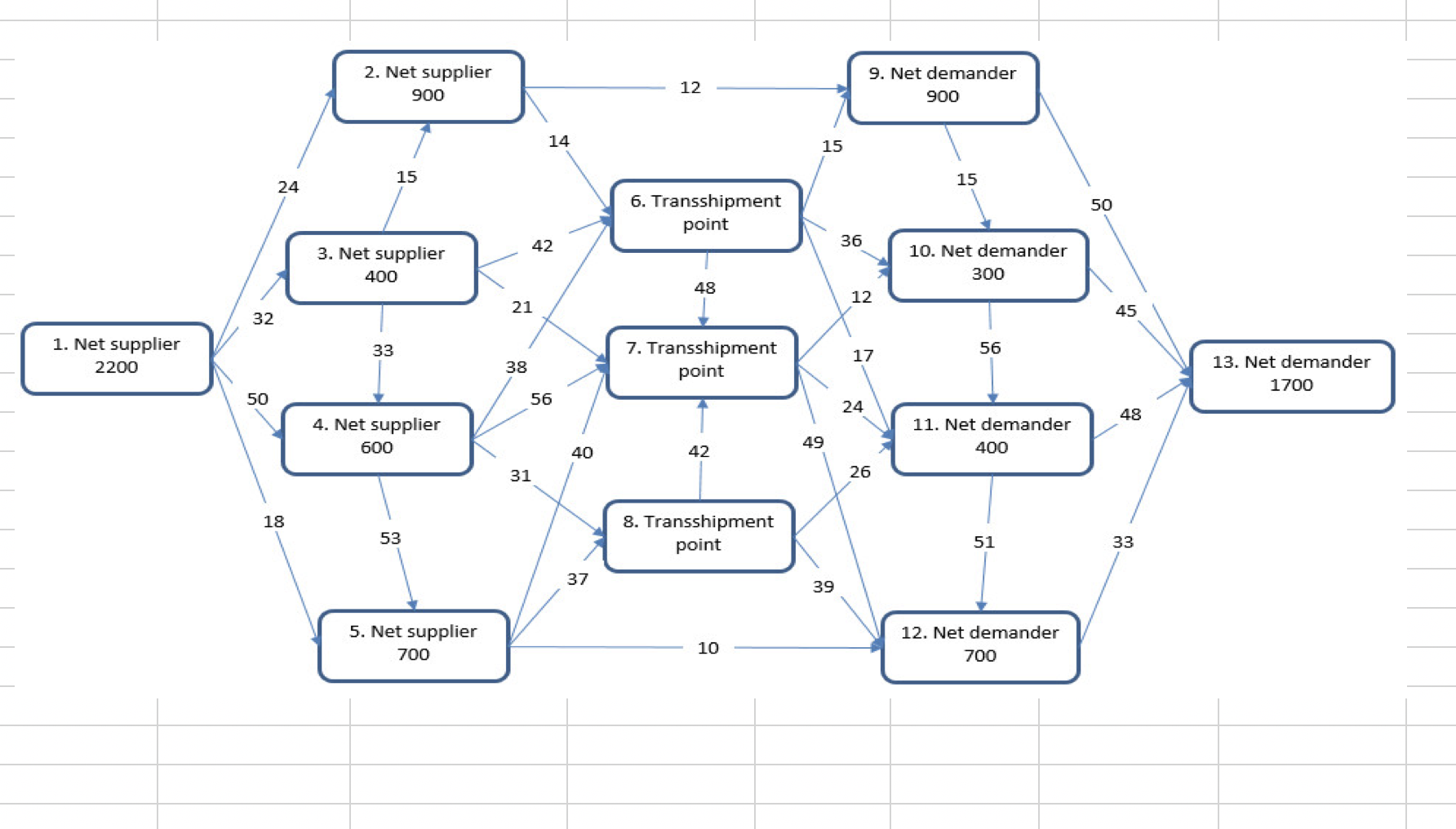
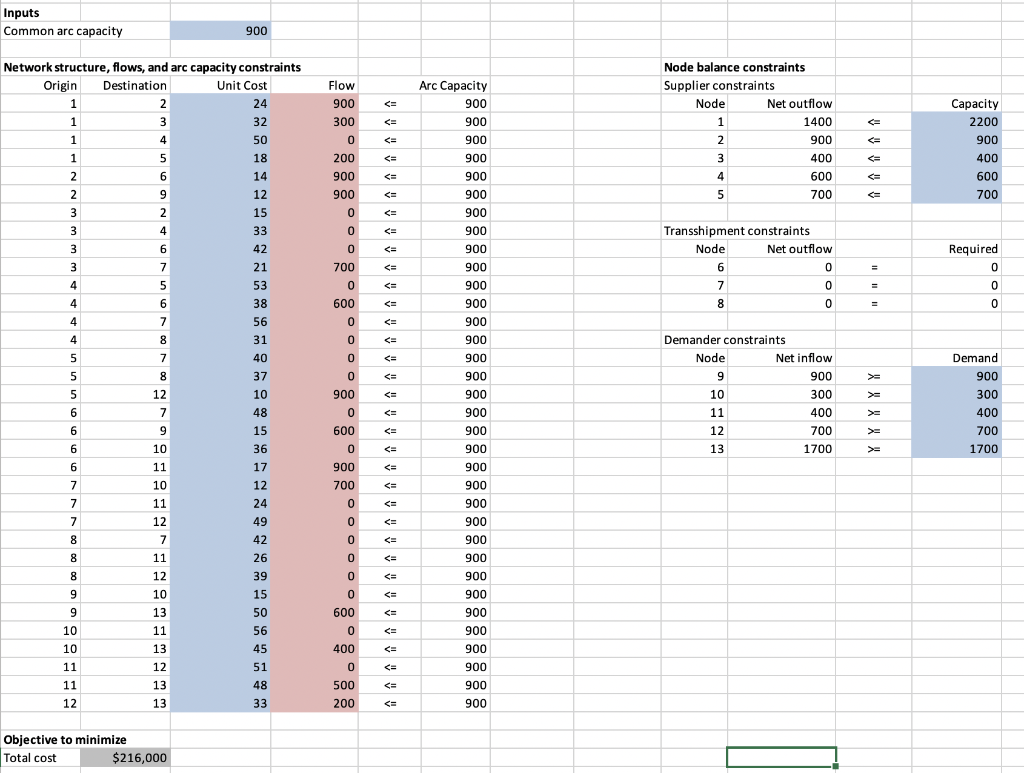
This is a typical logistics model, with the corresponding network shown in the attached spreadsheet. Each net supplier's net outflow cannot exceed the capacity shown in its node, each net demander's net inflow must be at least the demand shown in its node, and each transshipment point must have a net outflow (and net inflow) of 0. The unit shipping costs are shown on the arcs, and the common arc capacity in the network is 900. The correct model and the optimal solution are shown in the attached spreadsheet.
Let the common arc capacity vary from 600 to 2,400 in increments of 100. Which of the following is true of the resulting optimal solutions?
| a. When the common arc capacity is at least 2,000, the optimal total cost is the same as if there were no arc capacity constraints. | |
|
| | b. When the common arc capacity is 2,400, there are no arcs with flow equal to this capacity. | |
|
| | c. For each of these common arc capacities, each supplier's capacity constraint is binding except for supplier 1's, and all demand constraints are binding. | |
|
| | d. None of these choices are true. |
|
2. Net supplier 900 15 9. Net demander 900 43 21 59 55 57 15 6. Transshipment point 48 48 3. Net supplier 1200 10. Net demander 1200 49 25 47 32 47 1. Net supplier 1500 29 45 39 7. Transshipment point 28 13. Net demander 800 42 22 18 41 4. Net supplier 1300 12 11. Net demander 600 41 48 31 51 37 33 8. Transshipment point 16 42 10 37 5. Net supplier 800 18 12. Net demander 1500 Inputs Common arc capacity 1200 Network structure, flows, and arc capacity constraints Origin Destination Unit Cost 1 2 57 1 3 47 Arc Capacity 1200 1200 = 8 12 1200 1200 5 = rrrrrrrrrrrrrrrrrrrrrrrrrrrrrrrrrr Demander constraints Node Net inflow 9 900 10 1200 11 600 12 1500 13 800 Demand 900 1200 600 1500 800 1200 0 500 0 6 >= 7 9 1200 1200 6 = 21 48 6 = 1200 1200 6 S 900 10 48 Demander constraints Node Net inflow 9 900 10 300 11 400 12 700 13 1700 0 0 900 0 600 0 900 X X X X X 300 400 700 1700 7 9 10 11 6 6 15 36 900 900 900 900 900 900 900 900 900 900 900 900 900 900 900 900 900 900 900 900 900 900 6 17









 Study Help