







Question: This is all the information I was given from my professor so. About 20 years ago, many U.S. states adopted more stringent requirements for becoming
This is all the information I was given from my professor so. 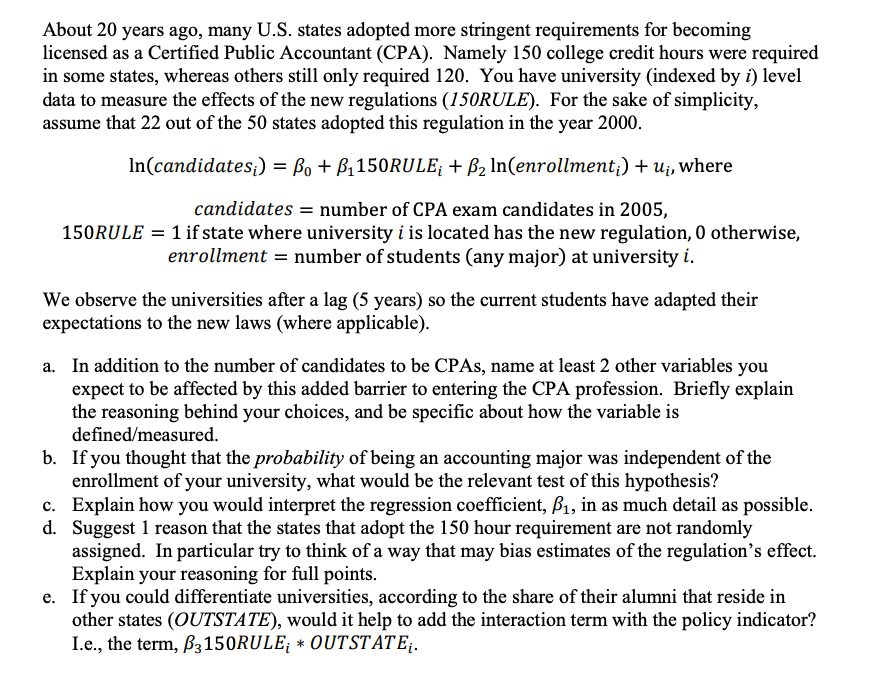
About 20 years ago, many U.S. states adopted more stringent requirements for becoming licensed as a Certified Public Accountant (CPA). Namely 150 college credit hours were required in some states, whereas others still only required 120. You have university (indexed by i) level data to measure the effects of the new regulations (150RULE). For the sake of simplicity, assume that 22 out of the 50 states adopted this regulation in the year 2000. In(candidates;) = Bo + B1150RULE; + B2 In(enrollment;) + U, where = candidates = number of CPA exam candidates in 2005, 150RULE = 1 if state where university i is located has the new regulation, 0 otherwise, enrollment = number of students (any major) at university i. We observe the universities after a lag (5 years) so the current students have adapted their expectations to the new laws (where applicable). a. In addition to the number of candidates to be CPAs, name at least 2 other variables you expect to be affected by this added barrier to entering the CPA profession. Briefly explain the reasoning behind your choices, and be specific about how the variable is defined/measured. b. If you thought that the probability of being an accounting major was independent of the enrollment of your university, what would be the relevant test of this hypothesis? c. Explain how you would interpret the regression coefficient, B1, in as much detail as possible. d. Suggest 1 reason that the states that adopt the 150 hour requirement are not randomly assigned. In particular try to think of a way that may bias estimates of the regulation's effect. Explain your reasoning for full points. e. If you could differentiate universities, according to the share of their alumni that reside in other states (OUTSTATE), would it help to add the interaction term with the policy indicator? I.e., the term, B3150RULE; * OUTSTATE. * About 20 years ago, many U.S. states adopted more stringent requirements for becoming licensed as a Certified Public Accountant (CPA). Namely 150 college credit hours were required in some states, whereas others still only required 120. You have university (indexed by i) level data to measure the effects of the new regulations (150RULE). For the sake of simplicity, assume that 22 out of the 50 states adopted this regulation in the year 2000. In(candidates;) = Bo + B1150RULE; + B2 In(enrollment;) + U, where = candidates = number of CPA exam candidates in 2005, 150RULE = 1 if state where university i is located has the new regulation, 0 otherwise, enrollment = number of students (any major) at university i. We observe the universities after a lag (5 years) so the current students have adapted their expectations to the new laws (where applicable). a. In addition to the number of candidates to be CPAs, name at least 2 other variables you expect to be affected by this added barrier to entering the CPA profession. Briefly explain the reasoning behind your choices, and be specific about how the variable is defined/measured. b. If you thought that the probability of being an accounting major was independent of the enrollment of your university, what would be the relevant test of this hypothesis? c. Explain how you would interpret the regression coefficient, B1, in as much detail as possible. d. Suggest 1 reason that the states that adopt the 150 hour requirement are not randomly assigned. In particular try to think of a way that may bias estimates of the regulation's effect. Explain your reasoning for full points. e. If you could differentiate universities, according to the share of their alumni that reside in other states (OUTSTATE), would it help to add the interaction term with the policy indicator? I.e., the term, B3150RULE; * OUTSTATE. *
Step by Step Solution
There are 3 Steps involved in it

Get step-by-step solutions from verified subject matter experts
 Study Help