Question: This is all the information i was given please try to answer it to the best of your ability 2. Review the McDonnell Douglas case.
This is all the information i was given please try to answer it to the best of your ability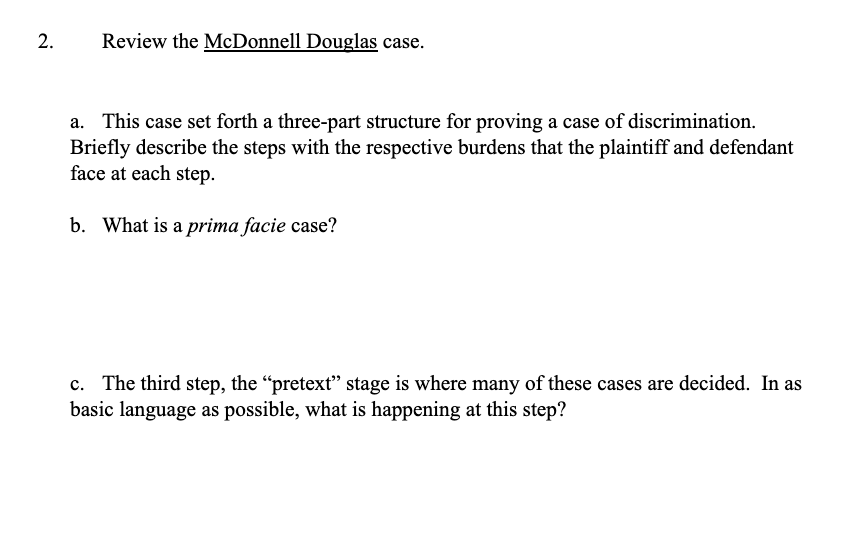
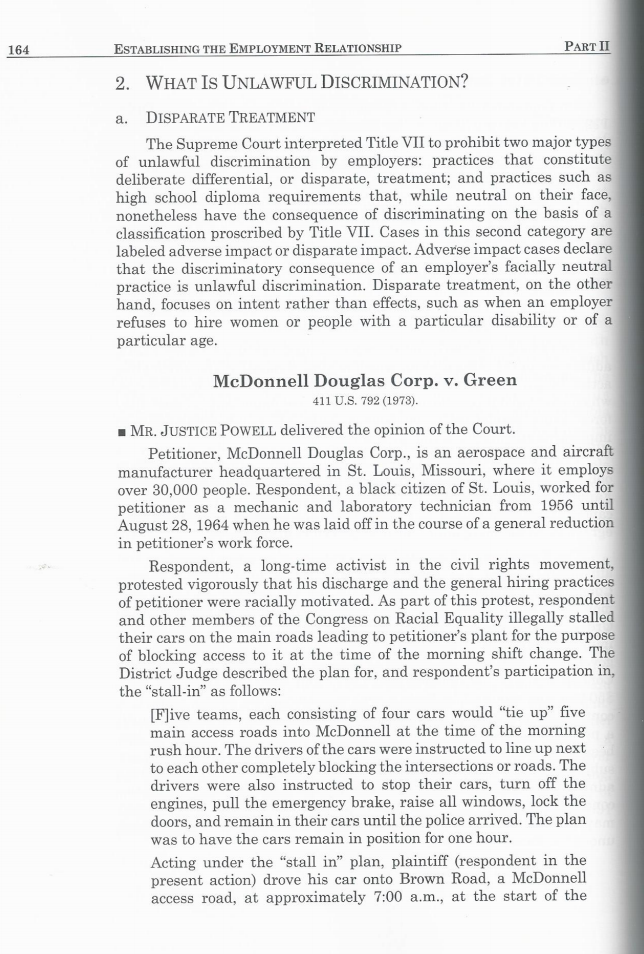
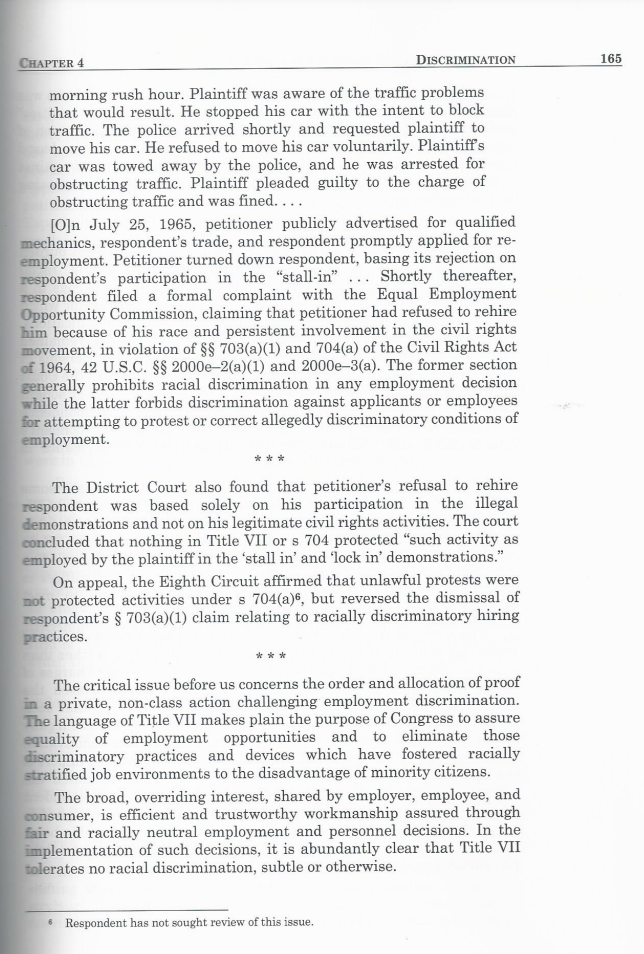
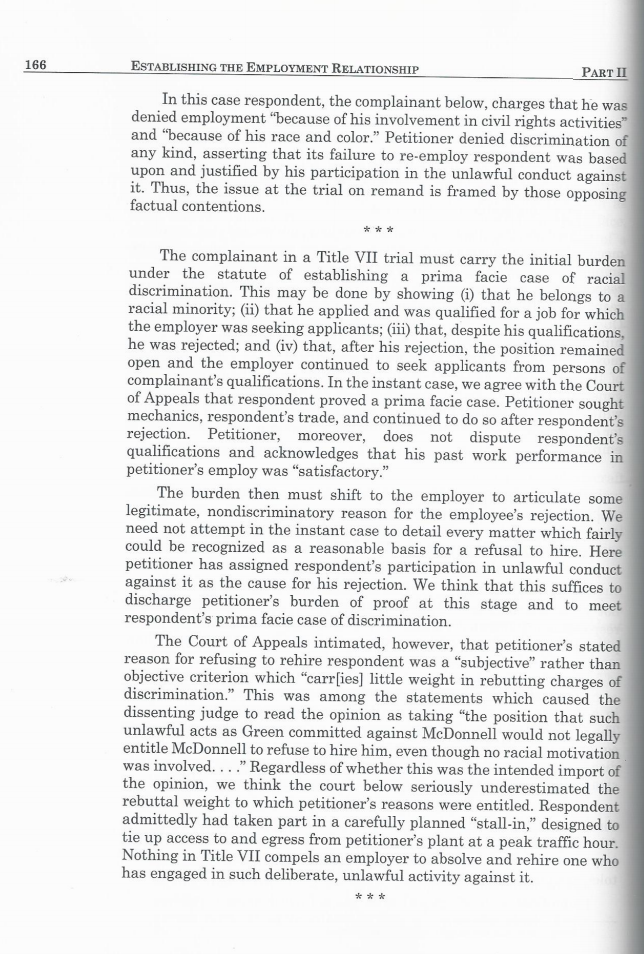
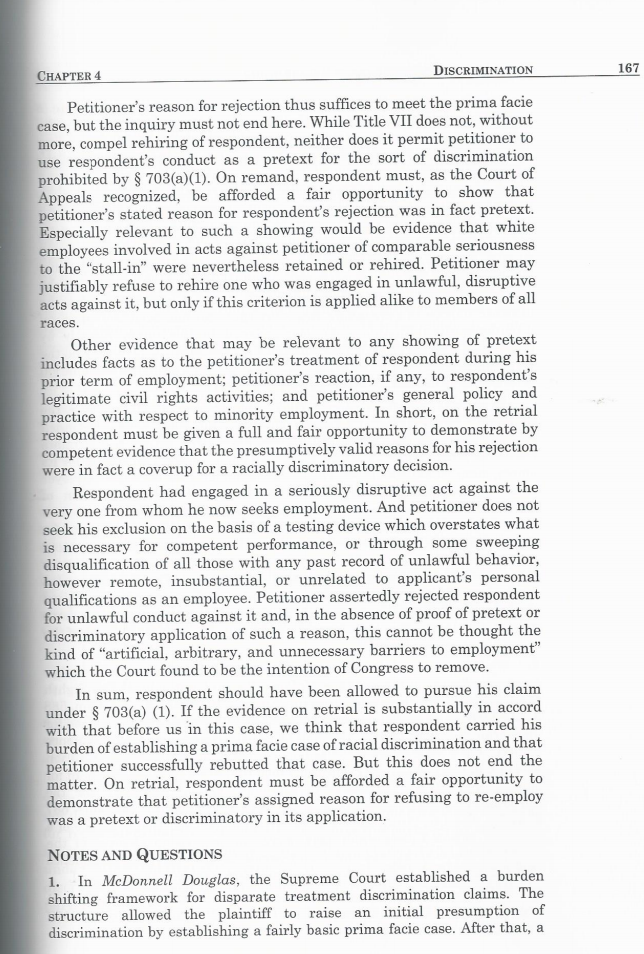
2. Review the McDonnell Douglas case. a. This case set forth a three-part structure for proving a case of discrimination. Briefly describe the steps with the respective burdens that the plaintiff and defendant face at each step. b. What is a prima facie case? c. The third step, the pretext" stage is where many of these cases are decided. In as basic language as possible, what is happening at this step? 164 ESTABLISHING THE EMPLOYMENT RELATIONSHIP PART II 2. WHAT IS UNLAWFUL DISCRIMINATION? a. DISPARATE TREATMENT The Supreme Court interpreted Title VII to prohibit two major types of unlawful discrimination by employers: practices that constitute deliberate differential, or disparate, treatment; and practices such as high school diploma requirements that, while neutral on their face, nonetheless have the consequence of discriminating on the basis of a classification proscribed by Title VII. Cases in this second category are labeled adverse impact or disparate impact. Adverse impact cases declare that the discriminatory consequence of an employer's facially neutral practice is unlawful discrimination. Disparate treatment, on the other hand, focuses on intent rather than effects, such as when an employer refuses to hire women or people with a particular disability or of a particular age. McDonnell Douglas Corp. v. Green 411 U.S. 792 (1973). . MR. JUSTICE POWELL delivered the opinion of the Court. Petitioner, McDonnell Douglas Corp., is an aerospace and aircraft manufacturer headquartered in St. Louis, Missouri, where it employs over 30,000 people. Respondent, a black citizen of St. Louis, worked for petitioner as a mechanic and laboratory technician from 1956 until August 28, 1964 when he was laid off in the course of a general reduction in petitioner's work force. Respondent, a long-time activist in the civil rights movement, protested vigorously that his discharge and the general hiring practices of petitioner were racially motivated. As part of this protest, respondent and other members of the Congress on Racial Equality illegally stalled their cars on the main roads leading to petitioner's plant for the purpose of blocking access to it at the time of the morning shift change. The District Judge described the plan for, and respondent's participation in, the "stall-in" as follows: [F]ive teams, each consisting of four cars would "tie up" five main access roads into McDonnell at the time of the morning rush hour. The drivers of the cars were instructed to line up next to each other completely blocking the intersections or roads. The drivers were also instructed to stop their cars, turn off the engines, pull the emergency brake, raise all windows, lock the doors, and remain in their cars until the police arrived. The plan was to have the cars remain in position for one hour. Acting under the "stall in" plan, plaintiff (respondent in the present action) drove his car onto Brown Road, a McDonnell access road, at approximately 7:00 a.m., at the start of the 165 CHAPTER 4 DISCRIMINATION morning rush hour. Plaintiff was aware of the traffic problems that would result. He stopped his car with the intent to block traffic. The police arrived shortly and requested plaintiff to move his car. He refused to move his car voluntarily Plaintiff's car was towed away by the police, and he was arrested for obstructing traffic. Plaintiff pleaded guilty to the charge of obstructing traffic and was fined. ... [O]n July 25, 1965, petitioner publicly advertised for qualified mechanics, respondent's trade, and respondent promptly applied for re- employment. Petitioner turned down respondent, basing its rejection on respondent's participation in the "stall-in ... Shortly thereafter, respondent filed a formal complaint with the Equal Employment Opportunity Commission, claiming that petitioner had refused to rehire him because of his race and persistent involvement in the civil rights movement, in violation of 88 703(a)(1) and 704(a) of the Civil Rights Act of 1964, 42 U.S.C. 98 2000-2(a)(1) and 2000e-3(a). The former section generally prohibits racial discrimination in any employment decision while the latter forbids discrimination against applicants or employees for attempting to protest or correct allegedly discriminatory conditions of employment. * The District Court also found that petitioner's refusal to rehire respondent was based solely on his participation in the illegal demonstrations and not on his legitimate civil rights activities. The court concluded that nothing in Title VII or s 704 protected "such activity as employed by the plaintiff in the 'stall in' and 'lock in' demonstrations." On appeal, the Eighth Circuit affirmed that unlawful protests were not protected activities under s 704(a), but reversed the dismissal of respondent's $ 703(a)(1) claim relating to racially discriminatory hiring practices. shte The critical issue before us concerns the order and allocation of proof in a private, non-class action challenging employment discrimination. The language of Title VII makes plain the purpose of Congress to assure equality of employment opportunities and to eliminate those discriminatory practices and devices which have fostered racially stratified job environments to the disadvantage of minority citizens. The broad, overriding interest, shared by employer, employee, and consumer, is efficient and trustworthy workmanship assured through fair and racially neutral employment and personnel decisions. In the implementation of such decisions, it is abundantly clear that Title VII tolerates no racial discrimination, subtle or otherwise. 6 Respondent has not sought review of this issue, 166 ESTABLISHING THE EMPLOYMENT RELATIONSHIP PART II In this case respondent, the complainant below, charges that he was denied employment "because of his involvement in civil rights activities and "because of his race and color. Petitioner denied discrimination of any kind, asserting that its failure to re-employ respondent was based upon and justified by his participation in the unlawful conduct against it. Thus, the issue at the trial on remand is framed by those opposing factual contentions. The complainant in a Title VII trial must carry the initial burden under the statute of establishing a prima facie case of racial discrimination. This may be done by showing (i) that he belongs to a racial minority; (ii) that he applied and was qualified for a job for which the employer was seeking applicants; (iii) that, despite his qualifications, he was rejected; and (iv) that, after his rejection, the position remained open and the employer continued to seek applicants from persons of complainant's qualifications. In the instant case, we agree with the Court of Appeals that respondent proved a prima facie case. Petitioner sought mechanics, respondent's trade, and continued to do so after respondent's rejection. Petitioner, moreover, does not dispute respondent's qualifications and acknowledges that his past work performance in petitioner's employ was "satisfactory." The burden then must shift to the employer to articulate some legitimate, nondiscriminatory reason for the employee's rejection. We need not attempt in the instant case to detail every matter which fairly could be recognized as a reasonable basis for a refusal to hire. Here petitioner has assigned respondent's participation in unlawful conduct against it as the cause for his rejection. We think that this suffices to discharge petitioner's burden of proof at this stage and to meet respondent's prima facie case of discrimination. The Court of Appeals intimated, however, that petitioner's stated reason for refusing to rehire respondent was a "subjective" rather than objective criterion which "carr[ies) little weight in rebutting charges of discrimination. This was among the statements which caused the dissenting judge to read the opinion as taking the position that such unlawful acts as Green committed against McDonnell would not legally entitle McDonnell to refuse to hire him, even though no racial motivation was involved. ..."Regardless of whether this was the intended import of the opinion, we think the court below seriously underestimated the rebuttal weight to which petitioner's reasons were entitled. Respondent admittedly had taken part in a carefully planned "stall-in," designed to tie up access to and egress from petitioner's plant at a peak traffic hour. Nothing in Title VII compels an employer to absolve and rehire one who has engaged in such deliberate, unlawful activity against it. 167 CHAPTER 4 DISCRIMINATION Petitioner's reason for rejection thus suffices to meet the prima facie case, but the inquiry must not end here. While Title VII does not, without more, compel rehiring of respondent, neither does it permit petitioner to use respondent's conduct as a pretext for the sort of discrimination prohibited by $ 703(a)(1). On remand, respondent must, as the Court of Appeals recognized, be afforded a fair opportunity to show that petitioner's stated reason for respondent's rejection was in fact pretext. Especially relevant to such a showing would be evidence that white employees involved in acts against petitioner of comparable seriousness to the "stall-in were nevertheless retained or rehired. Petitioner may justifiably refuse to rehire one who was engaged in unlawful, disruptive acts against it, but only if this criterion is applied alike to members of all races. Other evidence that may be relevant to any showing of pretext includes facts as to the petitioner's treatment of respondent during his prior term of employment; petitioner's reaction, if any, to respondent's legitimate civil rights activities; and petitioner's general policy and practice with respect to minority employment. In short, on the retrial respondent must be given a full and fair opportunity to demonstrate by competent evidence that the presumptively valid reasons for his rejection were in fact a coverup for a racially discriminatory decision. Respondent had engaged in a seriously disruptive act against the very one from whom he now seeks employment. And petitioner does not seek his exclusion on the basis of a testing device which overstates what is necessary for competent performance, or through some sweeping disqualification of all those with any past record of unlawful behavior, however remote, insubstantial, or unrelated to applicant's personal qualifications as an employee. Petitioner assertedly rejected respondent for unlawful conduct against it and, in the absence of proof of pretext or discriminatory application of such a reason, this cannot be thought the kind of "artificial, arbitrary, and unnecessary barriers to employment" which the Court found to be the intention of Congress to remove. In sum, respondent should have been allowed to pursue his claim under $ 703(a) (1). If the evidence on retrial is substantially in accord with that before us in this case, we think that respondent carried his burden of establishing a prima facie case of racial discrimination and that petitioner successfully rebutted that case. But this does not end the matter. On retrial, respondent must be afforded a fair opportunity to demonstrate that petitioner's assigned reason for refusing to re-employ was a pretext or discriminatory in its application. NOTES AND QUESTIONS 1. In McDonnell Douglas, the Supreme Court established a burden shifting framework for disparate treatment discrimination claims. The structure allowed the plaintiff to raise an initial presumption of discrimination by establishing a fairly basic prima facie case. After that, a 2. Review the McDonnell Douglas case. a. This case set forth a three-part structure for proving a case of discrimination. Briefly describe the steps with the respective burdens that the plaintiff and defendant face at each step. b. What is a prima facie case? c. The third step, the pretext" stage is where many of these cases are decided. In as basic language as possible, what is happening at this step? 164 ESTABLISHING THE EMPLOYMENT RELATIONSHIP PART II 2. WHAT IS UNLAWFUL DISCRIMINATION? a. DISPARATE TREATMENT The Supreme Court interpreted Title VII to prohibit two major types of unlawful discrimination by employers: practices that constitute deliberate differential, or disparate, treatment; and practices such as high school diploma requirements that, while neutral on their face, nonetheless have the consequence of discriminating on the basis of a classification proscribed by Title VII. Cases in this second category are labeled adverse impact or disparate impact. Adverse impact cases declare that the discriminatory consequence of an employer's facially neutral practice is unlawful discrimination. Disparate treatment, on the other hand, focuses on intent rather than effects, such as when an employer refuses to hire women or people with a particular disability or of a particular age. McDonnell Douglas Corp. v. Green 411 U.S. 792 (1973). . MR. JUSTICE POWELL delivered the opinion of the Court. Petitioner, McDonnell Douglas Corp., is an aerospace and aircraft manufacturer headquartered in St. Louis, Missouri, where it employs over 30,000 people. Respondent, a black citizen of St. Louis, worked for petitioner as a mechanic and laboratory technician from 1956 until August 28, 1964 when he was laid off in the course of a general reduction in petitioner's work force. Respondent, a long-time activist in the civil rights movement, protested vigorously that his discharge and the general hiring practices of petitioner were racially motivated. As part of this protest, respondent and other members of the Congress on Racial Equality illegally stalled their cars on the main roads leading to petitioner's plant for the purpose of blocking access to it at the time of the morning shift change. The District Judge described the plan for, and respondent's participation in, the "stall-in" as follows: [F]ive teams, each consisting of four cars would "tie up" five main access roads into McDonnell at the time of the morning rush hour. The drivers of the cars were instructed to line up next to each other completely blocking the intersections or roads. The drivers were also instructed to stop their cars, turn off the engines, pull the emergency brake, raise all windows, lock the doors, and remain in their cars until the police arrived. The plan was to have the cars remain in position for one hour. Acting under the "stall in" plan, plaintiff (respondent in the present action) drove his car onto Brown Road, a McDonnell access road, at approximately 7:00 a.m., at the start of the 165 CHAPTER 4 DISCRIMINATION morning rush hour. Plaintiff was aware of the traffic problems that would result. He stopped his car with the intent to block traffic. The police arrived shortly and requested plaintiff to move his car. He refused to move his car voluntarily Plaintiff's car was towed away by the police, and he was arrested for obstructing traffic. Plaintiff pleaded guilty to the charge of obstructing traffic and was fined. ... [O]n July 25, 1965, petitioner publicly advertised for qualified mechanics, respondent's trade, and respondent promptly applied for re- employment. Petitioner turned down respondent, basing its rejection on respondent's participation in the "stall-in ... Shortly thereafter, respondent filed a formal complaint with the Equal Employment Opportunity Commission, claiming that petitioner had refused to rehire him because of his race and persistent involvement in the civil rights movement, in violation of 88 703(a)(1) and 704(a) of the Civil Rights Act of 1964, 42 U.S.C. 98 2000-2(a)(1) and 2000e-3(a). The former section generally prohibits racial discrimination in any employment decision while the latter forbids discrimination against applicants or employees for attempting to protest or correct allegedly discriminatory conditions of employment. * The District Court also found that petitioner's refusal to rehire respondent was based solely on his participation in the illegal demonstrations and not on his legitimate civil rights activities. The court concluded that nothing in Title VII or s 704 protected "such activity as employed by the plaintiff in the 'stall in' and 'lock in' demonstrations." On appeal, the Eighth Circuit affirmed that unlawful protests were not protected activities under s 704(a), but reversed the dismissal of respondent's $ 703(a)(1) claim relating to racially discriminatory hiring practices. shte The critical issue before us concerns the order and allocation of proof in a private, non-class action challenging employment discrimination. The language of Title VII makes plain the purpose of Congress to assure equality of employment opportunities and to eliminate those discriminatory practices and devices which have fostered racially stratified job environments to the disadvantage of minority citizens. The broad, overriding interest, shared by employer, employee, and consumer, is efficient and trustworthy workmanship assured through fair and racially neutral employment and personnel decisions. In the implementation of such decisions, it is abundantly clear that Title VII tolerates no racial discrimination, subtle or otherwise. 6 Respondent has not sought review of this issue, 166 ESTABLISHING THE EMPLOYMENT RELATIONSHIP PART II In this case respondent, the complainant below, charges that he was denied employment "because of his involvement in civil rights activities and "because of his race and color. Petitioner denied discrimination of any kind, asserting that its failure to re-employ respondent was based upon and justified by his participation in the unlawful conduct against it. Thus, the issue at the trial on remand is framed by those opposing factual contentions. The complainant in a Title VII trial must carry the initial burden under the statute of establishing a prima facie case of racial discrimination. This may be done by showing (i) that he belongs to a racial minority; (ii) that he applied and was qualified for a job for which the employer was seeking applicants; (iii) that, despite his qualifications, he was rejected; and (iv) that, after his rejection, the position remained open and the employer continued to seek applicants from persons of complainant's qualifications. In the instant case, we agree with the Court of Appeals that respondent proved a prima facie case. Petitioner sought mechanics, respondent's trade, and continued to do so after respondent's rejection. Petitioner, moreover, does not dispute respondent's qualifications and acknowledges that his past work performance in petitioner's employ was "satisfactory." The burden then must shift to the employer to articulate some legitimate, nondiscriminatory reason for the employee's rejection. We need not attempt in the instant case to detail every matter which fairly could be recognized as a reasonable basis for a refusal to hire. Here petitioner has assigned respondent's participation in unlawful conduct against it as the cause for his rejection. We think that this suffices to discharge petitioner's burden of proof at this stage and to meet respondent's prima facie case of discrimination. The Court of Appeals intimated, however, that petitioner's stated reason for refusing to rehire respondent was a "subjective" rather than objective criterion which "carr[ies) little weight in rebutting charges of discrimination. This was among the statements which caused the dissenting judge to read the opinion as taking the position that such unlawful acts as Green committed against McDonnell would not legally entitle McDonnell to refuse to hire him, even though no racial motivation was involved. ..."Regardless of whether this was the intended import of the opinion, we think the court below seriously underestimated the rebuttal weight to which petitioner's reasons were entitled. Respondent admittedly had taken part in a carefully planned "stall-in," designed to tie up access to and egress from petitioner's plant at a peak traffic hour. Nothing in Title VII compels an employer to absolve and rehire one who has engaged in such deliberate, unlawful activity against it. 167 CHAPTER 4 DISCRIMINATION Petitioner's reason for rejection thus suffices to meet the prima facie case, but the inquiry must not end here. While Title VII does not, without more, compel rehiring of respondent, neither does it permit petitioner to use respondent's conduct as a pretext for the sort of discrimination prohibited by $ 703(a)(1). On remand, respondent must, as the Court of Appeals recognized, be afforded a fair opportunity to show that petitioner's stated reason for respondent's rejection was in fact pretext. Especially relevant to such a showing would be evidence that white employees involved in acts against petitioner of comparable seriousness to the "stall-in were nevertheless retained or rehired. Petitioner may justifiably refuse to rehire one who was engaged in unlawful, disruptive acts against it, but only if this criterion is applied alike to members of all races. Other evidence that may be relevant to any showing of pretext includes facts as to the petitioner's treatment of respondent during his prior term of employment; petitioner's reaction, if any, to respondent's legitimate civil rights activities; and petitioner's general policy and practice with respect to minority employment. In short, on the retrial respondent must be given a full and fair opportunity to demonstrate by competent evidence that the presumptively valid reasons for his rejection were in fact a coverup for a racially discriminatory decision. Respondent had engaged in a seriously disruptive act against the very one from whom he now seeks employment. And petitioner does not seek his exclusion on the basis of a testing device which overstates what is necessary for competent performance, or through some sweeping disqualification of all those with any past record of unlawful behavior, however remote, insubstantial, or unrelated to applicant's personal qualifications as an employee. Petitioner assertedly rejected respondent for unlawful conduct against it and, in the absence of proof of pretext or discriminatory application of such a reason, this cannot be thought the kind of "artificial, arbitrary, and unnecessary barriers to employment" which the Court found to be the intention of Congress to remove. In sum, respondent should have been allowed to pursue his claim under $ 703(a) (1). If the evidence on retrial is substantially in accord with that before us in this case, we think that respondent carried his burden of establishing a prima facie case of racial discrimination and that petitioner successfully rebutted that case. But this does not end the matter. On retrial, respondent must be afforded a fair opportunity to demonstrate that petitioner's assigned reason for refusing to re-employ was a pretext or discriminatory in its application. NOTES AND QUESTIONS 1. In McDonnell Douglas, the Supreme Court established a burden shifting framework for disparate treatment discrimination claims. The structure allowed the plaintiff to raise an initial presumption of discrimination by establishing a fairly basic prima facie case. After that, a









 Study Help