







Question: Please read the question Question: Give an example from your own history as a student in which you a teacher helped you make meaning and
Please read the question
Question: Give an example from your own history as a student in which you a teacher helped you make meaning and transer your learning. What was meaningful about the experience?
 ']
']

Give an example from your own history as a student in which you a teacher helped you make meaning and transer your learning. What was meaningful about the experience?
Question
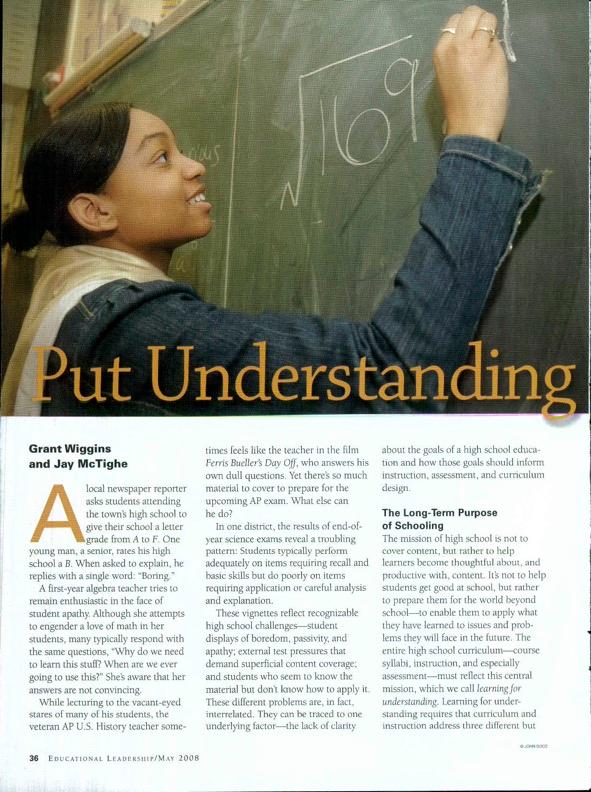
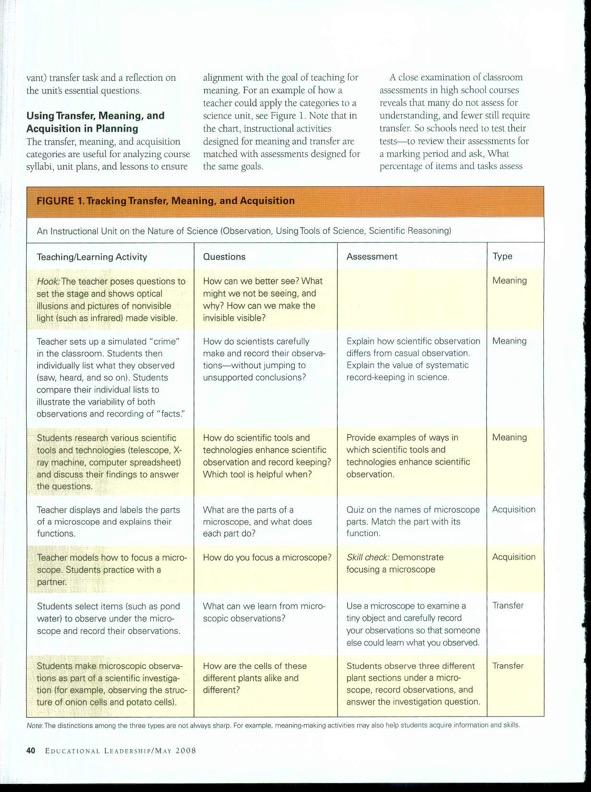
16 Put Understanding A Grant Wiggins and Jay McTighe local newspaper reporter asks students attending the town's high school to grade from A tof One young man, a senior rates his high school a B. When asked to explain, he replies with a single word: "Boring A first-year algebra teacher tries to remain enthusiastic in the face of student apathy. Although she attempts to engender a love of math in her students, many typically respond with the same questions, "Why do we need to learn this stuff? When are we ever going to use this?" Shes aware that her answers are not convincing While lecturing to the vacant-eyed stares of many of his students, the veteran AP U.S. History teacher some times feels like the teacher in the film about the goals of a high school educa- Ferris Bueller's Day Off, who answers his tion and how those goals should inform own dull questions. Yet there's so much instruction, assessment, and curriculum material to cover to prepare for the design upcoming AP exam. What else can he do? The Long-Term Purpose In one district, the results of end-of- of Schooling year science exams reveal a troubling The mission of high school is not to pattern: Students typically perform cover content, but rather to help adequately on items requiring recall and learners become thoughtful about, and basic skills but do poorly on items productive with content. It's not to help requiring application or careful analysis students get good at school, but rather and explanation to prepare them for the world beyond These vignettes reflect recognizable school enable them to apply what high school challenges-student they have learned to issues and prob displays of boredom, passivity, and lems they will face in the future. The apathy; external test pressures that entire high school curriculumcourse demand superficial content coverage: syllabi, instruction, and especially and students who seem to know the assessment must reflect this central material but don't know how to apply it mission, which we call learning for These different problems are, in fact, understanding. Learning for under interrelated. They can be traced to one standing requires that curriculum and underlying factor--the lack of clarity Instruction address three different but 36 EDUCATIONAL LEADERSHIP/MAY 2008 interrelated academic goals helping To get from his high school to his home. Out-of-context learning of skills is students (1) acquire important informa Jamal travels 5.0 miles east and then 40 tion and skills, (2) make meaning of that miles north. When Sheila goes to her arguably one of the greatest weaknesses home from the same high school, she of the secondary curriculum--the content, and (3) effectively transfer their travels 8.0 miles east and 2.0 miles south natural outgrowth of marching through learning to new situations both within What is the measure of the shortest the textbook instead of teaching with school and beyond it. distance, to the nearest tenth of a mile meaning and transfer in mind. Schools All learnets need to acquire facts and between Jamals home and Shetias home? skills. But an education consists of more (Students were provided with a grid they writing, and world language skills in too often teach and test mathematics could use to plot the answer.) than a pile of facts or a laundry list of isolation rather than in the context of skills. Even if students can recite key Fewer than 40 percent of New York authentic demands requiring passages from The Federalist Papers by 10th graders correctly answered this thoughtful application. If we don't give heart, if they have only acquired the item, despite the fact that the requisite students sufficient ongoing opportuni facts they won't be able to adequately knowledge is covered in every ties to puzzle over genuine problems, answer questions like, Why do we need Algebra 1 class in North America. Test make meaning of their learning, and checks on power? What are the chief results such as these reveal not a failure apply content in various contexts, then problems that a three-branch system of of coverage but a failure of transfer. long-term retention and effective First The high school curriculum should start with the long-term goals of schooling: meaning making and transfer of learning. government is meant to address? When is the balance of power threatened Where should I stand on the current debates about presidentinl power? But if their lessons and assessments have asked them to explore various ways in which governmental powers have been checked and balanced (or not) during different periods of history, they will be able to make meaning of facts and address such questions when they natu- rally arise in their lives. Unfortunately, the common methods of teaching and testing in high schools focus on acquisition at the expense of meaning and transfer. As a result, when confronted with unfamiliar questions or problems (even selected-response prob- lems on standardized tests), many students flounder. Consider a high school algebra question that was included on state tests in New York and Massachusetts ASSOCIATION FOR SUPERVISION AND CURRICULUM DEVELOPMENT 37 performance are unlikely, and high include conferencing, encouraging to a regimen of excessive teacher talk, schools will have failed to achieve their student self-assessment and reflection rote memorization of discrete facts, and purpose. and providing specific commentary, mind-numbing skill-drill worksheets feedback, and corrections in the context The unfortunate reality is that some Teaching for Meaning and Transfer of authentic application students will never get beyond the first If transfer, meaning, and acquisition are As these categories make clear, there is rung of the coverage ladder, with 115 all fundamental goals of high school rarely one best teaching approach. In a isolated and uninteresting approach to instruction, what is the role of the high school committed to teaching for content; they will therefore have teacher? To support these goals, teachers understanding, we would see all three minimal opportunities to engage in and can weave together these three instruc pedagogies in regular use actually use what they are learning in a tional approaches Mortimer Adler meaningful way (And we wonder why describes in The Paideia Program (1984) Rethinking Instructional these students aren't motivated!) Direct instruction. In this role, the Sequence Retum to one of the opening vignettes teacher's primary goal is to help learners When meaning making and transfer and recall the scene in the movie Ferris acquire basic information and skills assume greater prominence in the Bueller's Day Off in which the history through explicit instruction and curriculum, the sequence of learning teacher drones on about the Hawley modeling Direct instructional strategies events takes on a new significance. Most Smoot Tarill and the Laffer Curve, poses cull recall questions, and then answers them himself . This episode comes High schools have a propensity to cover lots painfully close to familiar high school experience. Imagine that the teacher had of content before allowing students to use framed the same content around an essential question (When should the that content in authentic situations. government promote free trade and when should it protect its industries?) and a culminating performance task (As an advisor to the Secretary of include lecture, multimedia presenta- high schools, aided and abetted by text- Commerce, give advice on the US posi tions, convergent questioning, demon- books that stress acquisition almost to tions on Chinese imports and NAFTA). stration, modeling, guided practice, and the exclusion of the other two aims. Such a change would have enhanced feedback. have a propensity to cover lots of engagement, understanding, rigor and Facilitation Teachers in this role content before allowing students to use relevance seek to help learners make meaning and that content in authentic situations. This understand important ideas and approach, based on a climb-the-ladder, A More Meaningful Sequence processes. Teachers guide leamers in step-by-step model of cognition, may be Here's another illustration of an alterna actively processing information and well intentioned, but it reveals a funda- tive instructional sequence built with exploring complex problems through mentally flawed conception of learning meaning and transfer in mind this one such instructional strategies as analogies. Research in cognitive psychology (Brans in high school mathematics. The unit graphic organizers, divergent ques. ford, Brown, & Cocking, 2001) chal- involves statistics, specifically the tioning and probing, simulations, lenges the notion that students must concept of measures of central tendency problem-based learning, Socratic semi- learn all the important facts and basic (mean, media, mode, range, and so on). nars, reciprocal teaching, and student skills before they can address the key Typical high school math textbooks self-assessment concepts of a subject or apply the skills and classes begin by defining the terms Coaching in a coaching role. in more complex and authentic ways. mean, median, and mode: give examples teachers provide opportunities for And all we need to do is look at how illustrating each measure provide inde students to transfer learning in increas people leam sports, art, or their first pendent practice with about 15 prob ingly complex situations. Teachers estab language to recognize that this view ts Jems (for example, requiring students to lish clear performance goals, provide flawed. complete a table by calculating all three models, and give feedback (as personal- Sadly, the climb-the-ladder approach measures for a data set); and then pose ized as possible). They also provide just may have the greatest negative impact several hypothetical word problems in-time teaching (direct instruction) on lower-achieving students. Strugglingasking students to apply their skills, when needed. Instructional strategies high school students are often confined Notice how the following unit unfolds 38 EDUCATIONAL LEADERSHIP/MAY 2008 quite differently, with meaning making conceptual understanding and computa- 8. Lead a whole-dass discussion. Have and transfer preceding instruction in the tional accuracy students discuss related questions for basics 6. Provide opportunities for further example, How important are range (vani- 1. Begin with a hook problem. Give discussion. Have students engage in ation) and trend when teaching a solu- students a set of data--the finish times whole-class and small-group discussions tion? Should you be rewarded or penal- for 122 students in four 7th grade of additional examples--for example, ized for consistency or inconsistency or classes in a one-mile race held on field When is it most useful to know the for downward or upward trend? Have day. Ask students to work in small "average in various circumstances students investigate several situations groups to determine which class won (salaries, home prices, batting average. and draw conclusions (national sports the race and prepare to convince other price of a new car? When is it team ranking systems, scores in diving groups of their conclusion. Have each competitions, stock market perform- group present its solution and explana ance, and so on) tion to the class. Ask prompting ques. 9. Provide a small group application tions to stimulate alternative answers Ask students to propose the faires and to elicit mathematical reasoning, method for assigning quarterly grades. 2. Introduce essential questions. What is Should all grades be averaged? Should fair? How might mathematics help zeroes be factored in? Have each group determine what is fair and unfair? present its proposal and explain its Present various situations to provoke a thinking to the class discussion about faimess, such as, What 10 Revisit the original unit hook do we mean when we say that the rules problem. Ask students, "Now which class of a game of chance are not fair? When do you think won the one-mile race?" is straight majority voting fair, and when Ask them to use what they have learned Is it not fair? Is it fair to factor in degree to reevaluate the problem and their solu of difficulty in diving competitions? tions to it How about weighted grades in school? 11 Assign the final performance raske. Ask students to draw some tentative Have students individually review their conclusions to explore and test later in scores and grades for the quarter on the unit quizzes, tests, homework, class work, 3. Preview the culminating performance their math journal, and so on to deter- task. Tell students, "You will be asked to mine which measure of central tendency decide which measure of Central misleading? What other information will yield the Fairest grade for them. tendency--mean, median, or mode- does an individual need to act wisely Have them write a note to you should be used to calculate your final (for instance, to decide whether he or explaining their preferred method for quarterly grade in mathematics. You she can afford to buy a new car? grade calculation must explain which method you prefer 7. Provide an application task. Help 12. Give students opportunities to reflect and show your mathematical reasoning students think about the questions, on the unit's essential questions in their The usk will spark questions from When should we use mean, median, or math journal and in paired and whole- students, such as, What is a median? mode? Where should we be careful in class discussions a mode? using each measure? Have each student In this example, learning for under 4. Provide direct instruction on mets- construct a problem like the initial hook standing develops in an iterative fashion ures of central tendency linked back to problema set of data that yields an across the three categories of transfer. the initial problem and essential ques- uncertain solution to the question asked meaning, and acquisition. The acquist- tions. Give real-world examples Have students calculate the answer using tion of new vocabulary and techniques Students will be more likely to see the all three modes of central tendency, for calculating central tendency are value of this information given the choose the answer they think is best introduced in response to real problems earlier activities and forthcoming and write a defense of that answer. In around the issue of fairness and average performance task. pairs, have students share questions and and as preparation for the final perform 5. Provide practice on the basics. Have answers, try to solve each other's ance task. Although traditional quizzes students do problems from the textbook problem, and offer feedback to each are included, they are not the capstone to practice calculating mean, median other on the quality of their solutions assessment. The unit culminates in a and mode. Give quizzes to check for and explanations thought-provoking (and personally rele ASSOCIATION FOR SUPERVISION AND CURRICULUM DEVELOPMENT 39 vant) transfer task and a reflection on alignment with the goal of teaching for the units essential questions meaning. For an example of how a teacher could apply the categories to a Using Transfer, Meaning, and science unit, see Figure 1. Note that in Acquisition in Planning the chart, instructional activities The transfer, meaning, and acquisition designed for meaning and transfer are categories are useful for analyzing course matched with assessments designed for syllabi, unit plans, and lessons to ensure the same goals. A close examination of classroom assessments in high school courses reveals that many do not assess for understanding, and fewer still require transfer. So schools need to test their tests to review their assessments for a marking period and ask, What percentage of items and tasks assess FIGURE 1. Tracking Transfer, Meaning and Acquisition An Instructional Unit on the Nature of Science (Observation. Using Tools of Science, Scientific oning Teaching/Learning Activity Questions Assessment Type Hook: The teacher poses questions to How can we better see? What Meaning set the stage and shows optical might we not be seeing, and illusions and pictures of nonvisible why? How can we make the light (such as infrared made visible. Invisible visible? Teacher sets up a simulated "crime" How do scientists carefully Explain how scientific observation Meaning in the classroom Students then make and record their observa differs from casual observation individually list what they observed tions-without jumping to Explain the value of systematic (saw, heard, and so on). Students unsupported conclusions? record-keeping in science compare their individual lists to illustrate the variability of both observations and recording of "facts." Students research various scientific How do scientific tools and Provide examples of ways in Meaning tools and technologies (telescope, X- technologies enhance scientific which scientific tools and ray machine, computer spreadsheet) observation and record keeping technologies enhance scientific and discuss their findings to answer Which tool is helpful when? observation the questions. Teacher displays and labels the parts of a microscope and explains their functions What are the parts of a Quiz on the names of microscope Acquisition microscope, and what does parts. Match the part with its each part do? function How do you focus a microscope? Skicheck: Demonstrate Acquisition focusing a microscope Teacher models how to focus a micro- scope Students practice with a partner Students select items (such as pond What can we learn from micro- Use a microscope to examine a Transfer water) to observe under the micro- scopic observations? tiny object and carefully record scope and record their observations your observations so that someone else could learn what you observed. Students make microscopic observa- How are the cells of these Students observe three different Transfer tions as part of a scientific investige- different plants alike and plant sections under a micro- tion for example, observing the struc- different? scope, record observations, and ture of onion cells and potato cells). answer the investigation question None. The distinctions among the three types are not always sharp. For example, meaning making activities may also hobo students acquire information and saris, 40 EDUCATIONAL LEADERS/MAY 2008 Customized training and continued education developed especially for school leaders and teachers: Bachelor's & Master's Degree Programs Customized Employee Training National Conferences & Workshops Extensive Speaker's Bureau of Experts acquisition of discrete information and skills? What percentage require students to infer, generalize, analyze, and make connections, show their reasoning, or support their answer? What percentage require students to apply past learning to new situations? We recommend that schools develop a public syllabus for every course, which articulates the courses transfer-meaning acquisition priorities and concomitant assessments. Such an approach offers a practical means of freeing high school instruction from the dominance of the textbook and its emphasis on acquisi tion. The textbook should serve as a resource, but not as the syllabus. The Ever-Present Goal In high schools today, acquisition of content for its own sake dominates teachers and students' experience and therefore, schooling fails to achieve its purpose for a sizable proportion of learners. The approach proposed here suggests that to reform the high school curriculum in a meaningful way, we must challenge the common practice of teaching knowledge and skill for acquist- tion first and then teaching for meaning and transfer later. Rather, we must recognize that the purposeful and effec- tive use of content is the ever-present goal, and we must design all instruction with that goal in mind, a References Adler, M. (1984). The Paideta program. An educational syllabus. New York. Macmillan Bransford. T. Brown, A., & Cocking, R (Eds.). (2001). How people learn Bruin mind, experience, and school. Washington, DC National Research Council For more information call: 877-788-8205 or visit gcu.edu/edlead Grant Wiggins is President of Authentic Education in Hopewell, New Jersey grant authenticeducation.org. Jay McTigheis Educational Consultant with Jay McTighe and Associates, Columbia Maryland: imctigh@aol.com. They are coauthors of Understanding by Design, Expanded 2nd Edition (ASCD, 2005) and Schooling by Design: Mission, Action, and Achievement (ASCD, 2007) GRAND CANYON UNIVERSITY COLLEGE OF EDUCATION Cuponly accredited by the higher learning Commission and is of the North Central foreningen og 312263 04561 Students applicants sont totecting the department of education for certion and program and ASSOCIATION FOR SUPERVISION AND CURRICULUM DEVELOPMENT 41Step by Step Solution
There are 3 Steps involved in it
1 Expert Approved Answer
Step: 1 Unlock

Question Has Been Solved by an Expert!
Get step-by-step solutions from verified subject matter experts
Step: 2 Unlock
Step: 3 Unlock
 Study Help