







Question: this is all the information thats been given 1. In the wars of attrition we discussed in class, the per-period cost of fighting was the
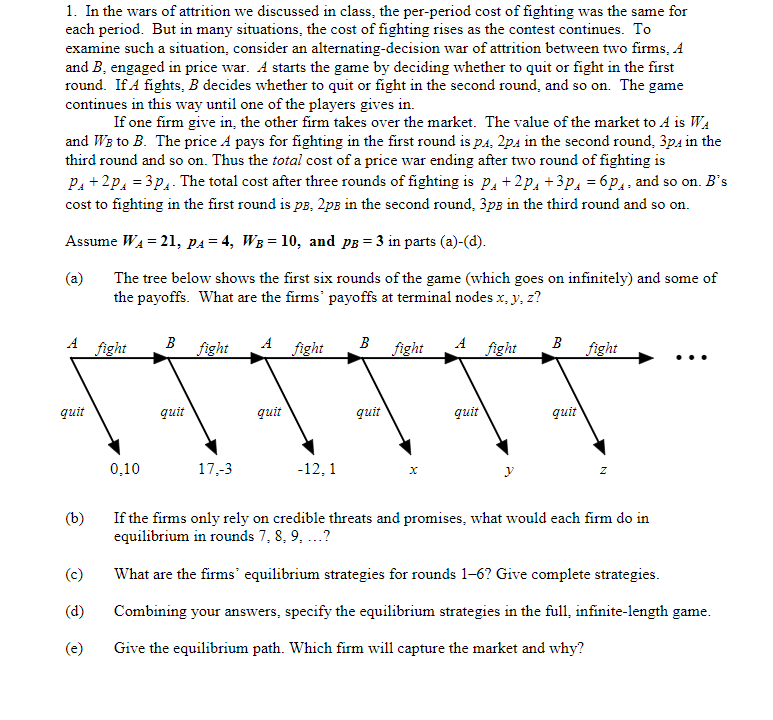
1. In the wars of attrition we discussed in class, the per-period cost of fighting was the same for each period. But in many situations, the cost of fighting rises as the contest continues. To examine such a situation, consider an alternating-decision war of attrition between two firms, A and B, engaged in price war. A starts the game by deciding whether to quit or fight in the first round. If A fights, B decides whether to quit or fight in the second round, and so on. The game continues in this way until one of the players gives in If one firm give in, the other firm takes over the market. The value of the market to A is W and WB to B. The price A pays for fighting in the first round is pA, 2p4 in the second round, 3p.4 in the third round and so on. Thus the total cost of a price war ending after two round of fighting is PA 2p3p The total cost after three rounds of fighting is p42p,+3p, = 6p4. and so on. B's cost to fighting in the first round is pE, 2pB in the second round, 3pB in the third round and so on Assume WA 21, pA= 4, WB= 10, and p3 3 in parts (a)-(d) The tree below shows the first six rounds of the game (which goes on infinitely) and some of the payoffs. What are the firms' payoffs at terminal nodes x, y, z? (a) A fight A fight A fight fight fight fight uit uit uit uit quit uit 17,-3 -12, 1 0,10 Z (b) If the firms only rely on credible threats and promises, what would each firm do in equilibrium in rounds 7, 8, 9. ...? (c) What are the firms' equilibrium strategies for rounds 1-6? Give complete strategies. Combining your answers, specify the equilibrium strategies in the full, infinite-length game (d) (e) Give the equilibrium path. Which firm will capture the market and why? 1. In the wars of attrition we discussed in class, the per-period cost of fighting was the same for each period. But in many situations, the cost of fighting rises as the contest continues. To examine such a situation, consider an alternating-decision war of attrition between two firms, A and B, engaged in price war. A starts the game by deciding whether to quit or fight in the first round. If A fights, B decides whether to quit or fight in the second round, and so on. The game continues in this way until one of the players gives in If one firm give in, the other firm takes over the market. The value of the market to A is W and WB to B. The price A pays for fighting in the first round is pA, 2p4 in the second round, 3p.4 in the third round and so on. Thus the total cost of a price war ending after two round of fighting is PA 2p3p The total cost after three rounds of fighting is p42p,+3p, = 6p4. and so on. B's cost to fighting in the first round is pE, 2pB in the second round, 3pB in the third round and so on Assume WA 21, pA= 4, WB= 10, and p3 3 in parts (a)-(d) The tree below shows the first six rounds of the game (which goes on infinitely) and some of the payoffs. What are the firms' payoffs at terminal nodes x, y, z? (a) A fight A fight A fight fight fight fight uit uit uit uit quit uit 17,-3 -12, 1 0,10 Z (b) If the firms only rely on credible threats and promises, what would each firm do in equilibrium in rounds 7, 8, 9. ...? (c) What are the firms' equilibrium strategies for rounds 1-6? Give complete strategies. Combining your answers, specify the equilibrium strategies in the full, infinite-length game (d) (e) Give the equilibrium path. Which firm will capture the market and why
Step by Step Solution
There are 3 Steps involved in it

Get step-by-step solutions from verified subject matter experts
 Study Help