







Question: - This is an individual assignment. - Follow the instruction and fill out/attach your answers/screenshots in the answer sheet template attached to the end of
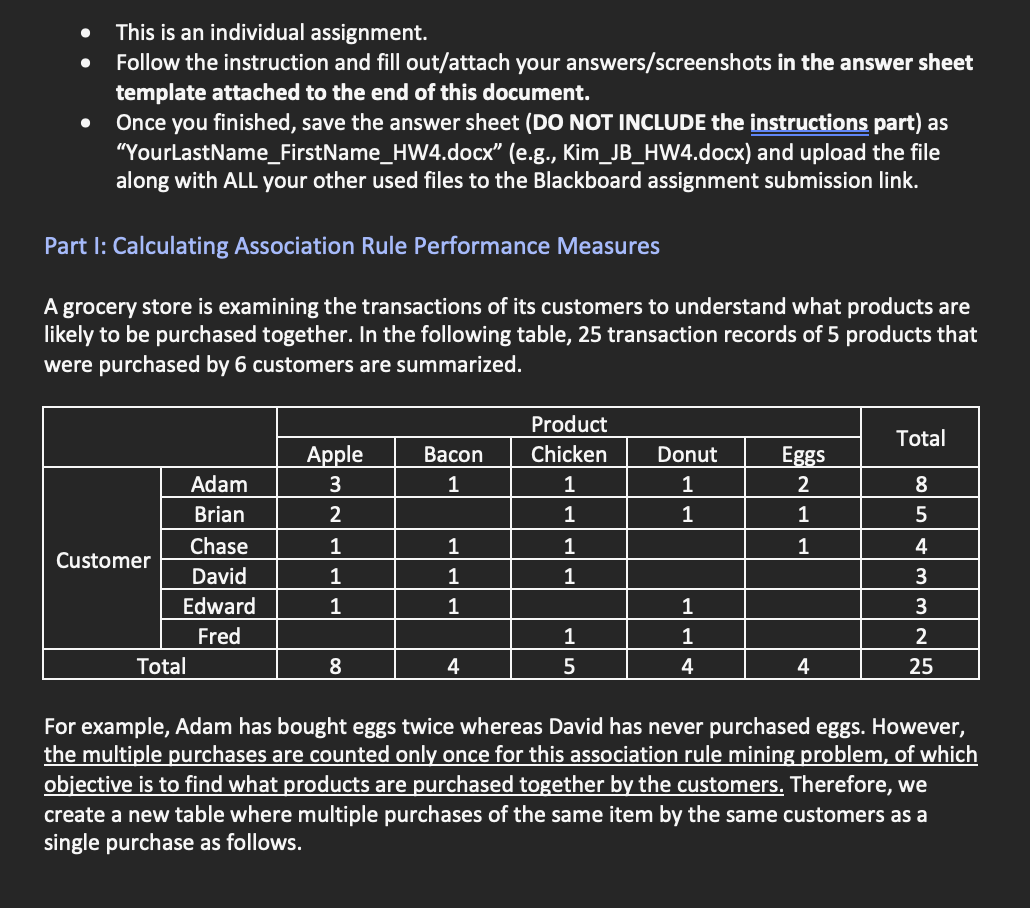
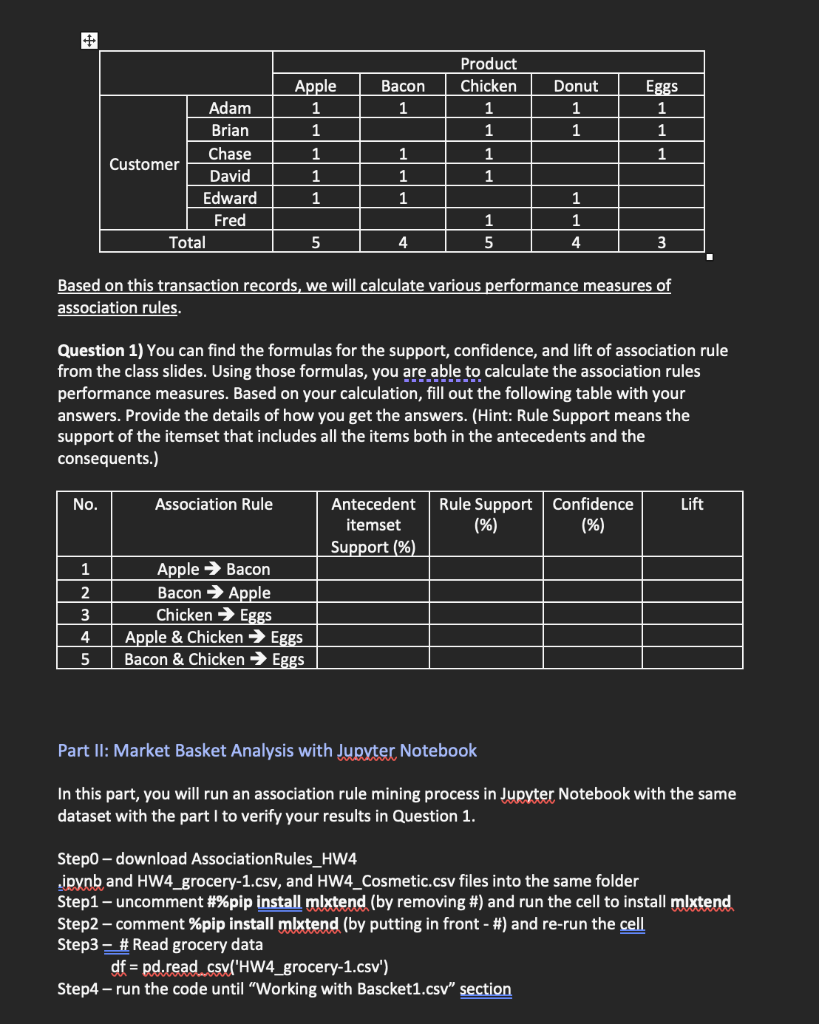
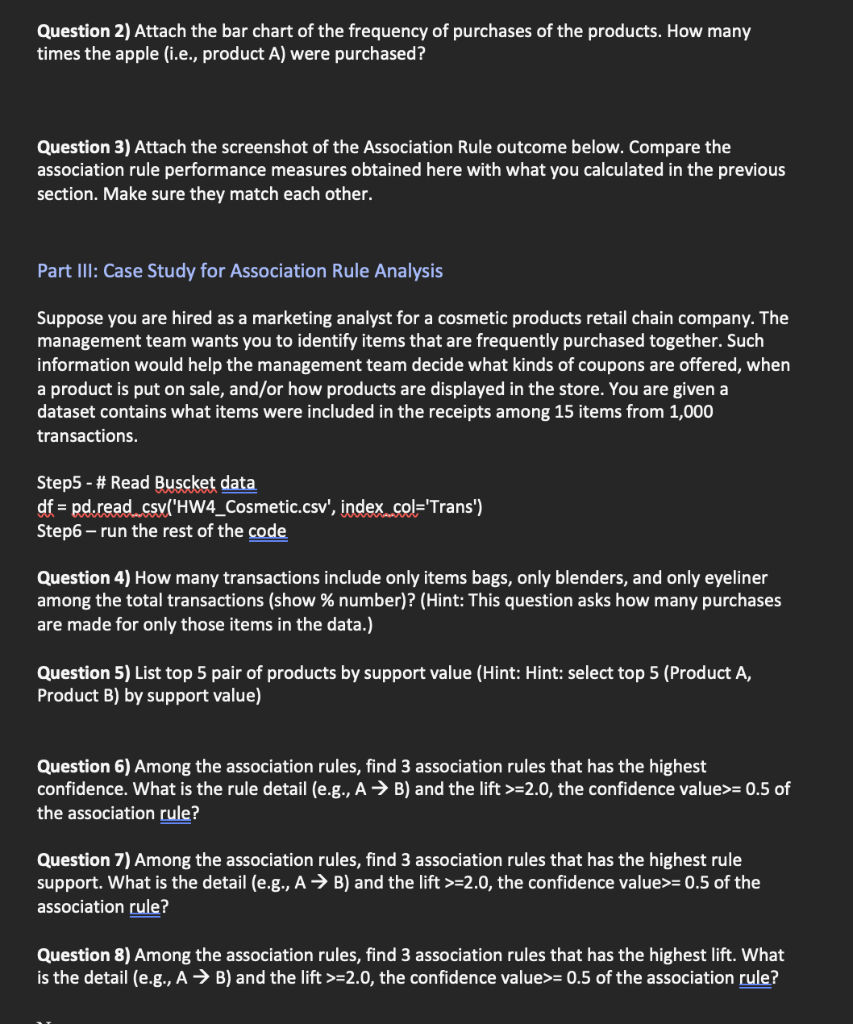
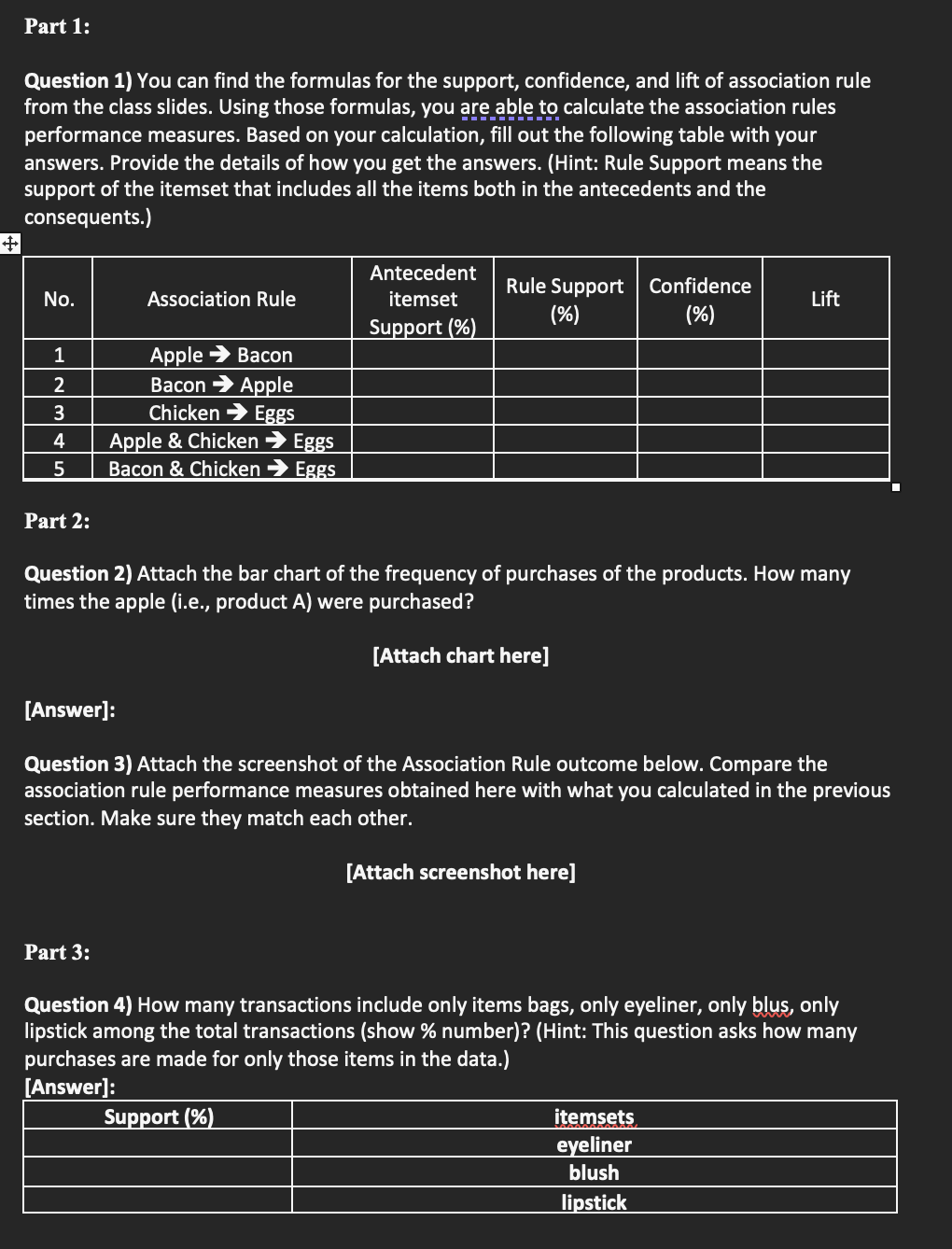
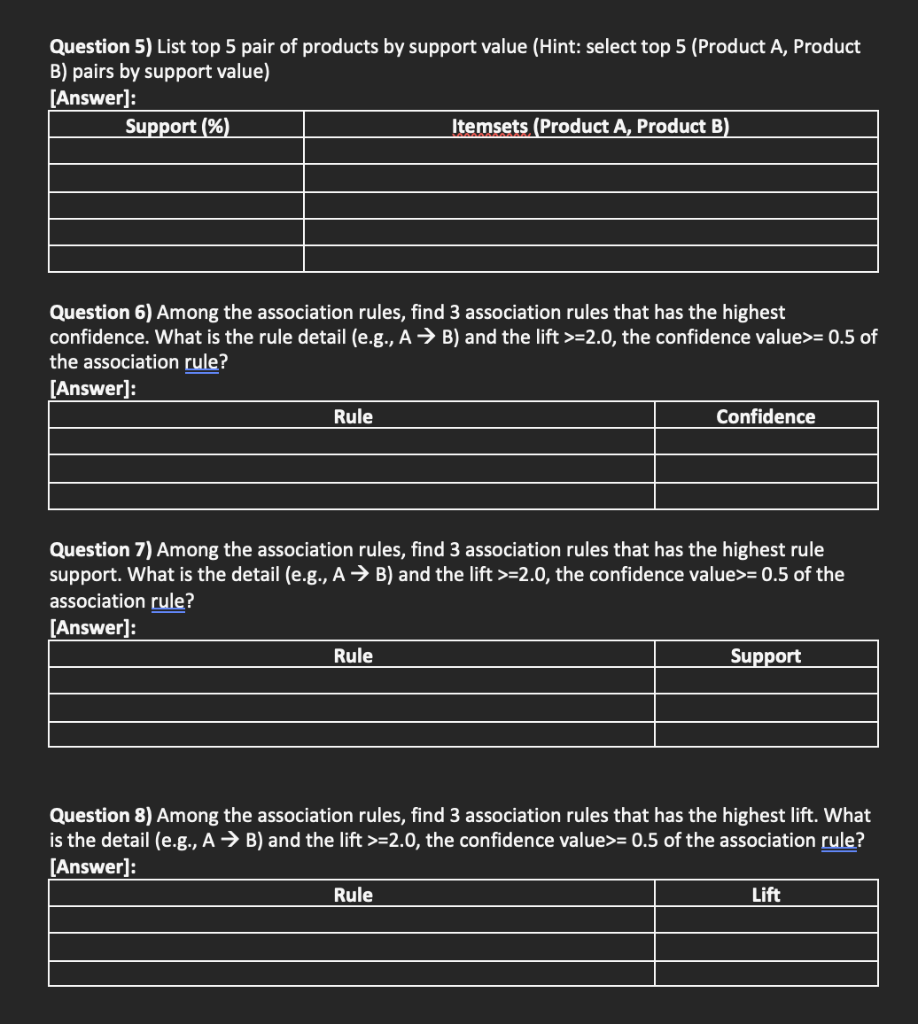
- This is an individual assignment. - Follow the instruction and fill out/attach your answers/screenshots in the answer sheet template attached to the end of this document. - Once you finished, save the answer sheet (DO NOT INCLUDE the instructions part) as "YourLastName_FirstName_HW4.docx" (e.g., Kim_JB_HW4.docx) and upload the file along with ALL your other used files to the Blackboard assignment submission link. Part I: Calculating Association Rule Performance Measures A grocery store is examining the transactions of its customers to understand what products are likely to be purchased together. In the following table, 25 transaction records of 5 products that were purchased by 6 customers are summarized. For example, Adam has bought eggs twice whereas David has never purchased eggs. However, the multiple purchases are counted only once for this association rule mining problem, of which objective is to find what products are purchased together by the customers. Therefore, we create a new table where multiple purchases of the same item by the same customers as a single purchase as follows. Based on this transaction records, we will calculate various performance measures of association rules. Question 1) You can find the formulas for the support, confidence, and lift of association rule from the class slides. Using those formulas, you are able to calculate the association rules performance measures. Based on your calculation, fill out the following table with your answers. Provide the details of how you get the answers. (Hint: Rule Support means the support of the itemset that includes all the items both in the antecedents and the consequents.) Part II: Market Basket Analysis with Jupyter Notebook In this part, you will run an association rule mining process in Jupyter Notebook with the same dataset with the part I to verify your results in Question 1. Step0 - download AssociationRules_HW4 jjpynb and HW4_grocery-1.csv, and HW4_Cosmetic.csv files into the same folder Step1 - uncomment \#\%pip install mlxtend (by removing \#) and run the cell to install mlxtend Step2 - comment \%pip install mlxtend (by putting in front - \#) and re-run the cell Step3 - \# Read grocery data df= pd.read_csv('HW4_grocery-1.csv') Step4 - run the code until "Working with Bascket1.csv" section Question 2) Attach the bar chart of the frequency of purchases of the products. How many times the apple (i.e., product A) were purchased? Question 3) Attach the screenshot of the Association Rule outcome below. Compare the association rule performance measures obtained here with what you calculated in the previous section. Make sure they match each other. Part III: Case Study for Association Rule Analysis Suppose you are hired as a marketing analyst for a cosmetic products retail chain company. The management team wants you to identify items that are frequently purchased together. Such information would help the management team decide what kinds of coupons are offered, when a product is put on sale, and/or how products are displayed in the store. You are given a dataset contains what items were included in the receipts among 15 items from 1,000 transactions. Step5 - \# Read Buscket data df= pd.read_csv('HW4_Cosmetic.csv', index col='Trans') Step6 - run the rest of the code Question 4) How many transactions include only items bags, only blenders, and only eyeliner among the total transactions (show \% number)? (Hint: This question asks how many purchases are made for only those items in the data.) Question 5) List top 5 pair of products by support value (Hint: Hint: select top 5 (Product A, Product B) by support value) Question 6) Among the association rules, find 3 association rules that has the highest confidence. What is the rule detail (e.g., AB ) and the lift >=2.0, the confidence value >=0.5 of the association rule? Question 7) Among the association rules, find 3 association rules that has the highest rule support. What is the detail (e.g., A B) and the lift >=2.0, the confidence value >=0.5 of the association rule? Question 8) Among the association rules, find 3 association rules that has the highest lift. What is the detail (e.g., AB ) and the lift >=2.0, the confidence value =0.5 of the association rule? Question 1) You can find the formulas for the support, confidence, and lift of association rule from the class slides. Using those formulas, you are able to calculate the association rules performance measures. Based on your calculation, fill out the following table with your answers. Provide the details of how you get the answers. (Hint: Rule Support means the support of the itemset that includes all the items both in the antecedents and the consequents.) Part 2: Question 2) Attach the bar chart of the frequency of purchases of the products. How many times the apple (i.e., product A) were purchased? [Attach chart here] [Answer]: Question 3) Attach the screenshot of the Association Rule outcome below. Compare the association rule performance measures obtained here with what you calculated in the previous section. Make sure they match each other. [Attach screenshot here] Part 3: Question 4) How many transactions include only items bags, only eyeliner, only blus, only lipstick among the total transactions (show \% number)? (Hint: This question asks how many purchases are made for only those items in the data.) [Answer]: Question 5) List top 5 pair of products by support value (Hint: select top 5 (Product A, Product B) pairs by support value) [Answer]: Question 6) Among the association rules, find 3 association rules that has the highest confidence. What is the rule detail (e.g., AB ) and the lift >=2.0, the confidence value >=0.50 the association rule? [Answer]: Question 7) Among the association rules, find 3 association rules that has the highest rule support. What is the detail (e.g., A B) and the lift >=2.0, the confidence value >=0.5 of the association rule? [Answer]: Question 8) Among the association rules, find 3 association rules that has the highest lift. What is the detail (e.g., AB ) and the lift >=2.0, the confidence value >=0.5 of the association rule? - This is an individual assignment. - Follow the instruction and fill out/attach your answers/screenshots in the answer sheet template attached to the end of this document. - Once you finished, save the answer sheet (DO NOT INCLUDE the instructions part) as "YourLastName_FirstName_HW4.docx" (e.g., Kim_JB_HW4.docx) and upload the file along with ALL your other used files to the Blackboard assignment submission link. Part I: Calculating Association Rule Performance Measures A grocery store is examining the transactions of its customers to understand what products are likely to be purchased together. In the following table, 25 transaction records of 5 products that were purchased by 6 customers are summarized. For example, Adam has bought eggs twice whereas David has never purchased eggs. However, the multiple purchases are counted only once for this association rule mining problem, of which objective is to find what products are purchased together by the customers. Therefore, we create a new table where multiple purchases of the same item by the same customers as a single purchase as follows. Based on this transaction records, we will calculate various performance measures of association rules. Question 1) You can find the formulas for the support, confidence, and lift of association rule from the class slides. Using those formulas, you are able to calculate the association rules performance measures. Based on your calculation, fill out the following table with your answers. Provide the details of how you get the answers. (Hint: Rule Support means the support of the itemset that includes all the items both in the antecedents and the consequents.) Part II: Market Basket Analysis with Jupyter Notebook In this part, you will run an association rule mining process in Jupyter Notebook with the same dataset with the part I to verify your results in Question 1. Step0 - download AssociationRules_HW4 jjpynb and HW4_grocery-1.csv, and HW4_Cosmetic.csv files into the same folder Step1 - uncomment \#\%pip install mlxtend (by removing \#) and run the cell to install mlxtend Step2 - comment \%pip install mlxtend (by putting in front - \#) and re-run the cell Step3 - \# Read grocery data df= pd.read_csv('HW4_grocery-1.csv') Step4 - run the code until "Working with Bascket1.csv" section Question 2) Attach the bar chart of the frequency of purchases of the products. How many times the apple (i.e., product A) were purchased? Question 3) Attach the screenshot of the Association Rule outcome below. Compare the association rule performance measures obtained here with what you calculated in the previous section. Make sure they match each other. Part III: Case Study for Association Rule Analysis Suppose you are hired as a marketing analyst for a cosmetic products retail chain company. The management team wants you to identify items that are frequently purchased together. Such information would help the management team decide what kinds of coupons are offered, when a product is put on sale, and/or how products are displayed in the store. You are given a dataset contains what items were included in the receipts among 15 items from 1,000 transactions. Step5 - \# Read Buscket data df= pd.read_csv('HW4_Cosmetic.csv', index col='Trans') Step6 - run the rest of the code Question 4) How many transactions include only items bags, only blenders, and only eyeliner among the total transactions (show \% number)? (Hint: This question asks how many purchases are made for only those items in the data.) Question 5) List top 5 pair of products by support value (Hint: Hint: select top 5 (Product A, Product B) by support value) Question 6) Among the association rules, find 3 association rules that has the highest confidence. What is the rule detail (e.g., AB ) and the lift >=2.0, the confidence value >=0.5 of the association rule? Question 7) Among the association rules, find 3 association rules that has the highest rule support. What is the detail (e.g., A B) and the lift >=2.0, the confidence value >=0.5 of the association rule? Question 8) Among the association rules, find 3 association rules that has the highest lift. What is the detail (e.g., AB ) and the lift >=2.0, the confidence value =0.5 of the association rule? Question 1) You can find the formulas for the support, confidence, and lift of association rule from the class slides. Using those formulas, you are able to calculate the association rules performance measures. Based on your calculation, fill out the following table with your answers. Provide the details of how you get the answers. (Hint: Rule Support means the support of the itemset that includes all the items both in the antecedents and the consequents.) Part 2: Question 2) Attach the bar chart of the frequency of purchases of the products. How many times the apple (i.e., product A) were purchased? [Attach chart here] [Answer]: Question 3) Attach the screenshot of the Association Rule outcome below. Compare the association rule performance measures obtained here with what you calculated in the previous section. Make sure they match each other. [Attach screenshot here] Part 3: Question 4) How many transactions include only items bags, only eyeliner, only blus, only lipstick among the total transactions (show \% number)? (Hint: This question asks how many purchases are made for only those items in the data.) [Answer]: Question 5) List top 5 pair of products by support value (Hint: select top 5 (Product A, Product B) pairs by support value) [Answer]: Question 6) Among the association rules, find 3 association rules that has the highest confidence. What is the rule detail (e.g., AB ) and the lift >=2.0, the confidence value >=0.50 the association rule? [Answer]: Question 7) Among the association rules, find 3 association rules that has the highest rule support. What is the detail (e.g., A B) and the lift >=2.0, the confidence value >=0.5 of the association rule? [Answer]: Question 8) Among the association rules, find 3 association rules that has the highest lift. What is the detail (e.g., AB ) and the lift >=2.0, the confidence value >=0.5 of the association rule
Step by Step Solution
There are 3 Steps involved in it

Get step-by-step solutions from verified subject matter experts
 Study Help