







Question: This is being done via netbeans Nonogram v.1 2 Nonogram is a 2-D puzzle in which cells are filled by the player to reveal a
This is being done via netbeans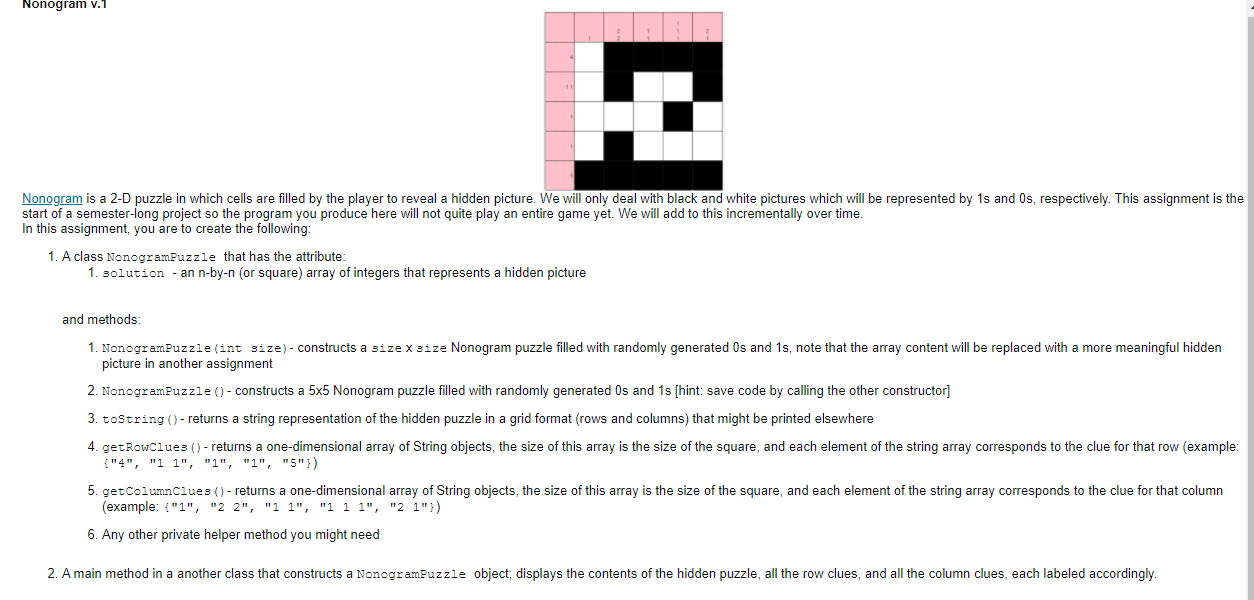
Nonogram v.1 2 Nonogram is a 2-D puzzle in which cells are filled by the player to reveal a hidden picture. We will only deal with black and white pictures which will be represented by 1s and Os, respectively. This assignment is the start of a semester-long project so the program you produce here will not quite play an entire game yet. We will add to this incrementally over time. In this assignment, you are to create the following: 1. A class NonogramPuzzle that has the attribute: 1. solution - an n-by-n (or square) array of integers that represents a hidden picture and methods: 1. NonogramPuzzle (int size) - constructs a size x size Nonogram puzzle filled with randomly generated Os and 1s, note that the array content will be replaced with a more meaningful hidden picture in another assignment 2. NonogramPuzzle () - constructs a 5x5 Nonogram puzzle filled with randomly generated 0s and 1s [hint: save code by calling the other constructor] 3. toString() - returns a string representation of the hidden puzzle in a grid format (rows and columns) that might be printed elsewhere 4. getRowClues () - returns a one-dimensional array of String objects, the size of this array is the size of the square, and each element of the string array corresponds to the clue for that row (example: {"4", "1 1", "1", "1", "5"}) 5.getColumnClues () - returns a one-dimensional array of String objects, the size of this array is the size of the square, and each element of the string array corresponds to the clue for that column (example: {"1", "22", "1 1", "1 1 1", "21"}) 6. Any other private helper method you might need 2. A main method in a another class that constructs a NonogramPuzzle object; displays the contents of the hidden puzzle, all the row clues, and all the column clues, each labeled accordingly. Nonogram v.1 2 Nonogram is a 2-D puzzle in which cells are filled by the player to reveal a hidden picture. We will only deal with black and white pictures which will be represented by 1s and Os, respectively. This assignment is the start of a semester-long project so the program you produce here will not quite play an entire game yet. We will add to this incrementally over time. In this assignment, you are to create the following: 1. A class NonogramPuzzle that has the attribute: 1. solution - an n-by-n (or square) array of integers that represents a hidden picture and methods: 1. NonogramPuzzle (int size) - constructs a size x size Nonogram puzzle filled with randomly generated Os and 1s, note that the array content will be replaced with a more meaningful hidden picture in another assignment 2. NonogramPuzzle () - constructs a 5x5 Nonogram puzzle filled with randomly generated 0s and 1s [hint: save code by calling the other constructor] 3. toString() - returns a string representation of the hidden puzzle in a grid format (rows and columns) that might be printed elsewhere 4. getRowClues () - returns a one-dimensional array of String objects, the size of this array is the size of the square, and each element of the string array corresponds to the clue for that row (example: {"4", "1 1", "1", "1", "5"}) 5.getColumnClues () - returns a one-dimensional array of String objects, the size of this array is the size of the square, and each element of the string array corresponds to the clue for that column (example: {"1", "22", "1 1", "1 1 1", "21"}) 6. Any other private helper method you might need 2. A main method in a another class that constructs a NonogramPuzzle object; displays the contents of the hidden puzzle, all the row clues, and all the column clues, each labeled accordingly
Step by Step Solution
There are 3 Steps involved in it

Get step-by-step solutions from verified subject matter experts
 Study Help