







Question: This is biomedical engineering so I wasn't sure if Prob/Stat was the right tutor, but it felt better than Math or Bio 1. Population coding
This is biomedical engineering so I wasn't sure if Prob/Stat was the right tutor, but it felt better than Math or Bio
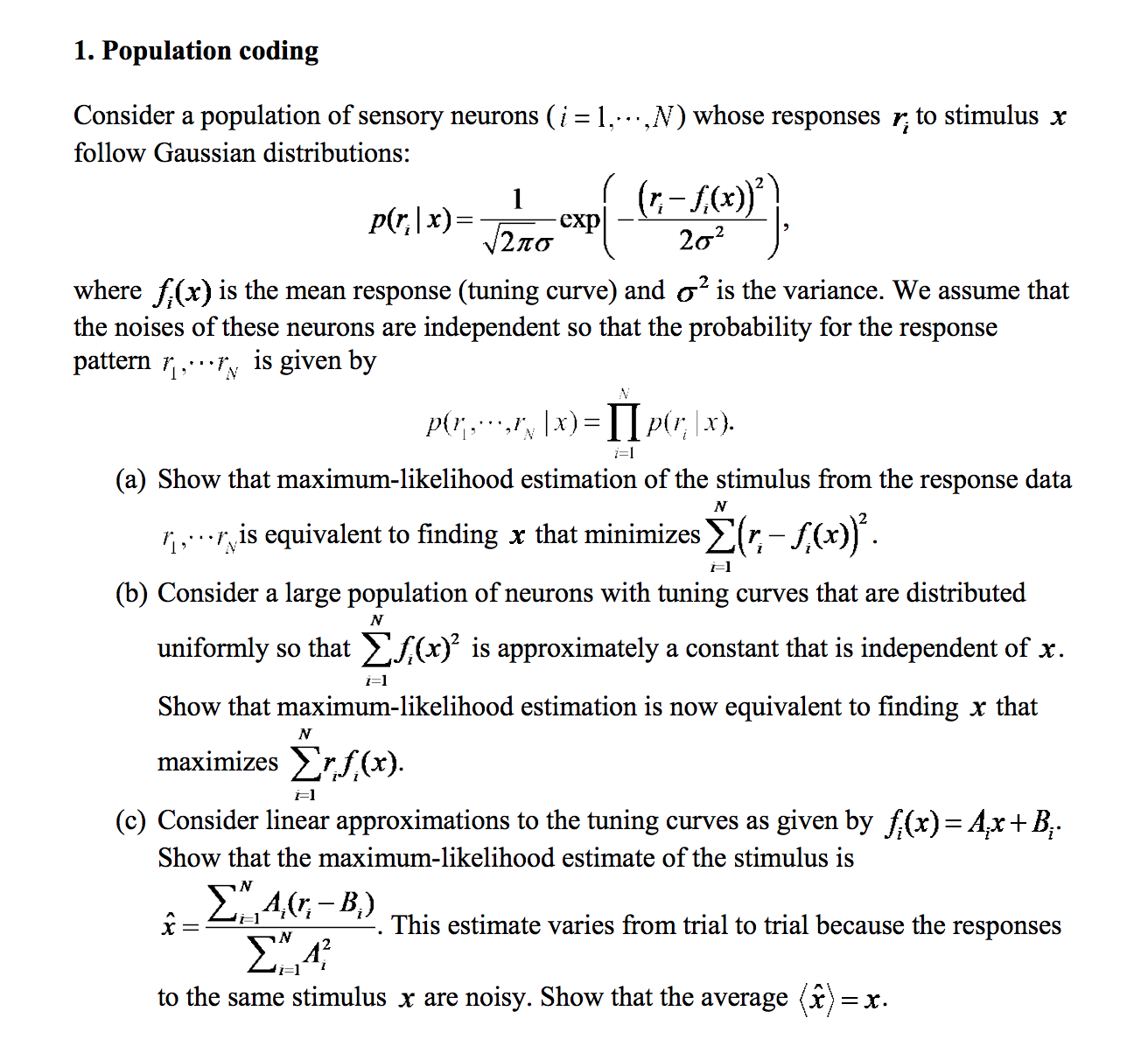
1. Population coding Consider a population of sensory neurons (5' : 1,. - -, N ) whose responses 1;. to stimulus x follow Gaussian distributions: _ l {_(r;-Ji(x))2l P('}|x) macXPL 202 J, where 120:) is the mean response (tuning curve) and 0'2 is the variance. We assume that the noises of these neurons are independent so that the probability for the response pattern r1,- --rN is given by N PMs-\"au- Ix) =1'lpv; Ix)- 121 (a) Show that maximum-likelihood estimation of the stimulus from the response data N r1,- - -rNis equivalent to nding x that minimizes ZR f;(x))2. H (b) Consider a large population of neurons with tuning curves that are distributed N uniformly so that 211302 is approximately a constant that is independent of x. i=1 Show that maximum-likelihood estimation is now equivalent to nding x that N maximizes Zr; f; (x). i=1 (0) Consider linear approximations to the tuning curves as given by j:(x) = Aix + B: Show that the maximum-likelihood estimate of the stimulus is . This estimate varies from trial to trial because the responses to the same stimulus x are noisy. Show that the average (SE) = x
Step by Step Solution
There are 3 Steps involved in it

Get step-by-step solutions from verified subject matter experts
 Study Help